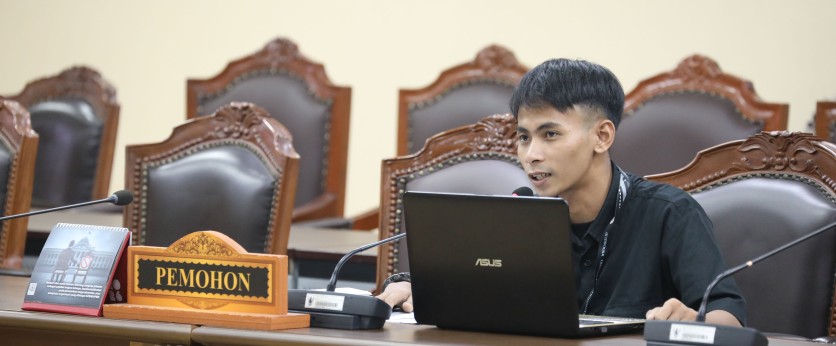
Muhammad Khaetami, the petitioner in the judicial review of Law No. 2 of 2004 on Industrial Relations Dispute Settlement, attending a panel hearing. Wednesday (6/10/2026). Photo by MKRI/Panji.
JAKARTA (MKRI) — The Constitutional Court held a preliminary hearing for the judicial review of Article 114 and Article 115 of Law No. 2 of 2004 on Industrial Relations Dispute Settlement (PPHI Law) on Wednesday, June 10, 2026. The hearing for Case No. 189/PUU-XXIV/2026 took place in the Court’s Panel Courtroom.
Petitioner Muhammad Khaetami, a student at Sultan Maulana Hasanuddin State Islamic University Banten, argued that Article 114 and Article 115 of the PPHI Law potentially impair his constitutional rights. In his petition, he asserted that although the two provisions are closely interconnected, they rest on different legal foundations.
Khaetami contended that the phrase “as well as the settlement of rights disputes and dismissal disputes by cassation justices” in Article 114 of the PPHI Law is vague, open to multiple interpretations, and ambiguous. According to him, Article 115 clearly stipulates that industrial relations disputes must be resolved within 30 days, yet Article 114 refers instead to general statutory laws and regulations in governing the settlement of such disputes.
“However, the two provisions rely on different foundations, Your Honors. Article 114 refers back to the prevailing statutory laws and regulations, while Article 115 is based on a 30-day time limit,” Khaetami told the panel chaired by Chief Justice Suhartoyo.
He argued that this discrepancy allows cassation proceedings in industrial relations disputes, which are regulated under Article 115, to be circumvented by relying on Article 114.
The Petitioner further highlighted what he described as a lack of transparency in the handling of cassation petitions at the Supreme Court because litigants receive no certainty regarding when decisions will be delivered.
“In my own case, Your Honors, I once received a message from an unknown number offering to expedite the process. I was shocked. How did this person know about my cassation filing? How did this person know the details of my case number when it had not yet been published in the Case Tracking Information System (SIPP)?” he explained.
In his petitum, Khaetami requested that the Court declare the phrase “as well as the settlement of rights disputes and dismissal disputes by cassation justices” in Article 114 of the PPHI Law contrary to the 1945 Constitution and therefore unconstitutional and not legally binding. He also asked the Court to declare Article 115 conditionally constitutional, provided it is interpreted to mean that “decisions on rights disputes or dismissal disputes at the Supreme Court must be rendered no later than 30 working days from the date the cassation case file is transmitted.”
Justices’ Advice
Responding to the petition, Constitutional Justice M. Guntur Hamzah advised the Petitioner to present clearer evidence supporting his arguments.
“You should also examine how time limits are calculated at the Constitutional Court. They are counted from registration, aren’t they?” Justice Guntur remarked.
He suggested that the issue raised by the Petitioner might concern the implementation of the law rather than the constitutionality of the provisions themselves.
Constitutional Justice Daniel Yusmic P. Foekh likewise advised the Petitioner to take Indonesia’s geographical conditions into account. He noted that if a cassation petition were filed from Papua, the interpretation sought by the Petitioner could create practical difficulties.
“Build your argument as to why the 30-day period should be calculated from the date of transmission rather than the date of receipt. Even at the Constitutional Court, the calculation begins only after a case has been entered into the constitutional case registration book. It cannot be counted the moment someone merely sends the documents. How would such a calculation be made?” Justice Foekh said.
Chief Justice Suhartoyo also reminded the Petitioner that Indonesia’s vast territory means the transmission of cassation case files may require considerable time, a factor that should be taken into consideration when challenging Article 115 of the PPHI Law.
Before adjourning the hearing, Chief Justice Suhartoyo informed the Petitioner that revisions to the petition may be submitted no later than Tuesday, June 23, 2026, at 12:00 p.m. Western Indonesia Time (WIB), either electronically or in person. He emphasized that the petition may only be revised once.
Author: Ilham W.M.
Editor: Lulu Anjarsari P.
PR: Raisa Ayuditha M.
Translator: Yuanna Sisilia
Disclaimer: The original version of the news is in Indonesian. In case of any differences between the English and the Indonesian versions, the Indonesian version will prevail.
Wednesday, June 10, 2026 | 16:54 WIB 7