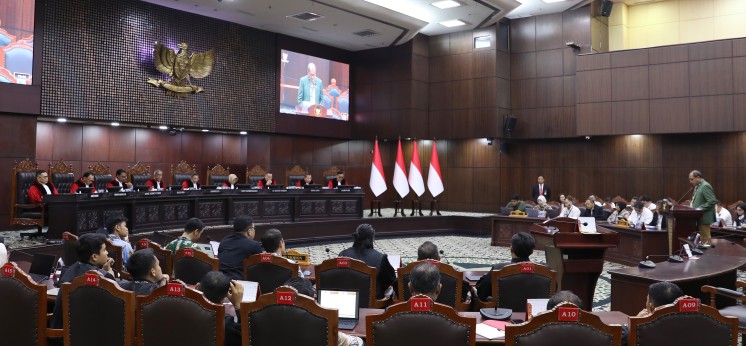
The Constitutional Court hearing a further hearing on the judicial review of Law No. 20 of 2025 on the Criminal Procedure Code (KUHAP) with the agenda of hearing the Government’s statement, Wednesday (6/10/2026). Photo by MKRI/Ifa.
JAKARTA (MKRI) — The Constitutional Court (MK) resumed the judicial review hearing of Law No. 20 of 2025 on the Criminal Procedure Code (KUHAP) on Wednesday, June 10, 2026. The fourth hearing for the petition filed by advocate Hanter Oriko Siregar was scheduled to hear the Government’s statement. At the hearing for Case No. 92/PUU-XXIV/2026, the Government’s testimony was delivered by Vice Minister of Law Edward Omar Sharif Hiariej in the Court’s plenary courtroom.
Responding to the Petitioner’s arguments, the Government asserted that judges’ observations as evidence should be understood as an instrument that strengthens the quality of proof rather than a space for unlimited judicial subjectivity. Their inclusion as evidence does not shift the burden of proof from the public prosecutor to judges. Prosecutors remain responsible for proving charges through lawful, relevant, and sufficient evidence, while judges maintain their position as parties who examine, assess, and decide cases.
“Judges’ observations do not transform judges into investigators, prosecutors, witnesses, or experts. Rather, they constitute a judicial function in assessing facts revealed during trial proceedings. Judges’ observations should be positioned as an evaluative evidentiary tool. They are used to assess the consistency and conformity among pieces of evidence, witness testimony, defendants’ statements, physical evidence, electronic evidence, documents, and circumstances emerging during trial proceedings,” Eddy explained before the hearing chaired by Chief Justice Suhartoyo.
Therefore, Eddy argued, Article 235 paragraph (1) letter g of the KUHAP does not contradict the principles of the rule of law, legal certainty, or the protection of human rights. Instead, the provision strengthens the quality of criminal evidence assessment by providing judges with a basis to evaluate facts comprehensively, rationally, and responsibly. The provision is also consistent with Article 24 paragraph (1) of the 1945 Constitution because it reinforces the judicial function in administering justice and upholding the law.
Also read:
Petitioner Questions Judges’ Observations as Evidence in Criminal Procedure Code (KUHAP)
Advocates Reinforce Ambiguity of Judges’ Observations as Evidence
DPR: Judges’ Observations as Evidence May Expand Evidentiary Value in Criminal Trials
At the preliminary hearing held on Wednesday, March 11, 2026, the Petitioner argued that the challenged provision raises serious issues from the perspectives of procedural law principles, evidentiary theory, and constitutional guarantees of a fair trial.
Article 4 of Law No. 20 of 2025 on the Criminal Procedure Code stipulates that “criminal proceedings regulated under this Law shall be conducted through a combination of an active judge system and balanced adversarial parties during courtroom examinations.”
The elucidation of Article 4 explains that the “active judge system” means judges play a substantial role in directing proceedings, deciding cases, actively discovering facts, and carefully assessing evidence. Meanwhile, “balanced adversarial parties” refers to an adversarial system that guarantees balance between the rights of investigators, public prosecutors, and suspects and/or defendants in criminal proceedings. Accordingly, Indonesia’s criminal procedural system combines elements of the Continental European system and the adversarial system.
According to the Petitioner, within reasonable legal reasoning, such procedural principles establish a clear distinction between the function of assessing and the function of proving. By qualifying “judges’ observations” as evidence, the a quo article allegedly creates legal uncertainty because the boundary between evaluative and evidentiary functions becomes blurred.
The Petitioner also questioned whether judges’ observations under the a quo article contradict the fundamental nature of evidence in procedural law. Doctrinally and historically, evidence in the KUHAP constitutes evidentiary instruments exclusively within the domain of litigating parties, namely public prosecutors and defendants, submitted to convince judges of the truth of legal facts. Evidence emerges from adversarial proceedings and possesses an objective character, meaning it can be presented, examined, and openly debated in court. Such a conception of evidence, the Petitioner argued, is an absolute prerequisite for the realization of a fair trial.
Author: Sri Pujianti
Editor: Lulu Anjarsari P.
PR: Fauzan Febriyan
Translator: Yuanna Sisilia
Disclaimer: The original version of the news is in Indonesian. In case of any differences between the English and the Indonesian versions, the Indonesian version will prevail.
Explore The Case: Case No. 92/PUU-XXIV/2026 (in Bahasa Indonesia)
Wednesday, June 10, 2026 | 15:07 WIB 2