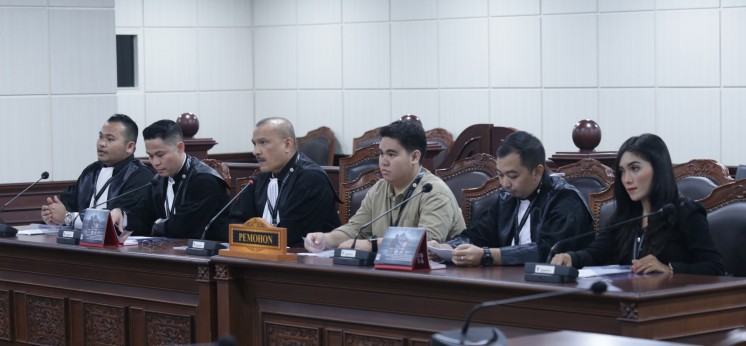
The Petitioners attending the preliminary hearing for Case No. 190/PUU-XXIV/2026 on the judicial review of Law No. 1 of 2009 on Aviation, Wednesday (6/10/2026). Photo by MKRI/Bayu.
JAKARTA (MKRI) — Nine advocates and two law students have filed a petition for the judicial review of Article 146, the Elucidation of Article 146, Article 170, and Article 176 of Law No. 1 of 2009 on Aviation with the Constitutional Court. They argue that passengers are rarely provided with transparent and verifiable information regarding the actual causes of flight delays.
“There is a clear causal relationship (causal verband) between the actual and potential impairment of the Petitioners’ constitutional rights and interests and the enforcement of Article 146 and its Elucidation, Article 170, and Article 176 of the Aviation Law,” Petitioner IV Amudian Laia stated during the preliminary hearing for Case No. 190/PUU-XXIV/2026 on Wednesday, June 10, 2026, in the Court’s courtroom.
The Petitioners contend that the challenged provisions contravene Article 1 paragraph (3), Article 28D paragraph (1), and Article 28H paragraph (2) of the 1945 Constitution. They argued that one of the most recurrent disputes between airlines and passengers concerns flight delays. Beyond safety and comfort considerations, on-time performance constitutes a fundamental expectation and a right of passengers.
“Weather Factors” and “Operational Technical Constraints”
According to the Petitioners, flight delays in Indonesia have become a recurring issue, with airlines frequently invoking “weather factors” and “operational technical constraints” as justification. However, passengers are never given transparency about the actual circumstances because such explanations are generally conveyed unilaterally and in generic terms, without authentic evidence or detailed clarification regarding the weather conditions or the technical disruptions cited.
The Petitioners asserted that, in practice, “weather factors” and “operational technical constraints” often serve as convenient explanations offered to passengers. Yet behind the scenes, strategic and operational decisions made by airline management play a crucial role in determining on-time performance.
They further argued that flight delays are not merely a matter of waiting time but rather a domino-effect phenomenon that generates systemic losses, including adverse impacts on passengers, airport ecosystems, and the environment, as well as broader economic repercussions. Airlines, they said, are legally obliged to provide accurate information supported by certificates issued by the relevant authorities regarding the reasons for delays and, in certain circumstances, to compensate affected passengers.
In reality, however, airlines rarely provide such supporting documentation. Delay announcements are generally made verbally through public address systems, citing weather conditions or operational reasons without presenting corroborating evidence or technical explanations that can be independently verified. Consequently, passengers are deprived of a legal instrument to assess the validity of the airline’s unilateral claims due to the absence of official certificates from the relevant authorities.
Article 146 of the Aviation Law stipulates that airlines are liable for losses arising from delays in the transportation of passengers, baggage, or cargo, unless they can prove that the delay was caused by weather factors or operational technical constraints. The Elucidation of Article 146 defines weather factors as heavy rain, lightning, storms, fog, haze, visibility below the prescribed minimum standard, or wind speeds exceeding the maximum permissible threshold that could jeopardize flight safety.
Operational technical constraints include situations where departure or destination airports cannot be used for aircraft operations; disruptions affecting airport access routes or runways due to cracks, flooding, or fire; aircraft queues for takeoff, landing, or departure slot allocation; and delays in refueling. Conversely, operational technical constraints do not include delays caused by pilots, co-pilots, or cabin crew; catering services; ground handling services; waiting for passengers checking in, transferring, or connecting to another flight; or aircraft unpreparedness.
Article 170 of the Aviation Law provides that the amount of compensation for delays referred to in Article 146 shall be further regulated by a ministerial regulation. Meanwhile, Article 176 stipulates that passengers, owners of cabin baggage, owners of checked baggage, cargo senders, and/or heirs of passengers who suffer losses as referred to in Articles 141, 143, 144, 145, and 173 may file lawsuits against airlines before a district court in Indonesia under Indonesian law.
Constitutional Arguments
The petition was heard by a panel of constitutional justices chaired by Constitutional Justice Enny Nurbaningsih, accompanied by Constitutional Justices Ridwan Mansyur and Arsul Sani.
During the advisory session, Justice Arsul suggested that the Petitioners elaborate more clearly on the actual and potential constitutional losses they claim to have suffered as a result of the enforcement of the challenged provisions.
He further advised the Petitioners to explain, within the petition’s legal reasoning (posita), how each challenged provision conflicts with the constitutional articles serving as the benchmark for review.
“The most important thing is to explain precisely where the contradiction lies. Once that contradiction has been clearly demonstrated, you may then support it with doctrines and other legal arguments,” Arsul remarked.
Before concluding the hearing, Justice Enny informed the Petitioners that they were granted a single opportunity to revise their petition within 14 days. Both soft-copy and hard-copy versions of the revised petition must be submitted to the Court no later than Tuesday, June 23, 2026, at 12:00 p.m. WIB.
Author: Mimi Kartika
Editor: N. Rosi
PR: Fauzan F.
Translator: Yuanna Sisilia
Disclaimer: The original version of the news is in Indonesian. In case of any differences between the English and the Indonesian versions, the Indonesian version will prevail.
Wednesday, June 10, 2026 | 17:52 WIB 5