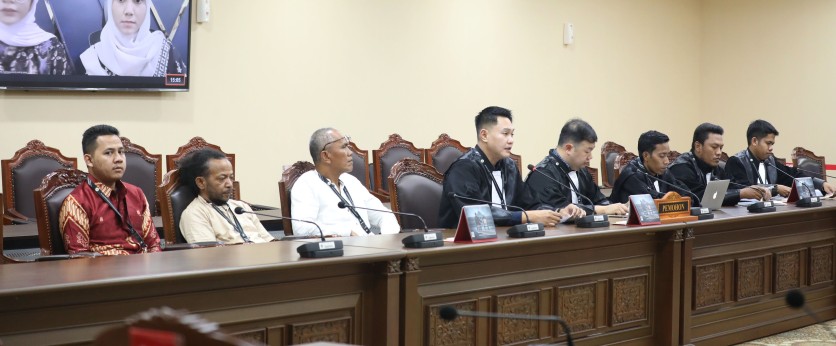
Petitioners and their Legal Counsels for judicial review of Law No. 3 of 2006 on Religious Courts presenting the main petition arguments, on Tuesday (6/9/2026). Photo by MKRI/Panji.
JAKARTA (MKRI) – Three Muhammadiyah cadres, Andri Sumarna, Muhamad Fajri Nur Rizky, and Rozak Daud, filed a petition to review Article 52A and the Elucidation of Article 52A of Law No. 3 of 2006 on Amendments to Law No. 7 of 1989 on Religious Courts (Religious Court Law) to the Constitutional Court (MK). The preliminary examination hearing for Petition No. 180/PUU-XXIV/2026 was held at the Constitutional Court on Tuesday, June 6, 2026.
Petitioners questioned the determination (itsbat) of the beginning of the month of Ramadan and the beginning of the month of Shawwal in the Hijri year. Article 52A of the Religious Courts Law states, "Religious courts provide istbat of the testimony of rukyat hilal in determining the beginning of the month in the Hijri year." Meanwhile, the Elucidation of Article 52A of the Religious Courts Law states, "So far, religious courts have been asked by the Minister of Religion to provide determination (itsbat) on the testimony of people who have seen or witnessed the crescent moon at the beginning of each month of Ramadan and the beginning of the month of Shawwal in the Hijri year in order for the Minister of Religion to issue a national determination for the determination of 1 (one) Ramadan and 1 (one) Shawwal. Religious courts can provide information or advice regarding the differences in determining the direction of the Qibla and determining prayer times."
According to Petitioners, the Elucidation to Article 52A of the Religious Courts Law doesn’t merely clarify the aforementioned norm, but rather narrows it down and adds new norms not found in the main body. First, it limits it to Ramadan and Shawwal, even though the Islamic calendar consists of 12 months. Second, it adds a new norm with the phrase "in the context of the Minister of Religious Affairs issuing a national decree for the determination of 1 (one) Ramadan and 1 (one) Shawwal." Third, it adds a new norm regarding "Religious courts may provide information or advice regarding the differences in determining the direction of the Qibla and determining prayer times."
The substantive differences between the main body text of Article 52A and the Elucidation to Article 52A create a normative inconsistency. On the one hand, the main body text of the article generally regulates the confirmation of the crescent sighting in determining the beginning of the Hijri month, but on the other hand, the Elucidation limits the application of the norm to the months of Ramadan and Shawwal and adds authority not outlined in the main article.
"The Elucidation of an article should only serve as an official interpretation of the norms within the main body of the law, not as a basis for establishing new norms. The Elucidation must not expand, narrow, modify, or include hidden changes to the substance of the statutory norms. If the Elucidation adds new norms, this will create normative ambiguity and legal uncertainty," said Juanda, one of the Petitioner's Legal Counsels.
The Rukyat Hilal and Hisab Methods
Petitioners argue that the 1945 Constitution of the Republic of Indonesia (UUD NRI) guarantees the right of every person to embrace and worship according to their religion, to be free from discriminatory treatment, and to receive state guarantees in practicing their religion and beliefs. These guarantees are stated in Article 28E paragraph (1), Article 28I paragraph (2), and Article 29 paragraph (2) of the 1945 Constitution. Freedom of religion encompasses not only the freedom to choose or formally embrace a religion, but also the freedom to practice religious teachings.
In the Islamic context, the performance of certain religious observances is closely related to determining the beginning of the Hijri month, including the Ramadan fast, Eid al-Fitr, Eid al-Adha, the Arafah fast, and other acts of worship whose times are determined based on the Hijri calendar. Furthermore, in Islamic religious practice, there is more than one method for determining the beginning of the Hijri month. In addition to the crescent sighting method, there is also the hisab method, which has been practiced, believed in, and practiced by some Muslims, including the Petitioners.
According to Petitioners, the Elucidation to Article 52A of the Religious Courts Law places the itsbat mechanism based on crescent sighting testimony as the basis for the Minister of Religious Affairs' national determination of the first of Ramadan and the first of Shawwal. With this construction, the Elucidation to Article 52A not only clarifies the authority of the Religious Courts but also has legal consequences in the form of prioritizing a particular method for determining the start of the Hijri month nationally.
Prioritizing crescent moon sighting as the basis for national determination has resulted in the neglect of the hisab method believed in by the Petitioners. Consequently, the Petitioners' religious beliefs and practices are denied equal recognition by the state, even though these methods are part of the prevailing religious practices within Islamic society.
This situation results in constitutional losses for the Petitioners because the state disproportionately limits the space for practicing worship according to the Petitioners' religious beliefs. These restrictions arise not from the primary norms within the body of the law, but from the Elucidation of the article, which should not establish new norms or limit citizens' constitutional rights.
Thus, the Elucidation of Article 52A of the Religious Courts Law has resulted in unequal treatment of Muslim groups who use the hisab method. This is contrary to the guarantee of religious freedom, the guarantee to worship according to each person's religion and belief, and the prohibition of discriminatory treatment as guaranteed by the 1945 Constitution of the Republic of Indonesia. Therefore, according to the Petitioners, the Elucidation of Article 52A of the Religious Courts Law should be declared contrary to Article 28E paragraph (1), Article 28I paragraph (2), and Article 29 paragraph (2) of the 1945 Constitution of the Republic of Indonesia and doesn’t have binding legal force as long as it is interpreted as a basis that places rukyat hilal as the only method for determining the beginning of the Hijri month nationally.
"Declaring that the Elucidation of Article 52A of Law No. 3 of 2006 on Amendments to Law No. 7 of 1989 on Religious Courts (State Gazette of the Republic of Indonesia of 2006 No. 22, Supplement to the State Gazette of the Republic of Indonesia No. 4611) is contrary to the 1945 Constitution of the Republic of Indonesia and has no binding legal force," said Auliya Khasanofa who read out the Petitioner's petition.
Justice's Advice
In response to the petition, Constitutional Justice M. Guntur Hamzah advised the Petitioner to refine his legal standing. "The evidence must be completed to determine whether the Petitioner has legal standing in relation to the relevant norm being reviewed," Justice Guntur said.
Justice Guntur also advised the Petitioners to strengthen the petition's position that the norm being challenged is in conflict with the 1945 Constitution of the Republic of Indonesia. "How can you say that it is in conflict with Article 29 paragraph (2), while in fact it doesn’t hinder religious freedom to practice your religious worship, what happened was a technical matter regarding the use of facilities, so that doesn’t hinder it," said Justice Guntur.
In addition, Constitutional Justice Daniel Yusmic P. Foekh advised the Petitioner to carefully examine the articles being challenged in the petition's petitum. "Please note that the matter concerns the material review of Article 52A and its Elucidation, but the petition only provides an Elucidation. We will examine that later," Justice Daniel said.
Constitutional Court Chief Justice Suhartoyo, who presided over the hearing, advised the Petitioners to prove whether all Muhammadiyah members necessarily follow the hisab method and are disadvantaged by the enactment of this norm. "Does the hisab method, which requires a religious court to issue a ruling for someone who witnesses the rukyat to be confirmed by the court, hinder the Petitioners from performing their religious duties? That must be clarified," Chief Justice Suhartoyo said.
Before closing the hearing, Chief Justice Suhartoyo informed the Petitioners that they could revise the petition and submit it no later than Monday, June 22, 2026, at 12:00 p.m. WIB, either offline or online. Revised petition can only be made once.
Track case No. 180/PUU-XXIV/2026
Author : Ilham Wiryadi Muhammad
Editor : N. Rosi
Translator : Donny Yuniarto
Disclaimer: The original version of the news is in Indonesian. In case of any differences between the English and the Indonesian versions, the Indonesian version will prevail.
Tuesday, June 09, 2026 | 20:02 WIB 2