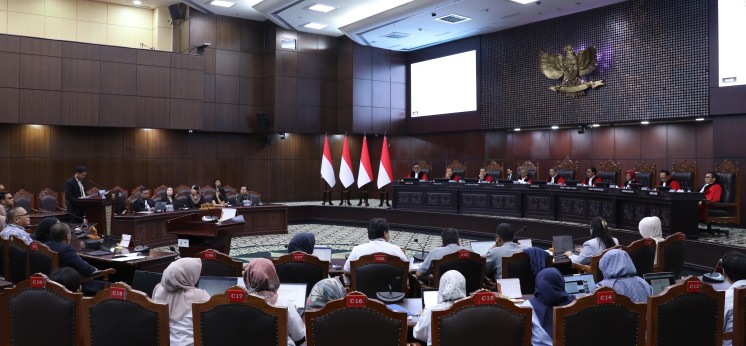
The Constitutional Court held a follow-up hearing on the judicial review of the Consumer Protection Law and the Health Law, with the agenda of hearing statements from Related Parties, on Monday (June 8, 2026) at the Constitutional Court. Photo by MKRI Public Relations/Ifa.
JAKARTA, (MKRI) - The Constitutional Court (MK) held a follow-up hearing in Case Number 123/PUU-XXIV/2026 concerning the judicial review of Article 8 of Law Number 8 of 1999 on Consumer Protection. The hearing, held on Monday (June 8, 2026), was scheduled to hear statements from Related Parties, including the National Consumer Protection Agency (BPKN), the Indonesian Consumers Foundation (YLKI), and the Indonesian E-Commerce Association (idEA).
BPKN member Fitrah Bukhari stated that regulations governing the liability of digital platforms should be directed toward achieving a balance between the growth of digital economic innovation and the need for consumer protection. In this context, clarity regarding the legal status of digital platforms is essential to ensure consumers’ right to fair legal certainty as guaranteed under Article 28D paragraph (1) of the 1945 Constitution.
“Based on complaints received by BPKN, many consumers experience difficulties in obtaining remedies when the seller’s identity is unclear, cannot be contacted, or is no longer active after a transaction has taken place. In such circumstances, consumers are highly dependent on the information, transaction data, and monitoring mechanisms possessed by digital platforms,” Fitrah said during the plenary hearing in Jakarta.
BPKN observed that modern digital platforms no longer function merely as passive intermediaries. Platforms are capable of determining transaction governance, controlling payment systems, regulating the display of information, moderating business actors operating within their systems, and retaining data necessary to identify parties responsible for a transaction.
Accordingly, the evolving functions and roles of digital platforms create a need for legal certainty regarding the extent to which platforms may be held liable in the context of consumer protection. Such certainty is necessary to prevent gaps in legal protection that could harm consumers due to uncertainty over which party may be held accountable when consumer rights are violated.
Representing YLKI, Executive Secretary Rio Priambodo likewise stated that marketplace responsibility should not end with seller identity verification. According to him, knowing who is selling a product is not the same as ensuring that the product being sold is lawful and safe, including compliance with distribution permits, accurate information, and the seller’s capacity to conduct business.
“YLKI proposes a shared-responsibility approach, whereby marketplaces bear responsibility in proportion to their level of involvement, thereby ensuring that there is always a party that can be held accountable,” Rio said.
He added that stronger accountability would ultimately benefit the digital ecosystem by fostering consumer trust, healthy competition, and security innovation. A fair marketplace, he argued, is not an obstacle to business but rather a foundation for sustainable business growth.
Read also:
Petitioners Challenge Absence of Mandatory SNI Reference for Consistent Consumer Protection
Petitioners Challenge Lack of Consumer Protection in the Digital Space
For context, the petition was filed by five law students challenging Article 8 of the Consumer Protection Law. They argued that the provision creates absolute legal uncertainty for digital consumers because it only targets conventional business actors, whereas in cyberspace consumer losses frequently arise from the absence of data validation by intermediary platforms.
The Petitioners contended that Article 8 of Law Number 8 of 1999 fails to address the phenomenon of marketplaces being able to alter product descriptions after a transaction has taken place, resulting in the loss of evidentiary certainty for consumers seeking to prove violations of Article 8 paragraph (1) letter f of the Law. They argued that the current formulation of Article 8 leaves a “legal vacuum” in cyber transactions, allowing platforms to characterize themselves merely as intermediaries in order to avoid sanctions under Article 62 of the Consumer Protection Law.
According to the Petitioners, the right to legal certainty includes the right to receive goods that conform to advertised promises as stipulated in Article 8 paragraph (1) letter f. However, this protection becomes ineffective without obligations requiring platforms to conduct automatic takedowns and provide immediate compensation. They further argued that the static nature of Article 8 prevents consumers from obtaining proportionate justice, as consumer losses are often suffered collectively while available remedies remain individual and weakened by unequal bargaining power.
The absence of provisions regarding “consumer protection insurance” within Article 8 as a guarantee of compensation certainty, they argued, demonstrates the weakness of the state’s legal protection framework in the era of digital disruption. Overall, the Petitioners maintained that Article 8 of the Consumer Protection Law is inconsistent with Article 28D paragraph (1) of the 1945 Constitution insofar as it does not encompass the obligations and responsibilities of digital platforms to validate, supervise, and ensure that goods comply with applicable legal standards.
In their petition, the Petitioners requested the Court to declare Article 8 of the Consumer Protection Law contrary to the 1945 Constitution and conditionally unconstitutional insofar as it is not interpreted to mean that the obligations and prohibitions contained therein apply equally to operators of electronic commerce platforms (marketplaces), which facilitate transactions and must bear joint liability for product nonconformity, invalid product information, and the obligation to ensure the availability of seller identities and transaction data for the restoration of consumer rights.
They further requested the Court to declare the elucidation of Article 8 paragraphs (2) and (3) of the Consumer Protection Law contrary to the Constitution and conditionally unconstitutional insofar as it is not interpreted to mean that the determination of whether goods are safe or harmful to consumers must be verified through independent verification and curation systems conducted by digital platform operators before such goods are marketed to the public. (*)
Author : Mimi Kartika
Editor : Lulu Anjarsari P.
PR : Raisa Ayuditha M.
Translator : Agusweka PS.
Disclaimer: The original version of the news is in Indonesian. In case of any differences between the English and the Indonesian versions, the Indonesian version prevails.
Case Track: Petition Number 123/PUU-XXIV/2026
Monday, June 08, 2026 | 15:34 WIB 117