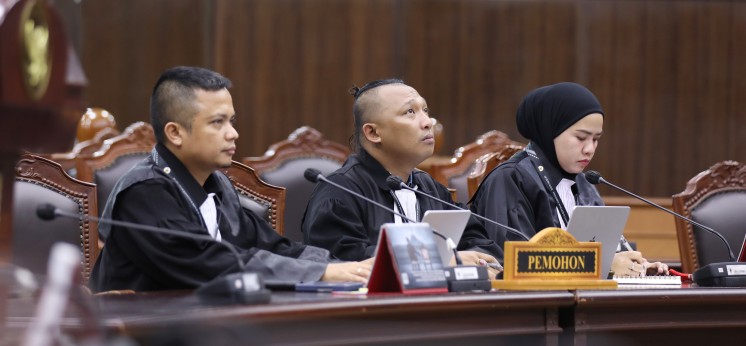
The Petitioners’ legal counsel presenting the main points of the petition at the preliminary hearing for the judicial review of Law No. 31 of 1997 on Military Courts, Monday (6/8/2026). Photo by MKRI/Ifa.
JAKARTA (MKRI) — An advocate, Syamsul Jahidin, and a state civil apparatus (ASN), Ria Merryanti, have filed a petition for the judicial review of Article 106 paragraph (1) and paragraph (2) of Law No. 31 of 1997 on Military Courts, as well as Article 65 paragraph (1), paragraph (2), and paragraph (3) of Law No. 3 of 2025 on the Indonesian National Armed Forces (TNI Law), before the Constitutional Court. The Petitioners argue that the challenged provisions may create obstacles to law enforcement, particularly when legal proceedings involve authorities or institutions led by TNI personnel.
“The a quo provisions are clearly contradictory to and inconsistent with the norms stipulated in Law No. 20 of 2025 on the Criminal Procedure Code (KUHAP), particularly regarding the right of legal counsel to be present and actively participate in examining their clients at every stage of legal proceedings. Therefore, Article 106 paragraph (1) and paragraph (2) are no longer relevant to be maintained,” Syamsul stated during the preliminary hearing of Case No. 178/PUU-XXIV/2026 on Monday, June 8, 2026, at the Constitutional Court in Jakarta.
Article 106 paragraph (1) of the Military Courts Law stipulates that, “When an investigator is examining a suspect, legal counsel may attend the examination by observing and listening to the proceedings.” Meanwhile, Article 106 paragraph (2) provides that, “In cases involving crimes against state security, legal counsel may attend the examination only by observing, without being able to hear the examination of the suspect.”
In addition, Article 65 paragraph (1) of the TNI Law states that, “Student soldiers are subject to the legal provisions applicable to soldiers.” Article 65 paragraph (2) stipulates that, “Soldiers are subject to the jurisdiction of military courts for violations of military criminal law and to the jurisdiction of general courts for violations of general criminal law as regulated by law.” Article 65 paragraph (3) further provides that, “If the jurisdiction of general courts as referred to in paragraph (2) is not functioning, soldiers shall be subject to the jurisdiction regulated by law.”
The Petitioners contend that these provisions are unequivocal, free from ambiguity, and leave no room for excessive interpretation. According to them, the Constitution clearly distinguishes judicial authority based on judicial environments or legal domains, rather than on the type of criminal offense. However, legal experts have allegedly overlooked this fundamental principle by determining the proper forum only after identifying the violation, which the Petitioners consider a reversed line of reasoning.
Through their petitum, the Petitioners request the Court to grant the petition in its entirety. They further seek a ruling declaring Article 106 paragraph (1) and paragraph (2) of the Military Courts Law, as well as Article 65 paragraph (1), paragraph (2), and paragraph (3) of the TNI Law, contrary to the 1945 Constitution and therefore unconstitutional and not legally binding.
Clarifying the Line of Argument
The petition was heard by a panel of constitutional justices chaired by Deputy Chief Justice Saldi Isra, accompanied by Constitutional Justices Adies Kadir and Liliek Prisbawono Adi.
During the advisory session, Justice Adies observed that the Petitioners’ arguments did not yet demonstrate a consistent line of reasoning. On the one hand, they argue that Article 106 of the Military Courts Law should be invalidated because it conflicts with the Criminal Procedure Code. On the other hand, their arguments concerning Article 65 of the TNI Law appear to uphold the special jurisdiction of military courts based on the judicial system framework established under the 1945 Constitution.
“This needs further clarification, Mr. Jahidin. Do you intend to limit the special jurisdiction of military courts or, instead, preserve it? Please make your position clearer,” Adies remarked.
Before adjourning the hearing, Saldi informed the Petitioners that they were entitled to revise their petition once within 14 days. Both the electronic and hard-copy versions of the revised petition must be submitted to the Court no later than Monday, June 22, 2026, at 12:00 p.m. WIB.
Author: Mimi Kartika
Editor: N. Rosi
Translator: Yuanna Sisilia
Disclaimer: The original version of the news is in Indonesian. In case of any differences between the English and the Indonesian versions, the Indonesian version will prevail.
Explore the case: Case No. 178/PUU-XXIV/2026
Monday, June 08, 2026 | 16:49 WIB 6