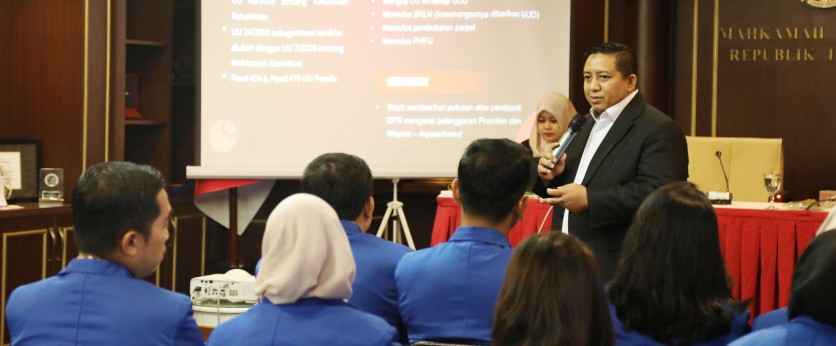
Junior Legal Counselor Achmad Junaedi delivered a presentation during the study visit of students from Esa Unggul University at the Constitutional Court’s Delegation Room on Monday, June 08,2026. Photo by MKRI /Panji
JAKARTA, MKRI — Law Students of Esa Unggul University (FH UEU) conducted a study visit to the Constitutional Court (MK) on Monday June 08,2026. The visit, attended by 21 students, was received directly by Junior Legal Counselor Achmad Junaedi.
Addressing the FH UEU students, Junaedi explained that the establishment of the Constitutional Court was driven by the absence of legal mechanisms to resolve political issues in the past. Therefore, under the 1945 Constitution of the Republic of Indonesia (UUD 1945), the Court is vested with the authority to review laws against the Constitution, adjudicate disputes concerning the constitutional authority of state institutions whose powers are granted by the Constitution, decide on the dissolution of political parties, resolve disputes over general election results, and rule on the opinion of the House of Representatives (DPR) alleging that the President and/or Vice President has violated the Constitution.
Junaedi further explained that there are two types of judicial review: substantive review and formal review. Substantive review aims to assess the substance of a legal norm contained in a law and is not subject to any time limitation. Formal review, meanwhile, examines the legislative process through which a law is enacted and must be filed within 45 days of the law’s promulgation.
Constitutional Court decisions on judicial review have far-reaching implications for society. These decisions have subsequently been categorized into 66 constitutional rights of citizens.
As for the Constitutional Court’s authority to adjudicate disputes over regional head election (pilkada) results, such authority was previously exercised by the Supreme Court (MA). The transfer of authority was prompted by the numerous conflicts that occurred in high courts across various regions. The reassignment was intended to distance the adjudication process from potential sources of conflict among supporters in the regions, which had frequently occurred in the past.
Junaedi also explained the independence of constitutional justices in rendering decisions and expressing opinions through their rulings. A constitutional justice may issue a dissenting opinion when disagreeing with a decision. Meanwhile, a justice who agrees with the outcome of a decision but relies on different legal reasoning may submit a concurring opinion, namely a separate opinion supporting the same conclusion on different grounds.
Following the presentation, the students visited the Constitutional History Center (Puskon MK), which serves as a center for documentation, learning, and information on the history and practice of constitutionalism in Indonesia, while also displaying the Constitutional Court’s historical collections and important archives. Located on the fifth and sixth floors of the Court’s First Building, the 1,462-square-meter facility provides educational resources for the public to better understand the Constitution.
Author: Ilham Wiryadi Muhammad
Editor: N. Rosi
Translator: Mauliza Ara Rizki/SO
Disclaimer: The original version of the news is in Indonesian. In case of any differences between the English and the Indonesian versions, the Indonesian version will prevail.
Monday, June 08, 2026 | 15:39 WIB 9