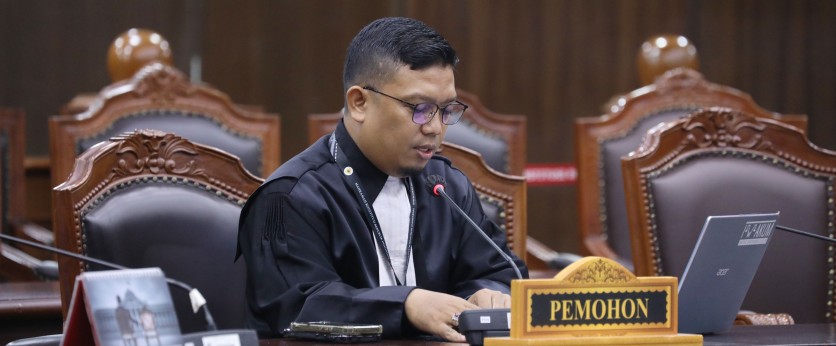
The Petitioners’ counsel Viktor Santoso Tandiasa presenting the petition against Law No. 20 of 2023 on the State Civil Apparatus (ASN), Thursday (6/4/2026). Photo by MKRI/Panji.
JAKARTA (MKRI) — Forum Solidaritas Mobilitas Karier or Fosmik (Solidarity Forum for Career Mobility) and civil servants (PNS) Dhira Dharma Wirawan, Rani Lestari Banjarnahor, and Candra Dewi Cahyaningrum have filed for the review of the constitutionality of Article 21 paragraph (8) and Article 46 paragraph (2) of Law No. 20 of 2023 on the State Civil Apparatus (ASN Law) to the Constitutional Court. The preliminary hearing for Case No. 174/PUU-XXIV/2026 took place on Thursday, June 4, 2026.
Represented by counsel Viktor Santoso Tandiasa of VST Law Firm, the Petitioners argued that the challenged provisions regulate the transfer of civil servants and effectively require them to serve for at least ten years in the relevant institution. According to them, the absence of clear statutory regulation in the ASN Law has enabled the Ministry of Administrative and Bureaucratic Reform to issue regulations that hinder the Petitioners’ personal development and family lives.
The Petitioners contend that the challenged provisions are inconsistent with the 1945 Constitution because they do not expressly regulate the period after which a transfers may be carried out. In practice, this has given rise to an administrative policy that effectively “locks” a civil servant’s employee identification number (NIP) for ten years before they may apply for a transfer or mobility program.
During the hearing, Tandiasa also described difficulties the Petitioners experienced as a result of the challenged provisions. Petitioner III, Rani Lestari Banjarnahor, suffers from health issues requiring adequate medical treatment. Although she has obtained approval for a transfer from the relevant authorities, the transfer cannot be implemented because of the ten-year service requirement.
“Petitioner III still cannot transfer because her records are locked in the SIASN application due to the ten-year service requirement for transfer or mobility. Consequently, her documents cannot be uploaded into the system because they are automatically blocked by the SIASN application,” Tandiasa explained.
Petitioner IV Candra Dewi Cahyaningrum also experienced a similar situation. She has sought a transfer in order to live with her husband and preserve her marriage. However, those efforts were unsuccessful because of the requirement to complete ten years of service before becoming eligible for a transfer.
“Petitioner IV is facing family difficulties that have nearly resulted in a divorce. She has made a lot of efforts to preserve her marriage, but the education office where she serves informed her that mobility or transfer was not possible because of the rule requiring ten years of service before any transfer or career/talent mobility may be granted,” Tandiasa stated.
The Petitioners argue that the lack of a clear statutory time limit for civil servants seeking transfers creates an opportunity for absolute and arbitrary administrative policies. On that basis, they request the Court to provide a constitutional interpretation safeguarding their constitutional rights.
In their petitums, the Petitioners request the Court to declare Article 21 paragraph (8) letter a of the ASN Law conditionally unconstitutional insofar as it is not interpreted to mean: “Talent and career development shall be implemented by guaranteeing the mobility rights of state civil apparatus personnel in a fair and equal manner, and shall not be impeded by administrative regulations that exceed a reasonable minimum service period of two (2) years and a maximum of five (5) years.”
They further request the Court to declare Article 46 paragraph (2) of the ASN Law conditionally unconstitutional insofar as it is not interpreted to mean: “Talent mobility shall be carried out after a minimum of two (2) years and a maximum of five (5) years in accordance with the principles of civil servant management, and shall accommodate humanitarian considerations, family reunification, and health conditions, without any permanent lock imposed through personnel administration systems.”
Justices’ Advice
In response to the petition, Constitutional Justice M. Guntur Hamzah noted that the difficulties described by the Petitioners appeared to have arisen from a regulation of the Ministry of Administrative and Bureaucratic Reform (PermenPAN-RB). Therefore, he advised them to demonstrate more clearly the connection between the implementing regulation and the provisions of the ASN Law being challenged.
“Those circumstances may indeed be detrimental from the perspective of a ministerial regulation, but this is a judicial review of a statute, not a review of a ministerial regulation. Accordingly, the argument needs to be sharpened,” he stated.
He further advised the Petitioners to clarify why the matter should be regarded as a constitutional challenge to the law itself, even though the practical problem appears to have arisen from the implementing regulation. In addition, he questioned whether the issue concerns the constitutionality of the statutory norm or merely its implementation. He also reminded the Petitioners to consider why the challenged provisions are accompanied by implementing regulations.
“There may be facts or data showing a high level of mobility among civil servants before they complete ten years of service. Such mobility could disrupt the distribution of personnel assignments, whereas each institution requires personnel placement according to its organizational needs,” he observed.
Constitutional Justice Daniel Yusmic P. Foekh likewise questioned whether the Petitioners’ grievance concerns the constitutionality of the statutory provisions or merely the implementation of implementing regulations. “Is the issue with the statutory provision itself, or with the regulations beneath it, such as Government Regulation No. 11 or the ministerial regulation?” he asked.
He further requested the Petitioners to explain the basis for proposing specific time limits in their petitums. He stressed that civil servant distribution remains a significant issue in many regions of Indonesia.
“When I served in East Nusa Tenggara, many people viewed becoming a civil servant merely as a stepping stone and then sought transfers to Java. I can imagine similar situations occurring in Papua, Kalimantan, and Sulawesi. While the desire to be reunited with a spouse may be understandable, civil servants agree to be assigned anywhere in Indonesia,” he remarked.
Finally, Chief Justice Suhartoyo, who chaired the session, advised that the legal standing of Petitioner I be strengthened. He also suggested that the Petitioners further elaborate the standards and parameters used to construct their constitutional arguments against the challenged provisions.
“It may be necessary to explain and elaborate the parameters you rely upon in interpreting Article 21 paragraph (8) letter a—for example, concepts such as fairness, equality, and the prohibition against unreasonable administrative restrictions. What standards or benchmarks are you referring to in order to interpret that provision in such a manner?” he stated.
At the end of the session, Chief Justice Suhartoyo announced that the Petitioners would be able to revise the petition and re-submit it only once before 12:00 WIB on Wednesday, June 17, 2026, either offline or online.
Explore Case No. 174/PUU-XXIV/2026 (in Indonesian).
Author : Ilham Wiryadi Muhammad
Editor : N. Rosi
Translator : Yuniar Widiastuti (NL)
Disclaimer: The original version of the news is in Indonesian. In case of any differences between the English and the Indonesian versions, the Indonesian version will prevail.
Thursday, June 04, 2026 | 16:11 WIB 10