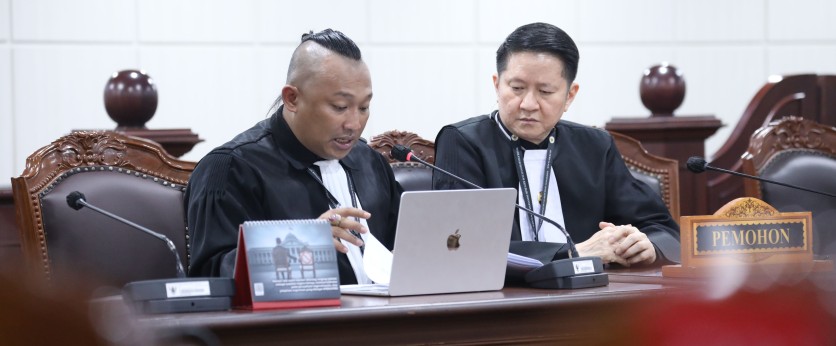
Syamsul Jahidin and Henoch Thomas attending the Judicial Review hearing on Notary Law to deliver the main point of the revised petition on Thursday (4/6). Photo by MKRI/Panji.
Jakarta (MKRI) – Henoch Thomas (Petitioner I) and Syamsul Jahidin (Petitioner II) have filed for a material review of Law No. 30 of 2004 on Notary as amended by Law No. 2 of 2014 on the Amendment to Law No. 30 of 2004 on Notary to the Constitutional Court (MK). The preliminary hearing of the case was held on Thursday, June 4, 2026, presided over by Deputy Chief Justice Saldi Isra. Jahidin mentioned that Article 66 paragraphs (1), (3), and (4) of the law are in breach of Article 28D paragraph (1) of the 1945 Constitution of the Republic of Indonesia.
Article 66 paragraph (3) of the Notary Law reads, “The Notary Honorary Council, within no later than 30 (thirty) working days from receipt of the letter requesting approval as referred to in paragraph (1), shall be obliged to provide an answer granting or refusing the request for approval.”
Article 66 paragraph (4) stipulates, “If the Notary Honorary Council does not provide an answer within the period referred to in paragraph (3), the Notary Honorary Council shall be deemed to have granted the request for approval.”
Jahidin stated that, from a constitutional perspective, the norms may deviate from the principles of constitutional supremacy and due process of law. These provisions confer quasi-judicial authority on the Notary Honorary Council (MKN) without any appeal mechanisms or legal control over its decisions. Therefore, MKN appears to assume the role of deciding whether an investigation is legitimate, which should be within the judiciary's scope. Such arrangements may cause authorities to overlap, weakening the checks-and-balances system provided for in the 1945 Constitution.
Jahidin further stated that the enactment of Article 66 paragraph (1) of the Notary law indicated that MKN approval may constitute a real case of constitutional noncompliance if left unchecked. There are several constitutional norms that are violated, including the right to justice and judicial independence, and administrative mechanisms notifications. Therefore, respect for constitutional supremacy can be maintained without ignoring the protection of the notary.
“Hence, the phrase ‘with the approval of the Notary Honorary Council’ in Article 66 paragraph (1) of the law need not be applied. It is because conducting an investigation against a notary, be it as an expert, witness, or suspect due to his/her involvement in a criminal offense, does not require ‘the approval of the Notary Honorary Council’ but rather only requires notification to the Notary Association or the Notary Supervisory Board, which is consistent with the rule of law principle that guarantees legal certainty, order, and legal protection centered on truth and justice,” Jahidin explained.
Based on such arguments, the Petitioners requested the Court to declare the phrase in Article 66 paragraph (1) stating that “For the purposes of judicial proceedings, investigators, public prosecutors, or judges, with the approval of the Notary Honorary Council, are authorized to” of the Notary Law conditionally unconstitutional and has no legally binding force as long as it is not interpreted as “Article 66 paragraph (1) reads, ‘For the purposes of judicial proceedings, investigators, public prosecutors, or judges, with the notification to the Notary Honorary Council, are authorized to’”.
In addition, they also requested the Court to declare Article 66 paragraph (4), which states, “If the Notary Honorary Council does not provide an answer within the period referred to in paragraph (3), the Notary Honorary Council shall be deemed to have granted the request for approval,” unconstitutional and not legally binding.
Basis for Review
During the advisory session, Justice Adies Kadir stated that the Petitioners needed to review the posita because they appear to have a different basis for review, namely Article 1 paragraph (3) of the 1945 Constitution. “You need to pay attention to the bases, which one is used as a basis for a review because initially you mentioned Article 28D paragraph (1) of the 1945 Constitution,” Justice Adies explained.
Subsequently, Justice Liliek P. Adi asked the Petitioner to strengthen their legal arguments so that the petition is not ne bis in idem with the previous petition submitted by other petitioners. “You need to strengthen your arguments to convince the Court,” Justice Liliek said.
Before adjourning, Deputy Chief Justice Saldi Isra stated that the Petitioners were given 14 days to revise the petition, which must be submitted to the Court on Wednesday, June 17, 2026, at 12.00 noon Western Indonesian Time, at the latest. The Court will then schedule the next hearing to examine the revised petition.
Case tracking: Petition No. 175/PUU-XXIV/2026 (in Indonesian)
Author: Sri Pujianti
Editor: Lulu Anjarsari P.
PR: Andhini S.F.
Translator: Rizky Kurnia Chaesario
Disclaimer: The original version of the news is in Indonesian. In case of any differences between the English and the Indonesian versions, the Indonesian version will prevail.
Thursday, June 04, 2026 | 14:26 WIB 15