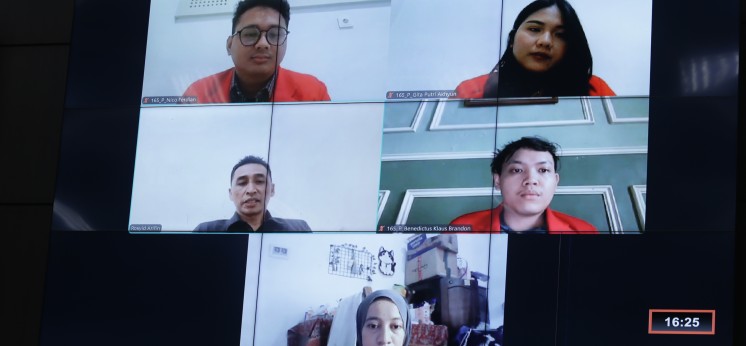
Petitioners during the Hearing on the Revision of Petition Number 165/PUU-XXIV/2026 concerning the Formal and Substantive Review of Law Number 6 of 2023 on Job Creation in conjunction with Law Number 36 of 1999 on Telecommunications, Wednesday (June 3, 2026). Photo by MKRI Public Relations/Bay.
JAKARTA, (MKRI) - The Constitutional Court once again held a hearing on Wednesday (June 3, 2026) to examine the petition challenging Article 71 Point 2 of Law Number 6 of 2023 on Job Creation (Job Creation Law) in conjunction with Article 28 of Law Number 36 of 1999 on Telecommunications (Telecommunications Law). The hearing was scheduled to review the Petitioners’ revised submission.
During the hearing, the Petitioners acknowledged that they had submitted their revised petition after the prescribed deadline. Nevertheless, they proceeded to explain several revisions, including changes to the posita, or statement of reasons supporting the petition. Reading the revised petition, Novarinda Benti Dahu stated that the current petition differs from the earlier submission. According to the Petitioners, internet quota that has been lawfully purchased by consumers constitutes an economic asset under the consumer’s control.
“The unilateral expiration of internet quota without fair treatment constitutes a clear violation of property protection and an arbitrary deprivation of private ownership rights, contrary to Article 28G paragraph (1) and Article 28H paragraph (4) of the 1945 Constitution,” Novarinda said.
The Petitioners further argued that an unequal bargaining position exists between business operators and consumers.
Accordingly, in their revised petition, they requested the Court to declare Article 71 Point 2 of the Job Creation Law in conjunction with Article 28 of the Telecommunications Law unconstitutional insofar as it is not interpreted to include legal protection for unused internet quota already purchased by consumers. They also requested the Court to declare the provision conditionally unconstitutional and lacking binding legal force insofar as it does not require telecommunications operators either to carry over unused internet quota to the next billing period or to provide fair compensation to consumers.
Read also:
Five Students Challenge Expiring Internet Data Quotas
For context, during the Preliminary Examination Hearing held on May 20, 2026, five students filed a constitutional challenge against the regulation governing telecommunications network service tariffs (internet quota) as stipulated in Article 71 Point 2 of the Job Creation Law in conjunction with Article 28 of the Telecommunications Law. The Petitioners in Case Number 165/PUU-XXIV/2026 are Rosyid Arifin, Benedictus Klaus Brandon Arya Setya, Nico Ferdian, Gita Putri Akhyun, and Novarinda Benti Dahu.
Article 71 Point 2 of the Job Creation Law provides:
“Several provisions of Law Number 36 of 1999 on Telecommunications are amended as follows: 2. Article 28 is amended to read as follows: (1) The tariff for Telecommunications Network Operations and/or Telecommunications Service Operations shall be determined by telecommunications network operators and/or telecommunications service operators based on a formula established by the Central Government. (2) The Central Government may establish upper and/or lower tariff limits for Telecommunications Operations while taking into account public interests and fair business competition.”
During the hearing, which was presided over by Chief Justice Suhartoyo, principal petitioner Gita Putri argued that the challenged provision places consumers in a disadvantaged position in their legal relationship with service providers, particularly regarding internet quota that has been purchased but cannot be fully utilized due to the expiration of the service period.
According to the Petitioners, the absence of clear and explicit regulations protecting unused internet quota creates legal uncertainty that is inconsistent with the rule of law principle guaranteed under Article 28D paragraph (1) of the 1945 Constitution. As consumers, they argued, they are left without certainty regarding their rights to services that have already been paid for. (*)
Author : Ilham WM.
Editor : Lulu Anjarsari P.
PR : Raisa Ayuditha M.
Translator : Agusweka PS.
Disclaimer: The original version of the news is in Indonesian. In case of any differences between the English and the Indonesian versions, the Indonesian version prevails.
Case Track: Petition Number 167/PUU-XXIV/2026
Wednesday, June 03, 2026 | 20:26 WIB 110