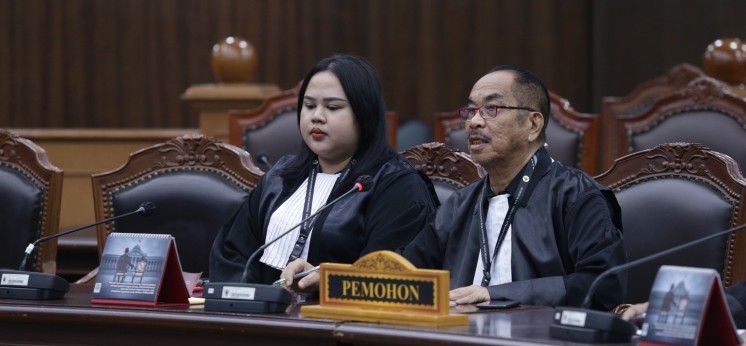
Petitioners during the Hearing to Confirm the Withdrawal of Petition Number 162/PUU-XXIV/2026, Wednesday (June 3, 2026), at the Constitutional Court. Photo by MKRI Public Relations/Bay.
JAKARTA, (MKRI) - Jonathan Waeo Salisi and Rachel Laisesa withdrew Petition Number 162/PUU-XXIV/2026 during a hearing held on Wednesday (June 3, 2026) at the Constitutional Court, Jakarta. In their earlier petition, the Petitioners sought clarification regarding the interpretation of Constitutional Court Decision Number 174/PUU-XXII/2024 on the judicial review of Law Number 22 of 2009 on Road Traffic and Transportation (UU LLAJ) against the 1945 Constitution, which was handed down on March 21, 2025.
“We withdraw it, Your Honors,” Jonathan stated, confirming the withdrawal before the Panel of Justices chaired by Chief Justice Suhartoyo.
Suhartoyo then stated that the confirmation of the withdrawal had been recorded in the hearing minutes. The hearing had specifically been scheduled to confirm the Petitioners’ withdrawal request.
Read also:
Advocates Seek Clarification on Interpretation of Constitutional Court Decision
For context, Jonathan Waeo Salisi and Rachel Laisesa had submitted a request for clarification regarding Constitutional Court Decision Number 174/PUU-XXII/2024 concerning the judicial review of the Road Traffic and Transportation Law against the 1945 Constitution. They described their submission as a petition seeking an “interpretive clarification of a Constitutional Court decision” and identified themselves as Petitioners.
“Our petition is not actually a judicial review of a law, but rather a request for clarification regarding the interpretation of a Constitutional Court decision,” Jonathan said during the preliminary examination hearing of the petition, which was registered as Case Number 162/PUU-XXIV/2026 on May 18, 2026.
Jonathan explained that differing interpretations had emerged regarding Decision Number 174/PUU-XXII/2024. The Petitioners argued that because the Court has the authority to review laws against the Constitution, it also functions as the final interpreter of the Constitution. Therefore, they contended that the Court should likewise have the authority to clarify the meaning of its own decisions when uncertainty arises in the implementation of legal norms that have already been adjudicated.
The ruling in Decision Number 174/PUU-XXII/2024 rejected the petition in its entirety. However, according to the Petitioners, the Court’s legal considerations discussed several articles and paragraphs closely related to driving licenses (SIM).
These provisions included, among others, Article 77 paragraph (1) of the Road Traffic and Transportation Law concerning the obligation of motor vehicle drivers to possess and carry a valid driving license; Article 81 regarding the forms, classifications, requirements, and procedures for obtaining a driving license; Article 85 concerning the validity period and territorial applicability of a driving license; Articles 87, 88, and 89 concerning the issuance of driving licenses, the authorities authorized to issue them, and markings related to traffic offenses; Articles 106 and 265 concerning vehicle inspections, including inspections of driving licenses; and Articles 281, 288 paragraph (2), and 314 concerning criminal sanctions and fines related to driving licenses.
The Petitioners further argued that, based on the overall regulatory framework governing driving licenses under the Law, the Court had found that the phrase “showing a driving license” formed part of Article 288 paragraph (2), the provision challenged in Case Number 174/PUU-XXII/2024, which falls within the category of criminal sanctions and/or fines. Article 288 paragraph (2) explicitly provides that:
“Any person driving a motor vehicle on the road who is unable to present a valid driving license as referred to in Article 106 paragraph (5) letter b shall be subject to imprisonment for a maximum of one month and/or a fine of up to Rp250,000.”
The Petitioners questioned whether presenting or displaying a digital driving license could be interpreted as insufficient or unrecognized for the purpose of driving within the territory of the Republic of Indonesia. They noted that one of the principal issues raised by the petitioner in Case Number 174/PUU-XXII/2024 involved the use of a digital driving license, yet the petitioner remained subject to Article 288 paragraph (2), creating the impression that the use of a digital driving license was not permitted or recognized.
They further pointed out that the National Police Traffic Corps (Korlantas Polri) had already introduced electronic driving licenses and electronic vehicle registration certificates (BPKB) pursuant to Article 85 paragraph (1) of the Road Traffic and Transportation Law. Consequently, they questioned whether electronic driving licenses and electronic vehicle registration certificates could also be interpreted as digital forms of those documents.
“Thus, this petition seeks clarification regarding the legal considerations associated with the ruling in Case Number 174/PUU-XXII/2024. We thank the Court for its attention,” Jonathan concluded. (*)
Author : Mimi Kartika
Editor : Lulu Anjarsari P.
PR : Fauzan Febriyan
Translator : Agusweka PS.
Disclaimer: The original version of the news is in Indonesian. In case of any differences between the English and the Indonesian versions, the Indonesian version prevails.
Case Track: Petition Number 162/PUU-XXIV/2026
Wednesday, June 03, 2026 | 17:07 WIB 148