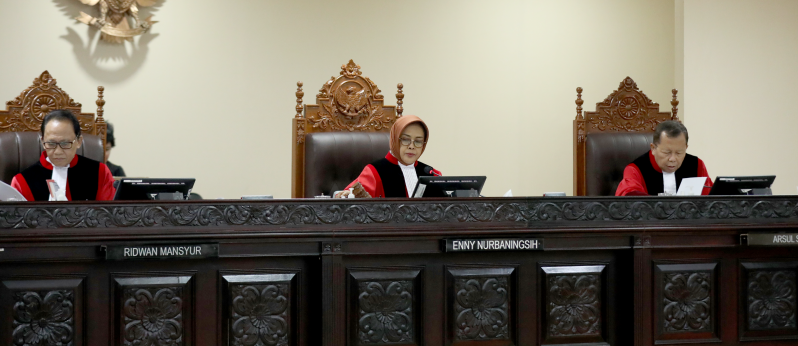
Constitutional Justice Enny Nurbaningsih (center) presiding over a hearing on Law No. 6 of 2023 on Job Creation alongside Constitutional Justices Ridwan Mansyur (left) and Asrul Sani (right), Wednesday (6/3/2026). Photo by MKRI/Fauzan.
JAKARTA (MKRI) — The Constitutional Court held the petition revision hearing for Case No. 167/PUU-XXIV/2026 on the material review of Article 78 paragraph (1) letter a and Article 153 paragraph (1) of Law No. 6 of 2023 on the Stipulation of Government Regulation in Lieu of Law No. 2 of 2022 on Job Creation into Law (Job Creation Law) on Wednesday, June 3, 2026.
The Petitioner’s counsel Leon Maulana Mirza Pasha explained that the case concerns the material review of Article 78 paragraph (1) letter a, Article 81 point 24, Article 81 point 43, and Article 153 paragraph (1) of Law No. 6 of 2023. He also stated that the Petitioner’s legal standing had been revised.
Zico Leonard Djagardo Simanjuntak, another counsel for the Petitioner, explained before the panel chaired by Constitutional Justice Enny Nurbaningsih that revisions had been made to the grounds for the petition. “The grounds for and the objects of the petition are different from [those in] past petitions, so this case can be adjudicated by the Constitutional Court,” he said.
Therefore, in the revised petitums, the Petitioner requests that the Court declares the phrase “the consent of the relevant worker/laborer” in Article 78 paragraph (1) letter a under Article 81 point 24 of the appendix to the Job Creation Law conditionally unconstitutional and without binding legal force insofar as it is not interpreted as “The consent of the relevant Worker/Laborer must be given pursuant to the Employer’s instruction and the written consent of the Worker concerned, whether in writing and/or through digital media, by means of an overtime work agreement, and a worker’s refusal to perform overtime work may not be used as grounds for termination of employment.”
Also read: Forced to Work Unpaid Overtime, Employee Challenges Job Creation Law
Yoga Julianta, a former Batam branch employee of distribution company PT Cipta Niaga Semesta presented his grievance before a panel chaired by Constitutional Justice Enny Nurbaningsih on Thursday, May 21, 2026 relating to disciplinary action imposed on him after he refused overtime work. He challenges Article 78 paragraph (1) letter a of the Job Creation Law, which stipulates, “Employers who employ Workers/Laborers beyond the working hours referred to in Article 77 paragraph (2) must fulfill the following requirements: a. the consent of the relevant Worker/Laborer.” He also seeks a review of Article 153 paragraph (1) of the Job Creation Law, which reads: “Employers shall be prohibited from terminating employment of Workers/Laborers on the grounds of: a. absence from work due to illness, as certified by a physician, for a period not exceeding twelve (12) consecutive months.”
The Petitioner argues that the application of these provisions had harmed his constitutional rights because the challenged norms failed to provide legal certainty for workers in refusing unreasonable working hours. He believes Article 153 paragraph (1) of the Law a quo harms him because it does not regulate circumstances involving the refusal and/or unwillingness to provide consent for overtime work orders, thereby creating a gap in legal protection and legal certainty against unilateral termination of employment by employers. Furthermore, he argues that Article 78 paragraph (1) of the Job Creation Law does not provide a standardized mechanism governing overtime arrangements. He further contends that Article 153 paragraph (1) of the Job Creation Law, which regulates employment termination, in fact creates opportunities for employers to terminate workers who refuse to do overtime work.
Explore cases No. 167/PUU-XXIV/2026 (in Indonesian).
Author : Ilham W. M.
Editor : Lulu Anjarsari P.
PR : Raisa Ayuditha M.
Translator : Yuniar Widiastuti (NL)
Disclaimer: The original version of the news is in Indonesian. In case of any differences between the English and the Indonesian versions, the Indonesian version will prevail.
Wednesday, June 03, 2026 | 20:43 WIB 21