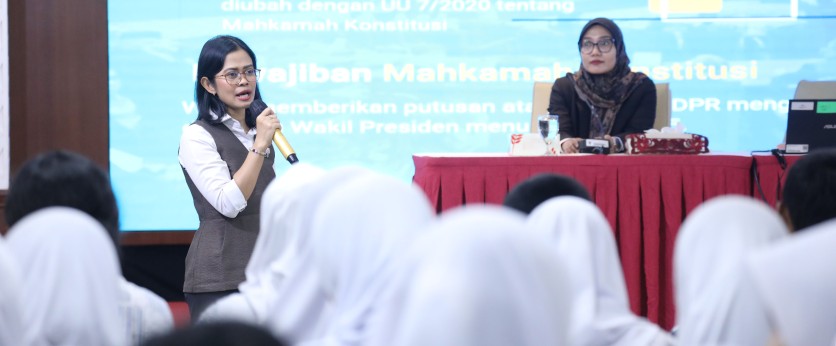
Thursday, May 21, 2026. Siswantana Putri Rachmatika, Junior Legal Analyst of the Constitutional Court, as the speaker accompanied by moderator Hersinta Setiarini, Junior Legal Counselor of the Constitutional Court, received a visit from students of SMPN 95 Jakarta at the hall of the Constitutional Court Building I. Photo by MKRI/Panji.
JAKARTA, MKRI – Students of State Junior High School 95 (SMPN 95) Jakarta visited the Constitutional Court (MK) on Thursday, May 21, 2026. The participants were directly welcomed by Siswantana Putri Rachmatika, Junior Legal Analyst of the Constitutional Court, who also served as the speaker in the event, with Hersinta Setiarini, Junior Legal Counselor of the Constitutional Court, acting as moderator.
In front of 225 student SMPN 95 students who filled the hall of Constitutional Court Building I, Siswantana Putri Rachmatika, familiarly called Tika, delivered presentation entitled “Getting to Know the Constitutional Court.” Tika explained that the Constitutional Court was established in 2003 as a result of the third amendment to the 1945 Constitution of the Republic of Indonesia (UUD NRI Tahun 1945). This places the Constitutional Court as a relatively new institution compared to other state institutions.
The establishment of the Constitutional Court and its authorities was motivated by several legal conditions before the reform era, including the absence of legal mechanisms for citizens to challenge laws deemed detrimental to their rights. Another background was the impeachment of the President and/or Vice President through political mechanisms without legal proceedings. In addition, disputes over the authority of state institutions were previously resolved through presidential authority rather than judicial decisions.
Another authority possessed by the Constitutional Court is the dissolution of political parties, where during the Old Order and New Order eras, political party dissolution was carried out through political decisions of the President. Meanwhile, the authority to adjudicate disputes over general election results was motivated by electoral fraud practices that occurred during the New Order era.
Based on those backgrounds, the Constitutional Court has the authority to review laws against the 1945 Constitution, adjudicate disputes over the authority of state institutions whose powers are granted by the 1945 Constitution, decide on the dissolution of political parties, adjudicate disputes over general election results (presidential and vice-presidential elections, legislative elections, and regional head elections), and is also obligated to decide on the opinion of the House of Representatives (DPR) regarding alleged violations by the President and/or Vice President under the 1945 Constitution.
Tika further explained that the Constitutional Court is one of the judicial power holders alongside the Supreme Court (MA). According to her, there are differences in the authority of judicial review between the Constitutional Court and the Supreme Court.
“So, the Constitutional Court reviews laws against the Constitution, while the Supreme Court reviews regulations below the level of laws against laws,” Tika stated.
Tika then explained the distinctive characteristics of the Constitutional Court compared to general courts. At the Constitutional Court, the public submits petitions, whereas at the Supreme Court, cases are filed as lawsuits. As a judicial institution, the Constitutional Court hears statements from various parties during hearings, including hearing statements from the President and the DPR as lawmakers when necessary. Furthermore, the Constitutional Court adheres to the presumption of constitutionality, meaning every law must be considered valid until a court decision states otherwise.
The Constitutional Court has established the vision of Upholding the Constitution through Modern and Trustworthy Judiciary. From this vision, missions were formulated to strengthen the integrity of constitutional justice and increase constitutional awareness among citizens and state administrators. By strengthening the independence and integrity of a modern Constitutional Court, the institution develops a judicial system supported not only by information technology, but also by a modern mindset through openness in case handling.
Writer: Ilham Wiryadi Muhammad
Editor: N. Rosi.
Translator: Mauliza Ara Rizki/SO
Disclaimer: The original version of the news is in Indonesian. In case of any differences between the English and the Indonesian versions, the Indonesian version will prevai
Thursday, May 21, 2026 | 15:37 WIB 6