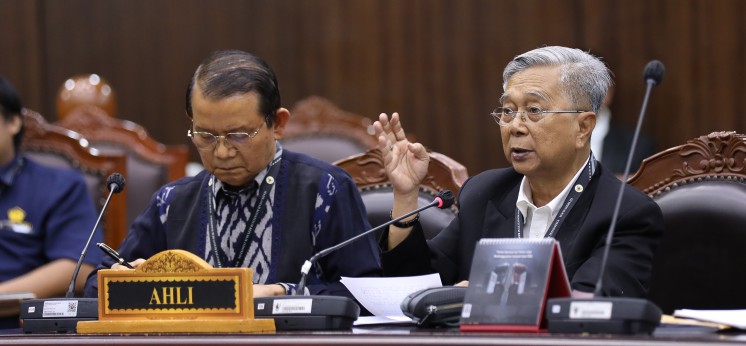
Nindyo Pramono and Kornelius Simanjuntak, Experts presented by Government, testify at another hearing on judicial review of Article 304 of Commercial Code on Wednesday (5/20/2026). Photo by MKRI/Ifa.
JAKARTA (MKRI) – The Constitutional Court (MK) held another hearing on judicial review of Article 304 of Commercial Code (KUHD) on Wednesday, May 20, 2026. The sixth hearing of Petition No. 25/PUU-XXIV/2026 filed by Ng Kim Tjoa was scheduled to hear testimony from Experts presented by President/Government, namely Nindyo Pramono and Kornelius Simanjuntak.
Nindyo Pramono explained in court hearing that Article 304 of Commercial Code meets the principles of legal certainty, utility, and justice. Therefore, it would be inappropriate to interpret it as not providing legal certainty within the context of the increasingly evolving practice of insurance contracts today.
"Article 304 of Commercial Code is only the minimum requirements that can be agreed upon by the parties in an insurance agreement and stated in the insurance policy. The development of the terms is left entirely to the will of the parties who will conclude the insurance agreement, based on the principle of freedom of contract as guaranteed by law. Even if in practice, the Insurance Company then deems it necessary to request additional documents in the context of the claim settlement process, then this is a normal business process in the context of implementing a healthy insurance business and prioritizing the principle of prudence, as long as the requirements stipulated by the Financial Services Authority Regulation mentioned above are met," explained Nindyo.
The Professor of Business Law at the Faculty of Law, Gadjah Mada University, further explained Article 304 of Commercial Code, which was being challenged in this hearing. According to him, the article only regulates the minimal elements that must be included in an insurance policy. In essence, a quo norm actually strengthens the implementation of the principle of consensualism, as it ensures that the parties' agreement is clearly and clearly stated in a legal document called a policy, which provides legal certainty for the parties.
Nindyo also stated that when the insured and the insurer have reached an agreement on the terms and conditions that will be stated in the policy as written evidence of the legally made insurance agreement, it is not appropriate to say that Article 304 of Commercial Code is contrary to the principle of consensualism. The presence of Article 304 of Commercial Code is after the insured and the insurer have agreed to the present of an insurance agreement, which will then be stated in the policy as evidence.
"Thus, if the provisions of Article 304 of Commercial Code are read systematically together with the entire legal framework governing the implementation of insurance business in Indonesia, then it is clear that these provisions do not conflict with the principle of consensualism, the principle of pacta sunt servanda, the principle of utmost good faith, or the principle of transparency," explained Nindyo.
Common Practices in Insurance Industry
The next Presidential Expert, Kornelius Simanjuntak, explained that insurance laws in other countries do not regulate claim submission requirements, unlike Commercial Code in Indonesia, which also does not contain requirements for claim submission. Kornelius revealed that he had read and researched insurance laws from nine countries to understand their respective laws.
More clearly, the Senior Lecturer in Insurance Law at the Faculty of Law, University of Indonesia, explained that none of the UK, Germany, Australia, and Canada, and the six ASEAN member countries, contain provisions or norms regarding the requirements for claim submission documents.
"Therefore, the inclusion of claim submission requirements in the policy which include the condition "The Insured is required to submit other documents deemed necessary by the Insurer," or "Other conditions stipulated in the policy" or with other sentences with the same meaning and content, has become a common and customary practice in the national and international insurance industry," said Kornelius.
At the hearing, Kornelius also explained the impact on the insured and the insurance industry if Article 304 of Commercial Code includes detailed, rigid, and definitive claim submission requirements. This means that the policy will contain numerous types and varieties of documents detailing the claim submission requirements. Consequently, the claim submission requirements will be extremely numerous. This could potentially disadvantage the insured in the claims settlement process, as they will have to complete a greater number of documents, as detailed in the policy.
This will further complicate the formulation and detailing of the claim documents required for each type of claim, situation, and circumstances of a claim event. Finally, insurance policies issued by insurance companies in Indonesia are considered unusual in the general practice of the global/international insurance industry.
"Therefore, it can be concluded that if Article 304 of Commercial Code contains detailed, rigid, and definite norms regarding the requirements for submitting claims, this is not good for the Insured and also for the Insurer," said Kornelius.
Also read:
Requesting Insurance Claim Requirements be Regulated in a Final and Rigid Manner in Commercial Code Review
Strengthening Constitutional Losses Due to Unclear Insurance Claim Requirements
House of Representatives: Commercial Code Doesn’t Prohibit Parties from Further Regulating the Terms of Insurance Agreements
Government: Insurance Law and PPSK Law Address Technical Limitations of Commercial Code
AAJI and AASI Clarify Minimum Mandatory Requirements for Insurance Agreements in Commercial Code
Previously, in Preliminary Examination Hearing held at Court on Monday, January 26, 2026, Petitioner argued that in an insurance agreement, an insurance policy constitutes a contract that regulates the rights and obligations between the insurer and the policyholder, or insured. Once agreed upon, the policy binds both parties to comply with its provisions.
As a crucial document, a policy should rigidly and definitively stipulate the conditions that must be met by the insured or policyholder when filing a claim. However, in practice, the claim requirements stipulated in the policy often disadvantage the policyholder or insured, because insurance companies insert open-ended provisions in the clauses governing the claim requirements, as experienced by the Petitioner. As a result, the insurer can impose additional requirements beyond those agreed upon in the policy. Therefore, the law needs to intervene in the contents of the policy, especially those governing the claim requirements, so that they are regulated rigidly and definitively.
Petitioner considers that the provisions in Article 304 of Commercial Code only regulate insurance policies that only contain certain administrative elements, such as the identity of the parties, the period of coverage, the amount of coverage, and the premium, without requiring the inclusion of definite and rigid terms and procedures for claiming the insurance money. This then results in several things, including the insured not knowing for sure from the outset the documents and requirements that must be met to obtain claim payment; insurance companies have normative flexibility to interpret or even add claim conditions outside of what is stipulated in the policy; claim conditions are often only known after the risk event occurs, so that the insured is in a position where it is unable to avoid or reject these conditions.
Therefore, Petitioner requested the Court declare Article 304 of Commercial Code contrary to the 1945 Constitution of the Republic of Indonesia and has no binding legal force as long as it is not interpreted as "The policy contains: 1. the day the insurance is provided; 2. the name of the insured; 3. the name of the person whose life is insured; 4. the period the danger for the insurer begins and ends; 5. the amount of money insured; 6. the insurance premium; 7. the claim conditions which are regulated in a final and rigid manner."
Track case No. 25/PUU-XXIV/2026
Author : Sri Pujiati
Editor : N. Rosi.
PR : Raisa Ayuditha Marsaulina.
Translator : Donny Yuniarto
Disclaimer: The original version of the news is in Indonesian. In case of any differences between the English and the Indonesian versions, the Indonesian version will prevail.
Wednesday, May 20, 2026 | 16:37 WIB 7