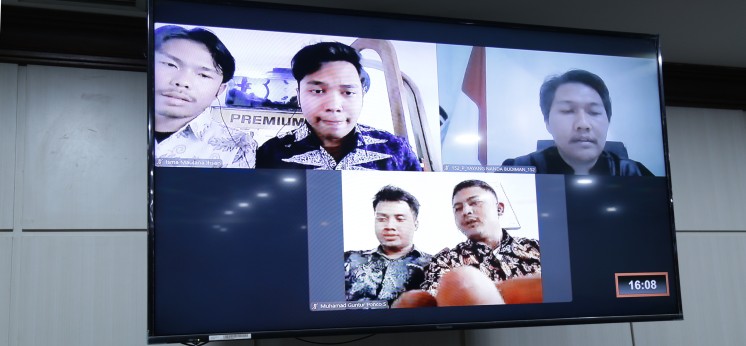
Petitioners attending the material review hearing of Petition No. 155/PUU-XXIV/2026 on the Indonesian National Police on Wednesday (20/5/2026). Photo by MKRI/Bay.
Jakarta (MKRI) – The Constitutional Court (MK) held another material review of Article 14 paragraph (1) letter (i) of Law No. 2 of 2002 on the Indonesian National Police (Police Law) on Wednesday, May 20, 2026. The second hearing for Petition No. 155/PUU-XXIV/2026 was scheduled to examine the revised petition.
The petitioners explained that they have revised the petition, including the structure of the petition and the Court’s authorities. Arguments were also added in the legal standing section. The basis for the petition was revised according to the Panel’s advice to explain the causal relationship between the norm tested and the petitioner’s constitutional harm.
“We also have worked on the posita according to the advice from the Panel of Justices, that is to add the causal relationship,” said one of the Petitioners, Isma Maulana Ihsan.
Also read:
Students Ask to Clarify Parameters for “Disturbing Order” in Police Law
Petition No. 155/PUU-XXIV/2026 was filed by Isma Maulana Ihsan, Yanuar Atha Prabowo, Riyan Zainur Anwar, and Guntur Ponco, bachelor’s students of Political Sciences of Universitas Islam Negeri Sunan Gunung Djati Bandung. They challenge Article 14 paragraph (1) letter i of the Police Law.
During the preliminary hearing on Thursday, May 7, 2026, the Petitioners considered the phrase to be a violation of their constitutional rights. They believe that the phrase “disturbing orders” will cause activities, such as expressing opinions in public, policy advocacy, academic forums, field research, and public policy supervision, to be considered obstructing orders if interpreted narrowly.
In their petition, they assert that they do not question the police’s authority to take measures to address violations, destruction of public facilities, or public threats. However, they intend to request an interpretation of that phrase so that it is not interpreted too broadly.
The phrase “disturbing order” does not have a clear limitation on the type of action, situation, or occurrence that qualifies as such. The lack of a clear limitation from the phrase has the potential to cause citizens' activities, which are guaranteed by the Constitution, including expressing opinions in public or on social media, peaceful gatherings, public discussion, and expressing criticism of government policy, to be arbitrarily categorized as a form of “disturbing order”.
Therefore, in their petitum, they request the Court to declare the phrase “disturbing order” in Article 14 paragraph (1) letter (i) and its elucidation in Police Law contradicts the 1945 Constitution of the Republic of Indonesia and has no legally binding force as long as it is not interpreted as “disturbances that manifestly pose a threat to state sovereignty, loss of life, physical violence, damage to property, serious disruption to public facilities, or other circumstances that objectively endanger public order, while continuing to observe proportionality and the humanistic presisi policing approach." They also request the Court to declare the phrase “disturbing order” in Article 14 paragraph (1) letter (i) of the Police Law constitutional as long as it is not used against citizens who exercise their constitutional rights to assemble, associate and to express opinions peacefully as guaranteed in Article 28E paragraph (3) of the 1945 Constitution.
Case tracking: Petition No. 155/PUU-XXIV/2026 (in Indonesian)
Author: Ilham Wiryadi Muhammad.
Editor: N. Rosi.
PR: Andhini SF.
Translator: Rizky Kurnia Chaesario
Disclaimer: The original version of the news is in Indonesian. In case of any differences between the English and the Indonesian versions, the Indonesian version prevails.
Wednesday, May 20, 2026 | 18:07 WIB 40