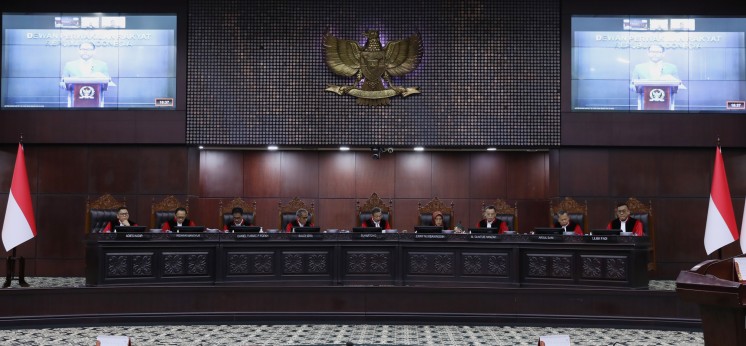
Material review hearing of Law No. 20 of 2025 on the KUHAP to hear testimony from the DPR RI on Tuesday (19/05). Photo by MKRI/Ifa.
Jakarta (MKRI) – The Constitutional Court (MK) continued the material review hearing of Article 1 point 22 and Article 151 paragraph (2) letter b of Law No. 20 of 2025 on the Criminal Procedure Code (KUHAP) on Tuesday, May 19, 2026. Petition No. 104/PUU-XXIV/2026 was filed by 39 advocates, among others, Aldi Rizki Khoiruddin, Erif Fahmi, Firman, and Agung Handi Sejahtera.
The third hearing was scheduled to hear testimony from the DPR RI and the government. However, the government requested a postponement for their testimony.
Member of the Third Commission of the DPR RI, M. Nasir Djamil, read out the DPR’s testimony, stating that advocates are one of the pillars of the judicial system, serving to uphold the rule of law and human rights. “Given the importance of advocates in the judicial system, lawmakers in drafting the 2025 KUHAP have strengthened and clarified the role of advocates as legal practitioners who must be present and involved in every criminal judicial process,” Nasir explained.
Based on this, the 2025 KUHAP normatively maintains and strengthens advocates’ position as legal practitioners within the criminal justice system. Therefore, to clarify the definition of an advocate in the 2025 KUHAP, it is necessary to examine Article 1 point 22 of the 2025 KUHAP. An advocate is a person whose profession is to provide legal services, both in and out of court, who meets the requirements based on statutory provisions governing lawyers and/or persons who may provide legal services, both in and out of court, as part of community service. This is to provide free legal aid in accordance with statutory regulations.
Nasir stated that to fully understand the provision in question regarding the definition of an advocate, there are two interconnected phrases: first, a person who provides legal services both in and out of court, and who meets the requirements set forth in the laws governing advocates. Second, a person who can provide legal services, both in and out of court, as part of community service to provide free legal aid in accordance with the provisions of laws and regulations.
Regarding the first point, the DPR RI explained that the phrase pertains to the definition of an advocate in the context of the profession as regulated in Law No. 18 of 2003 on Advocates (Advocates Law). Regarding the second phrase, the DPR emphasized that it does not alter the definition or the requirements for becoming a practicing advocate as set forth in the Advocates Law. However, it emphasizes the scope of the term “advocate,” particularly in the context of criminal procedure law. Consequently, the term, as used in the KUHAP, also encompasses providers of pro bono legal services recognized under other applicable laws and regulations.
Nasir further explained that the provision in question is a norm derived from the direct implementation of Constitutional Court Decision No. 150/PUU-XXII/2024, which interprets Article 3 paragraph (1) letter (c) and Article 20 paragraph (2) of the Advocates Law, it is emphasized that the provision of legal services free of charge or without collecting fees falls within the framework of community service.
“Therefore, the lawmakers defined the role of advocates within the context of criminal procedure law. As a result, the gap in access to justice for low-income individuals and for regions with a limited number of practicing advocates is addressed, ensuring that they continue to receive protection and justice,” said Nasir.
Two Advocates Legitimacy
Nasir also explained that the definition of an advocate as stipulated in Article 1 point 22 of the 2025 KUHAP encompasses two aspects: the legitimacy of the legal profession and the fact that advocates who serve the community by providing pro bono legal aid represent a concrete effort by the state. In this regard, the lawmakers seek to ensure that every citizen has the widest possible access to legal aid, as guaranteed under Article 28D paragraph (1) of the 1945 Constitution. In line with this, Nasir added that free legal aid is also critically needed for economically vulnerable groups.
“The provision has provided vulnerable groups with opportunities and access to legal services. This is in accordance with Article 28H paragraph (2) of the 1945 Constitution of the Republic of Indonesia, which guarantees that vulnerable groups receive special treatment in order to achieve equality and justice,” explained Nasir.
Also read:
Clarifying the Distinction Between Advocates and Legal Aid Bodies in Indonesia’s Legal System
Number of Petitioners in Advocate–Legal Aid Differentiation Case Increases
Petition No. 104/PUU-XXIV/2026 was filed by 39 advocates. During the preliminary hearing on Thursday, April 2, 2026, the petitioners argued that the challenged norms create disharmony and legal conflict between the definitions of “advocate” and “legal aid” under two distinct and autonomous regulatory regimes. They contended that Article 1 point 22 of the new KUHAP blurs these regimes by incorporating elements of free legal aid into the definition of an advocate.
They pointed out that Law No. 18 of 2003 on Advocates clearly positions the Advocate Organization as the sole professional body authorized to exercise eight organizational powers, while Law No. 16 of 2011 on Legal Aid defines Legal Aid Institutions (LBH) as organizations providing legal aid services to the poor as part of the state’s effort to guarantee access to justice.
On this basis, the Petitioners argued that LBHs have no inherent authority to appoint advocates or apply to the High Court for their swearing‑in, so equating “LBH membership identity” with “minutes of oath‑taking as an advocate” in Article 151 paragraph (2) letter b of the new KUHAP amounts to a normative error that creates structural disharmony in Indonesia’s legal system.
On these grounds, the Petitioners asked the Court to declare the phrase “and/or persons who may provide legal services inside or outside court as part of community service to provide free legal aid under statutory provisions” in Article 1 point 22 of the KUHAP unconstitutional and without binding force.
They also requested that the phrase “his or her identity as a member of a Legal Aid Institution” in Article 151 paragraph (2) letter b be declared unconstitutional and without binding force insofar as it is interpreted to mean that advocates not affiliated with an LBH cannot provide legal services in criminal court proceedings.
Author: Sri Pujianti.
Editor: N. Rosi.
PR: Fauzan F.
Translator: Rizky Kurnia Chaesario
Disclaimer: The original version of the news is in Indonesian. In case of any differences between the English and the Indonesian versions, the Indonesian version will prevail.
Tuesday, May 19, 2026 | 14:49 WIB 66