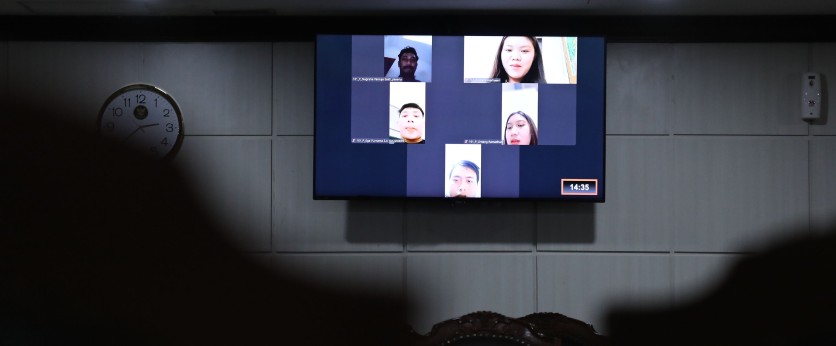
The Petitioners for the review of Law No. 11 of 2016 on Electronic Information and Transactions withdrawing their petition online, Monday (5/18/2026). Photo by MKRI/Panji.
JAKARTA (MKRI) — Five university students have filed a petition for the material review of Law No. 11 of 2008 on Electronic Information and Transactions (EIT Law) as amended by Law No. 19 of 2016 with the Constitutional Court. They are Ferdian Yudhistira, Nugraha Pamuja Sakti, Ega Purnama, Lintang Dwi Ramadhani, and Virana Marhaeni (Petitioners I-V).
The Petitioners intended to challenge Article 27 paragraph (3) of the EIT Law, which provides: “No person shall intentionally and without authority distributes and/or transmits and/or causes to be accessible Electronic Information and/or Electronic Records with contents of affronts and/or defamation.” They argued that the norm is contrary to Article 28D paragraph (1), Article 28E paragraph (3), and Article 28F of the 1945 Constitution.
The preliminary hearing for Case No. 161/PUU-XXIIV/2026 in one of the Court’s panel courtrooms on Monday, May 18, 2026 was presided over by Constitutional Justices Enny Nurbaningsih (chair), Ridwan Mansyur, and Arsul Sani. However, before proceeding with the hearing, Justice Enny reminded the Petitioners that the challenged provision was no longer in force. In response, Nugraha, representing the Petitioners, stated that they would withdraw the petition.
“With regard to the object of the petition and the withdrawal, we will await the submission of the withdrawal request letter,” said Justice Enny at the hearing, which was attended virtually by the Petitioners from their respective locations.
In their petition, the Petitioners argued that in practice, the provision has created an atmosphere of anxiety whenever they wish to publish criticism, opinions, or comments on social media, as it potentially increases the risk of criminalization of expression in digital spaces. The Petitioners maintained that the phrase “with contents of affronts and/or defamation” in the provision a quo is ambiguous and gives rise to differing interpretations in its legal application. Consequently, it becomes difficult to distinguish between legitimate criticism, personal opinions, and conduct that may lead to criminal prosecution for defamation.
Furthermore, this situation has also triggered self-restraint among citizens in expressing themselves, as individuals may choose not to freely voice their opinions in order to avoid criminal sanctions. Meanwhile, freedom of expression constitutes one of the fundamental pillars of a democratic system and should receive effective protection from the State.
Based on these arguments, the Petitioners requested that the Court declare Article 27 paragraph (3) of Law No. 11 of 2008 on Electronic Information and Transactions, as amended by Law No. 19 of 2016 amending Law No. 11 of 2008, unconstitutional and that the provision may continue to produce legal effect only if it is interpreted strictly, precisely, and in accordance with constitutional principles, particularly with respect to the phrase “with contents of affronts and/or defamation,” so as to prevent the provision from being applied in a manner that excessively restricts citizens’ freedom of opinion and freedom of expression in digital spaces.
The Petitioners further requested that the Court determine that Article 27 paragraph (3) of the EIT Law take into account citizens’ constitutional rights relating to freedom of expression, the right to convey opinions, the right to access and disseminate information, as well as the principle of fair legal certainty guaranteed under Article 28E paragraph (3), Article 28F, and Article 28D paragraph (1) of the 1945 Constitution.
Explore cases No. 161/PUU-XXIV/2026 (in Indonesian).
Author : Sri Pujianti
Editor : N. Rosi
PR : Raisa Ayuditha M.
Translator : Yuniar Widiastuti (NL)
Disclaimer: The original version of the news is in Indonesian. In case of any differences between the English and the Indonesian versions, the Indonesian version will prevail.
Monday, May 18, 2026 | 16:03 WIB 43