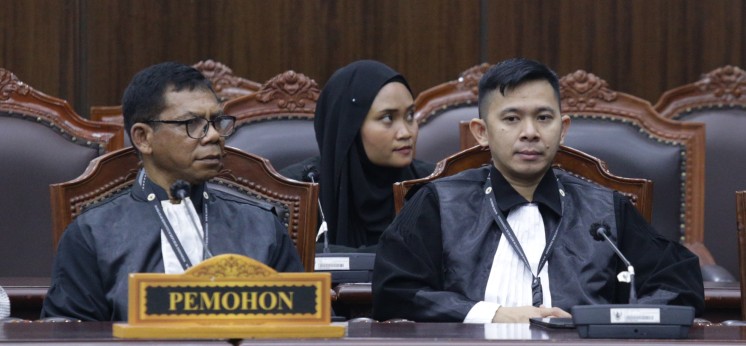
Petitioners’ legal counsel attending the decision pronouncement hearing of Case No. 118/PUU-XXIV/2026 on the material review of Law No. 20 of 2025 on the Criminal Procedure Code on Tuesday (12/5). Photo by MKRI/Bay.
Jakarta (MKRI) – The Constitutional Court (MK) declared unacceptable a petition submitted by four students seeking a review of Article 235, paragraph (1) letter g of Law No. 20 of 2025 on the Criminal Procedure Code (KUHAP). Decision Pronouncement Hearing of Case No. 118/PUU-XXIV/2026 was held on Tuesday, May 12, 2026.
Deputy Chief Justice Saldi Isra, who delivered the Court’s considerations, stated that the second petitum in Petition No. 118/PUU-XXIV/2026 constitutes an unusual formulation of petitum. In the Court’s view, in line with the established drafting practice for judicial review petitions before the Court, the Petitioner needs only to state that the provisions being challenged are contrary to the 1945 Constitution of the Republic of Indonesia. In addition, there are inconsistencies in the way the law is cited.
The Court found that the Petitioners had never explained how the challenged provisions are inconsistent with Article 28I paragraph (2) of the 1945 Constitution, which they invoked as a benchmark. “The Petitioners’ posita did not set out Article 28I paragraph (2) of the 1945 Constitution as a basis for review when challenging Article 235 paragraph (1) letter g of Law No. 20 of 2025. In the posita section, the Petitioners relied only on Article 28D paragraph (1) and Article 28G paragraph (1) of the 1945 Constitution as grounds for review,” Deputy Chief Justice Saldi said.
Also read:
Challenging Phrase “Judges’ Observation” under New Criminal Procedure Code
Petition on Constitutionality of Phrase “Judge’s Observation” in New Criminal Procedure Code Revised
During the preliminary hearing on Thursday, April 8, 2026, The Petitioners argued that the phrase “judges’ observation” lacks a clear limitation, objective parameter, or testing mechanism. This causes the norm not to fulfill the principle of lex certa and due process of law, and may create subjectivity in the process of criminal evidence.
The petitioners also consider the provision enabling discrimination because the evaluation depends on the judge’s perception. This condition, the petitioners argue, may lead to different judgments in cases with similar facts, thereby violating the principle of equality before the law guaranteed by the Constitution.
Moreover, the Petitioners state that the phrase also contradicts the rule of law principles by extending the judges’ authority beyond adjudication. They argue that judges not only assess the evidence but may themselves become a source of evidence, thereby blurring the line between the functions of evaluating and proving.
From the standpoint of the law of evidence, the Petitioners argued that “judges’ observation” does not meet the criteria for rational proof because it is neither traceable, verifiable, nor accountable, and that the provision undermines what has traditionally been a closed system of evidence.
“To declare the phrase “judge’s observation” in Article 235 paragraph (1) letter g of Law No. 20 of 2024 on the Criminal Procedure Code contrary to the 1945 Constitution of the Republic of Indonesia,” stated Harribertus Satori Nabir, reading out the petitum in the first hearing.
Decision No. 118/PUU-XXIV/2026 (in Indonesian)
Author: Ilham Wiryadi Muhammad.
Editor: N. Rosi.
PR: Fauzan F.
Translator: Rizky Kurnia Chaesario
Disclaimer: The original version of the news is in Indonesian. In case of any differences between the English and the Indonesian versions, the Indonesian version prevails.
Tuesday, May 12, 2026 | 20:01 WIB 71