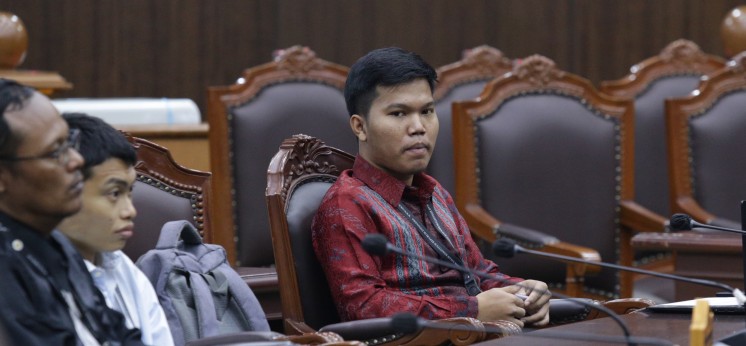
Petitioners attending the Decision Pronouncement Hearing of Case No. 111/PUU-XXIV/2026 on the material review of Law No. 20 of 2025 on the Criminal Procedure Code on Tuesday (12/5). Photo by MKRI.
Jakarta (MKRI) – The Constitutional Court (MK) declared unacceptable a petition filed by five advocates seeking a material review of Article 235 paragraph (1) letter e of Law No. 20 of 2025 on the Criminal Procedure Code. Decision for Case No. 111/PUU-XXIV/2026 was pronounced on Tuesday, May 12, 2026.
Chief Justice Suhartoyo, delivering the Court’s legal considerations, stated that the Petitioners had not provided any explanation or sufficient evidence to show that they were law students or law graduates who were currently subject to, or at real risk of being subject to, the determination of suspect status, nor that there was a tangible possibility of abuse of authority by law enforcement officials that could harm their constitutional rights. The Court considered that the Petitioners merely emphasized that the challenged provisions create a dissonance between the academic doctrines they have studied and the norms being reviewed, which in turn affects the scientific foundations of the legal profession they are pursuing or experiencing.
“On this point, the Court held that the situation described by the Petitioners does not constitute a specific, actual, or potential constitutional injury that, based on reasonable reasoning, can be deemed certain to occur, since legal doctrine, as the opinions or teachings of scholars, is dynamic and evolves over time in line with developments in society, advances in science, and court decisions,” Chief Justice Suhartoyo said as he read out the Court’s legal considerations.
Furthermore, in its considerations, the Court stated that the Petitioners had not substantiated or provided sufficient explanation regarding any activities related to academic inquiry into the contested provisions that could demonstrate a constitutional harm, whether actual or potential, that could reasonably be expected to occur.
Also read:
Testing the Status of Physical Evidence as Proof in the New Criminal Procedure Code
Petitioners Revise Petition on the New Commercial Code for Treating Physical Evidence as Means of Proof
Article 235 paragraph (1) states that lawful evidence consists of: a. witness testimony; b. expert testimony; c. documents; d. the defendant’s testimony; e. physical evidence; f. electronic evidence; g. judicial observation; and h. anything that can be used for evidentiary purposes at trial, provided it is obtained lawfully.
During the preliminary hearing on Tuesday, April 7, 2026, Kristopel Silaen explained that under the old KUHAP (Law No. 8 of 1981), physical evidence was not treated as an independent means of proof but as supporting or corroborating evidence.
He argued that the new KUHAP’s treatment of physical evidence as an independent means of proof amounts to a fundamental transformation of the criminal evidence system. By placing physical evidence on the same footing as other types of proof in Article 235 paragraph (1) letter e, the law affects suspect designation because Article 1 point 31 of the new KUHAP requires a minimum of two lawful pieces of evidence to name someone a suspect. This norm has created a risk of constitutional harm. In the Petitioners’ view, physical evidence lacks independent probative value comparable to other forms of proof, and treating it as such undermines the principle of legal certainty.
They further argue that the provision opens the door to arbitrary conduct by law enforcement officers, who might name suspects based solely on physical evidence, in breach of the presumption of innocence, due process of law, and human rights protections.
The Petitioners, therefore, ask the Court to grant their petition in its entirety and declare Article 235 paragraph (1) letter e unconstitutional and without binding force. Alternatively, they request that the provision be declared conditionally unconstitutional unless the phrase “physical evidence” is interpreted to mean evidence that is only valid when accompanied by at least one other lawful means of proof.
Decision No. 111/PUU-XXIV/2026 (in Indonesian)
Author: Ilham Wiryadi Muhammad.
Editor: N. Rosi.
PR: Fauzan F.
Translator: Rizky Kurnia Chaesario
Disclaimer: The original version of the news is in Indonesian. In case of any differences between the English and the Indonesian versions, the Indonesian version will prevail.
Tuesday, May 12, 2026 | 20:20 WIB 71