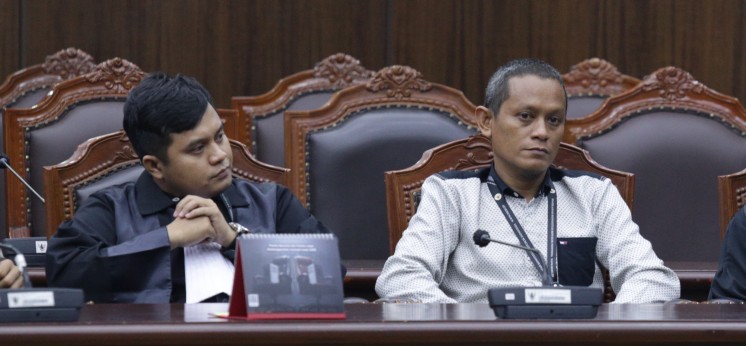
The Petitioner (right) at the ruling hearing for the material review of the Election Law for Case No. 124/PUU-XXIV/2026, Tuesday (5/12/2026). Photo by MKRI/Bayu.
JAKARTA (MKRI) — In its legal considerations for the material review of Article 240 paragraph (1) letter e of Law No. 7 of 2017 on General Elections, filed by Ardi Usman, the Court contends that the Petitioner’s posita consist largely of quotations from links or webpages, without any clear elaboration of legal arguments that adequately and convincingly demonstrates the inconsistency between the norm a quo and the 1945 Constitution. In light of this, the Court encountered difficulty in assessing the alleged contradiction between the norm being challenged and the constitutional provisions invoked as the basis for review.
“Based on such facts and legal considerations, the Court has no doubt in declaring the Petitioner’s petition unclear or vague. Therefore, the Court did not further consider the Petitioner’s petition,” Deputy Chief Justice Saldi Isra emphasized while delivering the Court’s legal considerations at a hearing on Tuesday, May 12, 2026 in the plenary courtroom.
Therefore, handing down the verdict, Chief Justice Suhartoyo emphasized that Petition No. 124/PUU-XXIV/2026 was inadmissible.
Also read:
Lack of Provision on Legislative Candidates’ Education Questioned
Petitioner Requests That Legislative Candidates Have Master’s Degree
At the preliminary hearing on Monday, April 13, the Petitioner argued that as a citizen he has the constitutional right to participate in government and to equal opportunity in people’s representation. However, the lack of provisions on education requirement for legislative candidates has restricted competition in political intellect and integrity, regeneration of leadership without intellect and research, restricted his right to participate without intellect and research, restricted opportunities to join in determining public policies to fit the needs of parliament in alignment with one’s education background.
In his petition, the Petitioner explained the education background of members of parliament (MPs) in several countries. In Iran, Ukraine, and Poland, 100% of the MPs have a master’s degree. In Sweden 82 of the MPs have a bachelor’s degree. In the UK, the number of MPs with a master’s degree is 90%, while 80% of American MPs have a bachelor’s degree.
The Petitioner contended that globally, 78% of legislative members have a bachelor’s degree while 40% have a graduate degree. Meanwhile, Indonesia’s democracy is not intellectual, but an anomaly that is prone to oligarchs. Therefore, he argued, the Constitutional Court as the Guarding of the Constitution has a moral responsibility to break the anomaly.
Explore case No. 124/PUU-XXIV/2026 (in Indonesian).
Author : Sri Pujianti
Editor : N. Rosi
PR : Raisa Ayuditha Marsaulina
Translator : Yuniar Widiastuti (NL)
Disclaimer: The original version of the news is in Indonesian. In case of any differences between the English and the Indonesian versions, the Indonesian version will prevail.
Tuesday, May 12, 2026 | 15:43 WIB 51