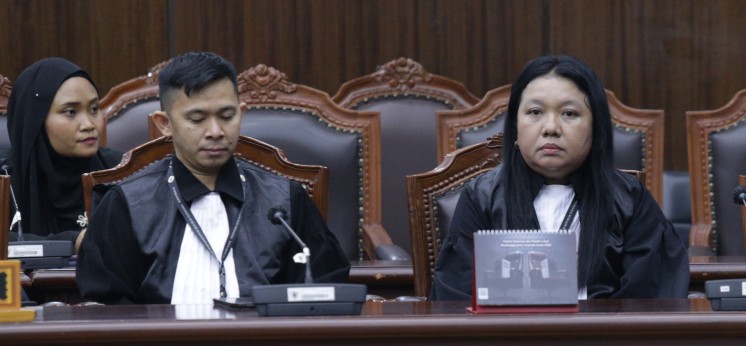
Petitioner’s legal counsel attending the Decision Pronouncement Hearing of Case No. 90/PUU-XXIV/2026 on the material review of Law No. 6 of 2023 on the Stipulation of the Government Regulation in Lieu of Law No. 2 of 2022 on Job Creation to Law on Tuesday (12/5). Photo by MKRI/Bay.
Jakarta (MKRI) – The Constitutional Court (MK) ruled unacceptable in Case No. 90/PUU-XXIV/2026 on the material review of Article 157A paragraphs (1), (2), and (3) of Law No. 6 of 2023 on the Stipulation of Government Regulation in Lieu of Law No. 2 of 2022 on Job Creation. The Court states that it does not find the norms to be a contradiction, as the petitioner argues they conflict with the articles of the 1945 Constitution of the Republic of Indonesia.
“In this case, the Petitioner only challenges the norms in Article 157A paragraphs (1), (2), and (3) of Law No. 6 of 2023 against Article 27 paragraphs (1) and (2) and Article 28D of the 1945 Constitution of the Republic of Indonesia,” Deputy Chief Justice Saldi Isra read out Decision No. 90/PUU-XXIV/2026 on Tuesday, May 12, 2026.
Deputy Chief Justice Saldi said that the entire petition is 18 pages, the posita is only 2,5 pages, and the petition mostly explains the Court’s authorities and the Petitioner’s legal system. Meanwhile, in the posita, the Petitioner only explains the wage payment issue during an industrial relations dispute linked to Constitutional Court Decision No. 168/PUU-XXI/2023, which, according to the Petitioner, provided greater protection to workers.
The Petitioner mentioned Article 27 paragraphs (1) and (2) and Article 28D of the 1945 Constitution, but there was no explanation that pointed out the norm contradiction of Article 157A paragraphs (1), (2), and (3) of Law No. 6 of 2023 against Article 27 paragraps (1) and (2) and Article 28D of the 1945 Constitution. Therefore, the Court is certain that the petition is unclear or vague (obscuur).
Also read:
PT Tiga Cipta Pariwara Challenges Wage Payments During Dismissal Disputes
Petitioner and Counsel Absent from Wage-Dispute Review Hearing
The petition was filed by Linawati Logito, director of PT Tiga Cipta Pariwara. During the preliminary hearing on Wednesday, March 11, 2026, she argued that the obligation to pay wages throughout the process of resolving termination-of-employment (PHK) disputes until a final and binding judgment, as set out in the contested provisions, is difficult to bear in her company’s situation.
“It would be unfair if the duration and amount of wages during proceedings were standardized across all companies, including those carrying out layoffs due to losses, PKPU (suspension of debt payment obligations), and other causes that significantly reduce their ability to pay,” said Grace Bintang Hidayanti Sihotang, the Petitioner’s legal counsel.
Article 157A provides: “(1) During the settlement of an industrial relations dispute, employers and workers/laborers must continue to perform their obligations. (2) Employers may suspend workers/laborers who are in the process of termination of employment while continuing to pay their wages and other entitlements they normally receive. (3) The obligations referred to in paragraph (1) shall continue until the completion of the settlement process of the industrial relations dispute at all levels.”
The Petitioner argues that the amount of wages payable during the settlement of industrial relations disputes should not be applied uniformly to all companies, whether they are making layoffs due to losses, liquidation, or other reasons. She says her company was forced to lay off employees because its finances had been in persistent deficit, leaving it unable to pay employees’ wages.
Losses from 2023 to 2025 were caused by a decline in advertising tenders, as audiences shifted rapidly from television to digital and online media, leading to a steep drop in television advertising projects and audited financial losses, both internally and externally, by public accounting firm Kanel and Partners.
In the case at hand, the Petitioner highlighted the risk posed when a highly paid employee files a termination dispute. If the case proceeds through multiple appeals up to cassation over several years, the obligation to pay wages during proceedings can impose a significant burden on a loss‑making company, a situation she likened to “rubbing salt into the wound.”
The Petitioner maintains that Article 157A paragraphs (1), (2), and (3) in conjunction with Constitutional Court Decision No. 168/PUU-XXI/2023, conflict with Article 27 paragraph (1) of the 1945 Constitution because they tilt too strongly in favor of workers and may invite abuse by bad‑faith parties.
In its petitum, the Petitioner asks the Court to declare unconstitutional and without binding legal force Article 157A, paragraphs (1), (2), and (3), of Law No. 6 of 2023 on Job Creation. She requests that the Court reconsider and avoid standardizing the amount and duration of wages during proceedings for all companies, particularly those implementing layoffs due to financial losses, and that, where termination provisions are regulated in an employment contract, workers must agree to those terms.
Read more: Decision No. 90/PUU-XXIV/2026 (in Indonesian)
Author: Mimi Kartika.
Editor: N. Rosi.
PR: Andhini SF.
Translator: Rizky Kurnia Chaesario
Disclaimer: The original version of the news is in Indonesian. In case of any differences between the English and the Indonesian versions, the Indonesian version will prevail.
Tuesday, May 12, 2026 | 16:55 WIB 62