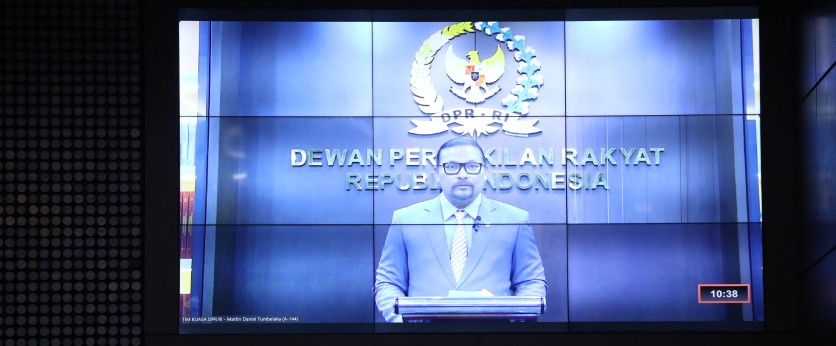
A member of Commission III of the House of Representatives, Martin Daniel Tumbelaka, representing the DPR in the hearing on the judicial review of Law Number 8 of 1999 on Consumer Protection. Photo by MKRI/Panji.
JAKARTA, (MKRI) – The Constitutional Court held a hearing to examine Petition Number 123/PUU-XXIV/2026 concerning the judicial review of Article 8 of Law Number 8 of 1999 on Consumer Protection (Consumer Protection Law), with the agenda of hearing statements from the House of Representatives (DPR) and the President on Tuesday (05/12/2026). Representing the DPR, Commission III member Martin Daniel Tumbelaka stated that Article 8 of the Consumer Protection Law constitutes the core of consumer protection in Indonesia, containing ten categories of substantive prohibitions for business actors and designed to be universal in nature.
“Therefore, it remains relevant and applicable both in conventional transactions and in transactions conducted through electronic systems,” Martin stated via an online channel.
He explained that Article 8 regulates prohibited acts for business actors, covering ten categories of substantive prohibitions, including the prohibition of trading damaged, defective, used, or contaminated goods without complete and accurate information. It also contains an absolute prohibition on the trade of defective or contaminated pharmaceutical and food products, along with the obligation to withdraw such products from circulation.
According to the DPR, the formulation of Article 8 is designed to be universal, making it applicable not only to conventional transactions but also to electronic transactions. The term “business actor” in the provision is broadly defined in Article 1 point 3 of the Consumer Protection Law, encompassing not only conventional businesses but also those operating through electronic systems.
In other words, normatively, Article 8 already covers digital business actors and carries legal implications that such actors are subject to the obligations and prohibitions set out in the Consumer Protection Law. Furthermore, consumer protection is not governed solely by the Consumer Protection Law as a lex generalis, but also by sector-specific regulations related to digital transactions.
The responsibility of electronic system providers in electronic commerce transactions has been comprehensively regulated in other laws, including the Law on Electronic Information and Transactions (ITE Law), the Trade Law, the Personal Data Protection Law, and their implementing regulations, including Government Regulation on Electronic Commerce.
Martin further explained that the allocation of responsibility between business actors and digital platforms follows a distributive justice approach. The responsibility of business actors is regulated under Article 19 of the Consumer Protection Law, while the responsibility of digital platforms is governed under the electronic information and transactions regime, including obligations such as verifying the identity of business actors, providing complaint mechanisms, removing unlawful content after notification, and cooperating with supervisory authorities.
He emphasized that the Applicants’ request for joint and several liability between business actors and digital platforms could instead create new forms of injustice for consumers, business actors, and platforms as the three pillars of the digital commerce ecosystem.
In the context of Article 8, the DPR argued that the absence of explicit provisions on joint liability does not mean consumers lose legal remedies. On the contrary, consumers still have layered legal avenues, including internal dispute resolution mechanisms on platforms (Government Regulation Number 80 of 2019), filing disputes with the Consumer Dispute Settlement Agency (BPSK), initiating class actions under Article 46 of the Consumer Protection Law, or reporting alleged fraud to law enforcement under the ITE Law.
Platform Responsibility
Meanwhile, representing the Government, Director General of Consumer Protection and Trade Compliance Moga Simatupang explained that the issue of joint liability for digital platforms in verifying harmful products has essentially been addressed through existing verification and curation mechanisms implemented by Electronic Commerce Operators (PPMSE).
Such mechanisms include the verification of business actors’ compliance with Indonesian National Standards (SNI) or other mandatory technical requirements, applicable standards in the country of origin for goods not yet subject to mandatory SNI, and halal certification for goods and services that are legally required to be certified.
Read also:
Petitioners Challenge Absence of Mandatory SNI Reference for Consistent Consumer Protection
Questioning the Absence of Consumer Protection in the Digital Space
For context, the petition was filed by five law students challenging Article 8 of the Consumer Protection Law. They argue that the provision creates absolute legal uncertainty for digital consumers by primarily targeting conventional business actors, while in digital reality, consumer harm often arises from the lack of data validation by intermediary platforms.
They contend that Article 8 fails to address marketplace practices where product descriptions can be altered after transactions, undermining the certainty of evidence needed to prove violations under Article 8 paragraph (1) letter f. According to the Applicants, this creates a “legal vacuum” in digital transactions, allowing platforms to claim the status of mere intermediaries to avoid sanctions under Article 62 of the Consumer Protection Law.
The right to legal certainty includes the right to receive goods as promised in advertisements (Article 8 paragraph (1) letter f). However, this norm becomes ineffective without obligations on platforms to automatically remove unlawful products and provide immediate compensation. The static nature of Article 8 hinders proportional justice, particularly where consumer losses are collective but remedies remain individual and weak in bargaining power.
From a constitutional perspective, the Applicants argue that the state fails to provide adequate protection when consumer protection laws are not adaptive to digital fraud mechanisms. Article 8 paragraph (4), which regulates product withdrawal, becomes ineffective in digital ecosystems where authorities lack the power to compel platforms to systematically block non-compliant products.
Legal certainty is further undermined when consumers receive incorrect or empty goods, yet platforms consider transactions complete based solely on delivery notifications without verifying the substance of the goods. The absence of regulation on “algorithm audits” also creates vulnerabilities for consumers who rely on digital markets.
They also argue that Article 8 is not aligned with international developments in e-commerce law, which increasingly emphasize strict liability for electronic system providers. Consumers are forced to bear a heavy burden of proof, particularly for chemical or herbal products that do not meet standards, without adequate platform support.
Finally, the absence of provisions on “consumer protection insurance” highlights the weakness of legal protection in the digital disruption era. Overall, the Applicants argue that Article 8 contradicts Article 28D paragraph (1) of the 1945 Constitution of the Republic of Indonesia (UUD 1945), insofar as it does not impose obligations on digital platforms to validate, supervise, and ensure product compliance.
In their petition, the Applicants request the Court to declare Article 8 of the Consumer Protection Law conditionally unconstitutional, insofar as it is not interpreted to impose absolute obligations and prohibitions on digital marketplace operators, including joint liability for non-compliant goods, inaccurate product information, and ensuring the availability of business identity and transaction data for consumer recovery. They also request that the Elucidation of Article 8 paragraphs (2) and (3) be declared conditionally unconstitutional unless interpreted to require verification and independent curation systems by digital platforms before products are marketed.
Author : Mimi Kartika
Editor : Lulu Anjarsari P.
PR : Raisa Ayuditha M.
Translator : Agusweka PS.
Disclaimer: The original version of the news is in Indonesian. In case of any differences between the English and the Indonesian versions, the Indonesian version prevails.
Case Track: Number 123/PUU-XXIV/2026
Tuesday, May 12, 2026 | 13:01 WIB 177