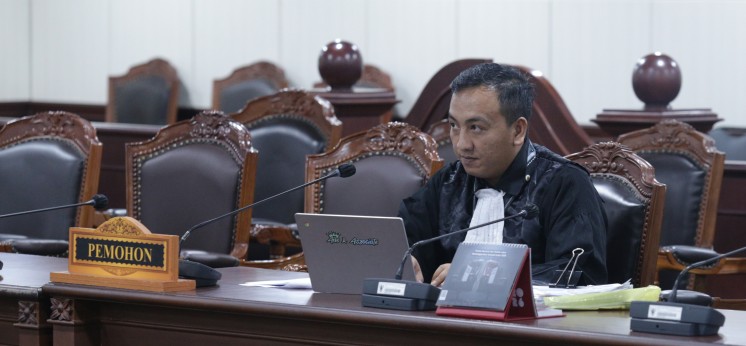
The Applicants attend the Preliminary Examination Hearing of Case Number 160/PUU-XXIV/2026 concerning the Judicial Review of Law Number 1 of 2004 on State Treasury, Monday (05/11/2026), at the Constitutional Court. Photo by MKRI/Bay.
JAKARTA, (MKRI) – Sixteen former employees of the regionally owned enterprise (BUMD) PDAM Tirta Alami, Kepahiang Regency, filed a petition for judicial review of Article 50 of Law Number 1 of 2004 on State Treasury (State Treasury Law). The preliminary hearing to examine Petition Number 160/PUU-XXIV/2026 was held at the Constitutional Court on Monday (05/11/2026), chaired by Deputy Chief Justice Saldi Isra.
Counsel for the Applicants, Muhammad Ade Afriansyah, explained that the provision being challenged has harmed the Applicants’ constitutional rights because it prevents the state from being compelled to implement court decisions. “Thus, Article 50 directly causes court rulings to lose their effectiveness and enforceability. This shows that the state may lose in court, yet legally cannot be compelled to execute the decision,” Ade stated.
The Applicants claim to have suffered constitutional losses, including not receiving salaries for approximately four years, unilateral termination, having obtained final and binding decisions from the Industrial Relations Court (PHI), yet being unable to execute those decisions due to Article 50 of the State Treasury Law.
According to the Applicants, Article 50 is not merely an administrative provision, but a norm that directly prohibits the seizure of state assets, which in practice constitutes the only mechanism for enforcing court decisions, thereby closing all avenues for execution. Consequently, Article 50 renders court rulings ineffective and unenforceable. This condition reflects what they describe as “state immunity against judicial enforcement,” which is clearly contrary to the principles of equality before the law, supremacy of law, and legal certainty.
Therefore, in their petition, the Applicants request the Court to declare Article 50 of the State Treasury Law conditionally unconstitutional, insofar as it is not interpreted as inapplicable to the enforcement of final and binding court decisions, particularly those concerning the fulfillment of wage rights of employees in state-owned and regionally owned enterprises (BUMN/BUMD).
In response, Constitutional Justice Adies Kadir advised the Applicants’ counsel to immediately submit the powers of attorney from the Applicants, as this constitutes a formal requirement for representation. “Make sure you retrieve and submit those powers of attorney after the hearing—do not wait until tomorrow,” Adies emphasized.
Adies further instructed the Applicants to include the names of all sixteen Applicants in the petition document. In addition, the Applicants were asked to clearly specify whether they are challenging the entire provision or only certain parts, and to elaborate on the constitutional losses resulting from the implementation of the challenged norm.
“Regarding the description of losses, do not merely present facts such as unpaid salaries, unilateral dismissal, or inability to execute judgments. These must be linked to violations of constitutional rights,” Adies stated, adding that the Applicants must also clearly explain how the challenged provision conflicts with the 1945 Constitution of the Republic of Indonesia (UUD 1945).
Subsequently, Constitutional Justice Liliek P. Adi advised the Applicants to further elaborate the posita of their petition. Liliek questioned whether execution had been pursued before the Industrial Relations Court and requested a more detailed explanation of the issues raised, as well as a review of similar petitions.
Meanwhile, Deputy Chief Justice Saldi Isra advised the Applicants to study the procedural law of the Court as stipulated in Constitutional Court Regulation Number 7 of 2025 concerning Procedures in Judicial Review Cases (PMK 7/2025). He emphasized that the petition must clearly identify the Applicants and the reasons for filing the petition.
“Once you have listed them, explain who each Applicant is—from Applicant one to sixteen. We do not yet understand why these individuals are filing the petition, what their legal standing is, and which constitutional rights are allegedly violated by Article 50,” Saldi advised.
Saldi further emphasized that the Court does not adjudicate the Applicants’ concrete cases, but rather assesses whether the challenged norm is in conflict with the Constitution. The concrete experiences of the Applicants serve only to establish legal standing.
Finally, Saldi informed that the Applicants are granted 14 days to revise their petition. The revised petition must be submitted either offline or online to the Registrar’s Office of the Court no later than Monday (05/25/2026) at 12:00 WIB. Revisions may only be submitted once within the allotted period.
Author : Ilham Wiryadi Muhammad
Editor : N. Rosi.
PR : Raisa Ayuditha M.
Translator : Agusweka PS.
Disclaimer: The original version of the news is in Indonesian. In case of any differences between the English and the Indonesian versions, the Indonesian version prevails.
Case Track: Number 160/PUU-XXIV/2026
Monday, May 11, 2026 | 16:42 WIB 24