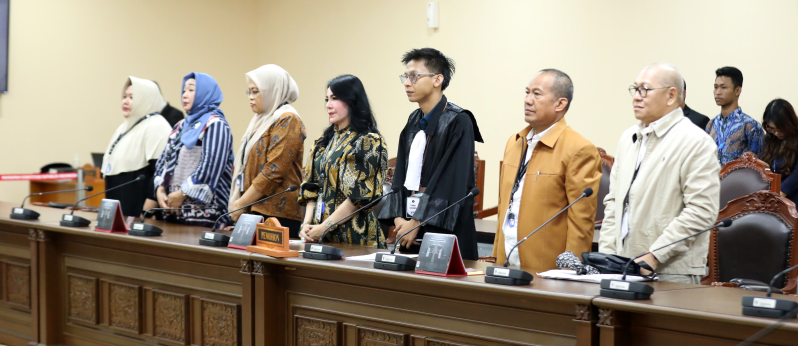
Petitioners, accompanied by legal counsel, attending the preliminary hearing to examine the revised petition of Case No. 140/PUU-XXIV/2026. Photo by MKRI/Fauzan.
Jakarta (MKRI) – The Constitutional Court (MK) held a material review hearing of Article 13 of Law No. 30 of 2004 on Notary as amended by Law No. 2 of 2014 on the Amendment to Law No. 30 of 2004 on Notary (Notary Law) on Monday, May 11, 2026. The second hearing of the case filed by Askanah (Petitioner I), Wakiyo (Petitioner II), and five other petitioners was scheduled to hear the main points of their revised petition. The hearing was presided over by Justice Enny Nurbaningsih, along with Justices Ridwan Mansyur and Arsul Sani.
The main points of the revised Petition No. 140/PUU-XXIV/2026 were conveyed by legal counsel Syamsul Jahidin, who attended the hearing online. He mentioned that there was an addition to the number of Petitioners, Petitioner III to Petitioner VII. Revision was also made on the explanation of the legal standing and constitutional harm, supplemented by the Decree of Appointment as Notary as evidence.
“To declare Article 13 of the Notary Law unconstitutional and has no legally binding force, as long as it is not interpreted as “A Notary shall be dishonorably dismissed by the Minister if he or she is sentenced to imprisonment, pursuant to a court decision that has obtained permanent legal force, to a term of five (5) years or more,” Tri Setiawan read out the petitum on the Panel Courtroom.
Also read:
The Lack of Firm Sanctions for Notaries Accused of Crimes Punishable by Under Five Years
During the preliminary hearing on Monday, April 27, 2026, the Petitioners argued that Article 13 of the Notary Law, particularly the phrase “committing a criminal offense punishable”, violates their constitutional rights. Article 13 of the Notary Law states, “A Notary shall be dishonorably dismissed by the Minister if he or she is sentenced to imprisonment, pursuant to a court decision that has obtained permanent legal force, for committing a criminal offense punishable by imprisonment for five (5) years or more.”
Syamsul Jahidin mentioned that the Notary Law provides supervisory mechanisms through the Notary Supervisory Council to oversee notaries in the performance of their duties and exercise of their authorities. Among the authorities stipulated in Article 73, paragraph e, of the Notary Law is the imposition of sanctions, including oral and written warnings. The application of administrative sanctions and law enforcement instruments under the Notary Law includes preventive (supervision) and repressive actions (sanctions).
However, the challenged norm does not include sanctions for a notary accused of a criminal offense punishable by less than five years. This creates opportunities for the supervisory authorities over notaries to abuse their powers, exposing notaries facing criminal proceedings to potential extortion by those supervisors.
Case tracking: Petition No. 140/PUU-XXIV/2026
Author: Sri Pujianti.
Editor: N. Rosi.
PR: Adriana.
Translator: Rizky Kurnia Chaesario
Disclaimer: The original version of the news is in Indonesian. In case of any differences between the English and the Indonesian versions, the Indonesian version will prevail.
Monday, May 11, 2026 | 18:22 WIB 34