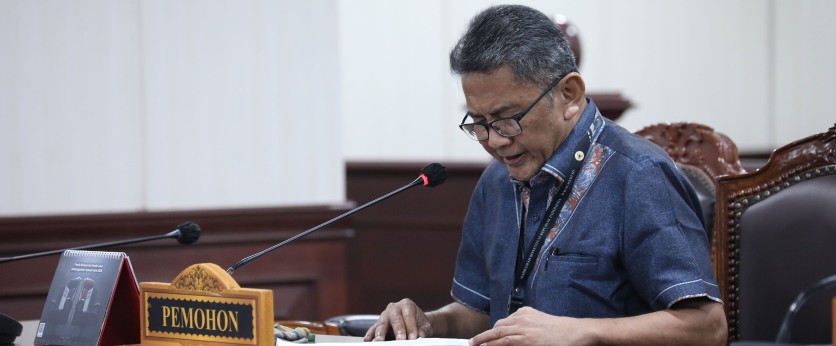
Nico Indra Sakti, the petitioner in the judicial review of Law No. 1 of 1974 on Marriage (Marriage Law), presented the main arguments of his petition during a hearing held in the Panel Courtroom on Thursday (May 7, 2026). Photo: MKRI/Panji
JAKARTA, MKRI – A retiree of a state-owned bank, Nico Indra Sakti, has filed a petition for a judicial review of Article 29 paragraphs (1), (3), and (4) of Law No. 1 of 1974 on Marriage (Marriage Law), as construed in the Decision No. 69/PUU-XIII/2015. The Petitioner seeks the replacement of the term marriage agreement in the challenged provisions with the term marital legal bond.
“Replacing the term agreement in the Marriage Law with legal bond,” Nico stated during the preliminary examination hearing of Case No. 156/PUU-XXIV/2026 at the courtroom in Jakarta on Thursday (May 7, 2026).
The Petitioner argued that an agreement is made before or at the time of marriage, when the parties are not yet bound by the marital relationship. A prenuptial agreement executed prior to marriage only gives rise to a legal bond concerning the separation of marital assets upon the ratification of the agreement a quo and the occurrence of the marriage itself.
According to the Petitioner, a prenuptial agreement executed at the time of marriage immediately creates a legal bond regarding the separation of marital assets, demonstrating that any alteration of a legal bond as a legal event must be effected through a new legal event in order to be enforceable against interested third parties. Such a change, he contended, cannot be accomplished solely through a contractual act, which does not bind third parties. The Petitioner maintained that once the legal event of marriage takes place, the prenuptial agreement, upon being ratified and recorded by the marriage registrar, is transformed into and gives rise to a legal bond governing the separation of marital property.
The transformation of an agreement made before marriage into a legal bond concerning the separation of joint property, the Petitioner argued, constitutes the proper legal procedure for regulating marital property relations under the Marriage Law. In his view, this demonstrates a significant distinction between a legal bond as a legal event and an agreement as a legal act, the latter of which may be amended through a relatively simple mechanism, such as an addendum.
In his petition, the Petitioner requests the Court to declare that Article 29 paragraph (1) of Law No. 1 of 1974 is contrary to the 1945 Constitution and has no binding legal force unless construed to mean: “At the time of, before, or during the marital bond, both parties, upon mutual consent, may enter into a written agreement ratified by the marriage registrar or a notary, after which its contents shall also apply to third parties insofar as such third parties are concerned.”
The Petitioner further requests the Court to declare that Article 29 paragraph (3) of the Marriage Law is contrary to the Constitution and has no binding legal force unless construed to mean: “Such agreement shall take effect upon the solemnization of the marriage, unless otherwise stipulated in the Marriage Agreement.”
In addition, he requests the Court to declare that Article 29 paragraph (4) of the Marriage Law is contrary to the Constitution and has no binding legal force unless construed to mean: “During the marriage, a marriage agreement concerning marital property or other matters may not be amended or revoked, except where both parties consent to such amendment or revocation, and provided that the amendment or revocation does not prejudice the rights of third parties.”
The petition was examined by a Panel of Justices chaired by Chief Justice Suhartoyo, accompanied by Constitutional Justice Daniel Yusmic P. Foekh and Constitutional Justice M. Guntur Hamzah. During the advisory session, Daniel stated that the Petitioner should provide stronger arguments explaining the alleged inconsistency between the challenged provisions and the constitutional provisions serving as the benchmark for review, particularly because the provisions had previously been interpreted by the Court in an earlier decision.
“Since this is a provision that has already been construed by the Court, the petition must be supported by stronger and more persuasive arguments in order to convince the Justices to consider granting the requested relief,” Daniel said.
Before adjourning the hearing, Chief Justice Suhartoyo informed the Petitioner that he was granted a single opportunity to revise the petition within 14 days. Both the electronic and hard-copy versions of the revised petition must be submitted to the Court no later than Wednesday, May 20, 2026, at 12:00 p.m.
Author : Mimi Kartika
Editor : N. Rosi
PR : Raisa Ayuditha M.
Translator : Nies Lindy
Explore Case No. 156/PUU-XXIV/2026
Disclaimer: The original version of the news is in Indonesian. In case of any differences between the English and the Indonesian versions, the Indonesian version will prevail.
Thursday, May 07, 2026 | 17:11 WIB 3