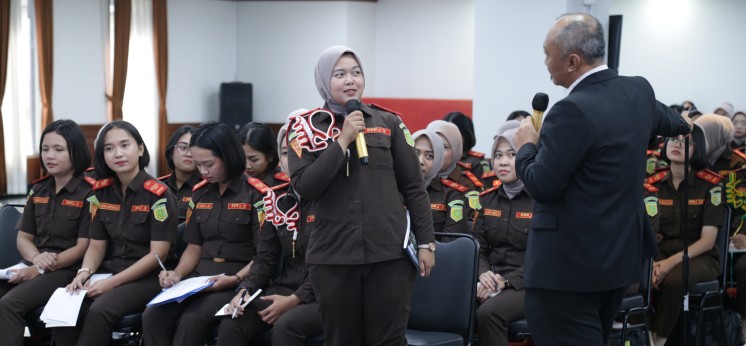
Representatives of the Attorney General’s Office Education and Training Agency attending an academic visit to the Constitutional Court, Thursday (7/5/2026). Photo by MKRI/Bay.
JAKARTA (MKRI) — Participants of the 2026 Prosecutor Formation Education and Training Program Batch LXXXIII, Wave I, of the Attorney General’s Office paid an academic visit to the Constitutional Court on Thursday, May 7, 2026. The visit marked the final day of a series of academic visits conducted in turns over three consecutive days at the Court.
The participants were received by the Head of the Public Relations and Protocol Bureau, Pan Mohamad Faiz, who expressed his appreciation for the visit. In his welcoming remarks, Faiz underscored the importance of constitutional understanding for aspiring law enforcement officers, particularly prosecutors, as part of broader efforts to uphold the rule of law and constitutional democracy in Indonesia.
The participants then attended a presentation delivered by Legal Analyst Syamsudin Noer, who provided a comprehensive explanation of the Constitutional Court’s position as one of the state institutions exercising judicial power pursuant to Articles 24 and 24C of the 1945 Constitution. He explained that the Court has the authority to conduct judicial review of laws against the 1945 Constitution, adjudicate disputes concerning the constitutional authority of state institutions, decide on the dissolution of political parties, settle disputes over general election results, and render decisions on opinions of the House of Representatives (DPR) regarding alleged violations committed by the President and/or Vice President.
“I believe all of you are already familiar with the legal basis. Therefore, I would like to focus on the Constitutional Court’s authority, particularly its power to review laws against the 1945 Constitution,” Syamsudin said.
He further elaborated on the stages of constitutional case proceedings, beginning with the filing of a petition, followed by preliminary examination, panel hearings, plenary hearings, and ultimately the pronouncement of final and binding decisions. Syamsudin also outlined several key principles governing the Court’s procedural law, including open court proceedings, the independence of constitutional justices, and the implementation of judicial proceedings that are simple, expeditious, and free of charge.
In addition to delivering the presentation, the speaker actively engaged participants through questions and discussions, creating an interactive and dynamic learning environment. The participants enthusiastically responded to the questions and took part in lively two-way discussions throughout the session. During the visit, they gained valuable insights to support their future law enforcement duties grounded in constitutional values and justice.
Following the presentation and discussion session, the participants continued their visit to the Constitutional History Center (Puskon). There, they observed various displays and dioramas depicting the history of Indonesia’s constitution, the development of the nation’s constitutional system, and the evolution of the 1945 Constitution and its amendments over time. The visit concluded the program by providing participants with a firsthand learning experience on Indonesia’s legal and constitutional history.
Author: Adriana
Editor: Tiara Agustina
Translator: Mauliza Ara Rizki/Yuanna Sisilia
Disclaimer: The original version of the news is in Indonesian. In case of any differences between the English and the Indonesian versions, the Indonesian version will prevail.
Thursday, May 07, 2026 | 15:58 WIB 3