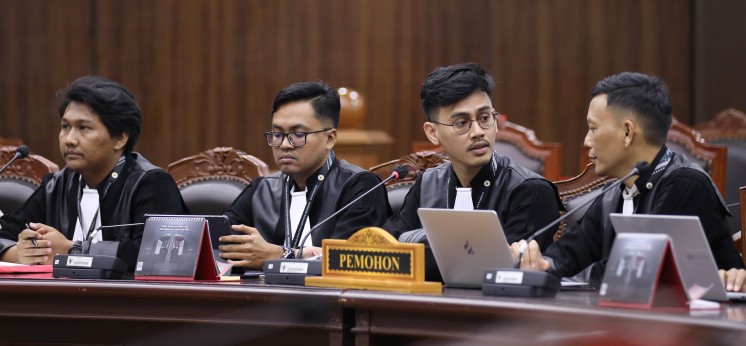
Petitioner's Legal Counsel attending Preliminary Panel Hearing for judicial review of Law No. 18 of 2003 on Advocates, Thursday (5/7/2026). Photo by MKRI/Ifa.
JAKARTA (MKRI) – An advocate named Yayang Nanda Budiman has filed a petition to challenge the phrase "inappropriate" in Article 6 letter b of Law No. 18 of 2003 on Advocates (the Advocates Law) with the Constitutional Court (MK). The preliminary hearing to review Petition No. 152/PUU-XXIV/2026 was held at the Constitutional Court on Thursday, May 7, 2026.
In detail, Article 6 letter b of the Advocate Law states: "Advocates may be subject to action for the following reasons: ..., b) acting or behaving inappropriately towards their opponents or colleagues."
During the hearing, Petitioner argued that the norm lacks clear boundaries, thus leading to multiple interpretations. He stated that as an advocate, his daily duties are never free from argumentative dynamics with fellow advocates on opposing sides. He further explained that in advocating for clients' interests, he often engages in assertive, harsh, and even high-pitched communication as part of his professional strategy. With the advancement of communication technology, differences of opinion also frequently occur on social media, both in written and audio-visual forms.
According to the Petitioner, Article 6 (b) of the Advocates Law doesn’t provide a clear definition of "improper" conduct, thus potentially leading to subjective interpretations. "This unclear norm has the potential to give rise to subjective, multiple, and diverse interpretations, both by the complainant, the Advocates Organization, and the Advocates Honorary Council," said Ihsan Firmansyah, the Petitioner's Legal Counsel, during the hearing.
Consequently, according to the Petitioner, any form of legal debate between advocates has the potential to be interpreted as "improper" conduct. The Petitioner also believes that this norm could hinder advocates' freedom to express their opinions and defend their clients legally.
Petitioner believes there should be clear, measurable, and objective boundaries for what constitutes "inappropriate" behavior, thus eliminating the possibility of subjective interpretation. According to Petitioner, such regulations are necessary not to limit advocates' freedom of expression, but rather to provide legal certainty and protect advocates from potential criminalization or unfounded reporting.
Therefore, in the petitum, Petitioner requested the Court to declare Article 6 letter b of the Advocate Law contrary to the 1945 Constitution of the Republic of Indonesia (UUD NRI) and has no conditional binding legal force as long as it is not interpreted as, "Advocates can be subject to action on the reasons of: ... b) acting or behaving inappropriately which objectively and measurably constitutes a violation of moral norms, decency, or public order, and meets the qualifications of violations as expressly regulated in the Advocate Code of Ethics against opponents or colleagues in the profession."
Justice's Advice
Regarding the petition, Constitutional Justice Arsul Sani provided several recommendations for revision to the Petitioner, including a closer look at the legal standing section. Justice Arsul noted that the Petitioner had not personally experienced any constitutional loss due to the implementation of the norm being reviewed. Therefore, the Petitioner was advised to argue for a potential constitutional loss that could be confirmed to have occurred to the Petitioner. To substantiate this loss, the Petitioner could provide examples of consequences experienced by fellow advocates who have experienced similar outcomes.
Justice Arsul also advised the Petitioner to reread the Indonesian Advocates' Code of Ethics. "We've read the provisions in Chapter IV, entitled 'Relationships with Colleagues,' Article 5. That's not enough. You have to argue for it, which means you have to review Article 5 of the Indonesian Advocates' Code of Ethics," Justice Arsul said.
Furthermore, Justice Arsul suggested that the Petitioner explain why the interpretation is a norm of morality, decency, or public order, and qualify the violation. Justice Arsul asked that what constitutes a norm of decency could differ from region to region, as norms of decency are not specific.
Constitutional Justice Ridwan Mansyur then, in his advice, asked the Petitioner to review other petitions challenging the Advocates Law to see if any were similar to this petition. Furthermore, he asked the Petitioner to further explain the Petitioner's legal standing and the extent of the loss of his constitutional rights.
"You should be able to explore this further and contest it, considering the constitutional rights violations contained in this article," said Justice Ridwan.
Justice Ridwan then highlighted the Petitioner's constitutional losses. "I see you've outlined this for seven pages, but it hasn't even surfaced yet. You've even mentioned the potential for multiple interpretations, and you haven't even outlined it yet, and then suddenly, you mention the potential losses," Justice Ridwan said.
Therefore, according to Justice Ridwan, the Petitioner needs to provide adequate arguments to explain what potential losses will definitely occur and what the causal relationship is with the implementation of this norm.
Finally, Constitutional Justice Enny Nurbaningsih, who presided over the hearing, briefly asked the Petitioner to adjust the mention of his identity in accordance with the Constitutional Court Regulations. Regarding the legal standing, Justice Enny noted several repetitions contained in the section. Crucially, according to Justice Enny, the Petitioner must be able to prove the loss of her constitutional rights guaranteed by the constitution, and what just legal certainty was harmed by the enactment of the norm. Justice Enny noted that this explanation was missing from the petition.
"Please explain where this legal uncertainty lies, leading you to feel your rights have been violated by the enactment of this norm. Be specific and specific. If possible, be specific and actual, hopefully. If not, as mentioned earlier, it's potentially certain to occur based on reasonable reasoning," Justice Enny said.
Furthermore, Justice Enny added, in the posita section, the Petitioner must be able to clearly explain why the interpretation referred to in the petitum should be given. This will provide a strong argumentative basis to convince the Constitutional Justices.
Before closing the hearing, Justice Enny informed the Petitioner that the revisions could be made within 14 days. Both soft and hard copies of the revised Petition must be submitted to the Court's Registrar's Office no later than Wednesday, May 20, 2026, at 12:00 p.m. WIB.
Track case No. 152/PUU-XXIV/2026
Author : Ilham Wiryadi Muhammad
Editor : N. Rosi
PR : Andhini S.F.
Translator : Donny Yuniarto
Disclaimer: The original version of the news is in Indonesian. In case of any differences between the English and the Indonesian versions, the Indonesian version will prevail.
Thursday, May 07, 2026 | 18:30 WIB 27