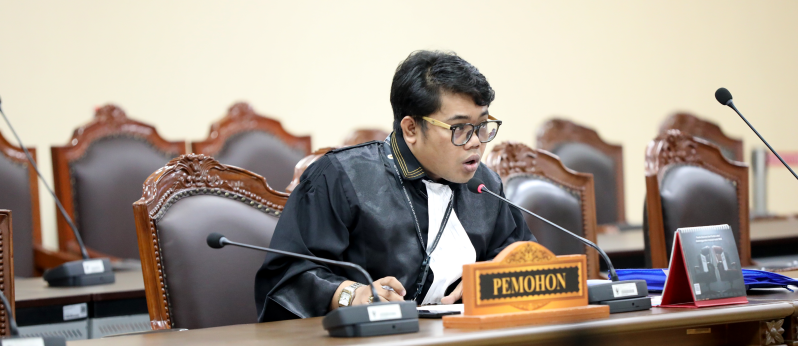
Christian Adrianus Sihite delivering his petition on the material review of Law No. 20 of 2025 on the Criminal Procedure Code (KUHAP) to the Constitutional Court. Photo by MKRI/Fauzan.
Jakarta (MKRI) – Christian Adrianus Sihite requested a material review of Law No. 20 of 2025 on the Criminal Procedure Code (KUHAP) to the Constitutional Court (MK). The preliminary hearing of Case No. 157/PUU-XXIV/2026 was held on Thursday, May 7, 2026, at the Panel Courtroom, heard by Deputy Chief Justice Saldi Isra, along with Justices Adies Kadir and Liliek P. Adi. The Petitioner stated that Article 170 paragraph (2) of the KUHAP contradicts Article 27 paragraph (1) and Article 28D paragraph (1) of the 1945 Constitution of the Republic of Indonesia.
Article 170 paragraph (2) of the KUHAP reads, “In the event that the criminal offense as referred to in paragraph (1) has its primary harm focused on military interests, such a case must be examined and adjudicated by a court within the military judicial system.”
Christian Adrianus Sihite (Petitioner) stated that, as an advocate, he has the obligation to provide his client, especially the victim, with the fullest legal defense to protect his/her interests and to ensure that the case is brought to the proper court. However, the norm focuses solely on the perpetrator’s status and does not consider the victim and the harm he/she suffers. Therefore, the Petitioner cannot be certain that his client’s case will be examined in a court that will most effectively protect the victim.
In a case involving military personnel, it is most likely to be brought to the military court. Meanwhile, his client is a civilian who, in principle, is entitled to transparency in the court’s procedure and equivalent access, as well as optimum protection. However, in such a situation, the Petitioner faces restrictions in carrying out his function to provide effective assistance, in terms of access, process control, and victim participation.
“Conceptually, the essence of a criminal case is the action that causes harm or suffering to the victim; however, Article 170 paragraph (1) of Law No. 20 of 2025 on the Criminal Procedure Court only involves the perpetrator without considering the victim's status and loss in determining the type of court. Therefore, considering the perpetrator as the sole basis of analysis is a reduction to the criminal offense itself,” Christian stated.
The uncertainty of the norm means the type of court cannot be determined from the outset. Therefore, the Petitioner cannot develop a proper legal strategy or determine the optimal evidentiary approach, and may risk his client's position. Meanwhile, as an advocate, he has a professional responsibility to provide the best legal service and ensure maximum protection for his clients. Due to the implementation of the tested norm, the Petitioner cannot guarantee the quality of defense he should provide, which directly harms the professionalism and integrity of the profession.
In the petitum, the Petitioner requests the Court to declare Article 170 paragraph (1) of the KUHAP conditionally unconstitutional as long as it is not interpreted as “Criminal offenses committed jointly by persons subject to the general court jurisdiction and persons subject to the military court jurisdiction, and/or involving civilian victims or causing harm to civilians, shall be examined and adjudicated by a court within the general judicial system.”
Constitutional Harm
During the advisory session, Justice Adies Kadir stated that the Petitioner needs to elaborate on the constitutional harm he suffers and the enactment of the tested norm. “You need to elaborate on the five prerequisites of the constitutional harm. Generally, in the petition, there is a contestation, but still in general. So, it needs to be explained against the tested articles,” Justice Adies said.
Justice Liliek P. Adi asked the Petitioner to explain the constitutional harm as an advocate. “Elaborate more on the constitutional harm when defending clients who are also tried in the general courts. What is the contradiction between the article and the constitutional harm,” Justice Liliek asked.
Deputy Chief Justice Saldi Isra requested the Petitioner to strengthen his legal standing. “Because this is still a potential harm. So, which constitutional right is violated, and it should be revised,” Deputy Chief Justice Saldi explained.
Before adjourning, Deputy Chief Justice Saldi stated that the Petitioner was given 14 days to revise the petition. The revised petition must be submitted no later than Wednesday, May 20, 2026, at 12 noon Western Indonesian Time. The Court will schedule the second hearing to examine the revised petition.
Case tracking: Petition No. 157/PUU-XXIV/2026
Author: Sri Pujianti.
Editor: N. Rosi.
PR: Fauzan F.
Translator: Rizky Kurnia Chaesario
Disclaimer: The original version of the news is in Indonesian. In case of any differences between the English and the Indonesian versions, the Indonesian version prevails.
Thursday, May 07, 2026 | 15:51 WIB 91