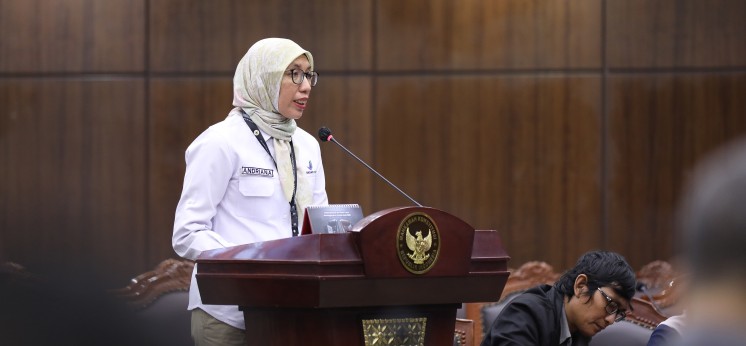
Andriana Krisnawati, representing the BPOM, delivering testimony as a Related Party in a resumed hearing on the judicial review of the Patent Law on Wednesday (06/05) at the Courtroom. Photo by MKRI/Ifa.
Jakarta (MKRI) – The Constitutional Court held a material review hearing on Article 4 and the phrase “interested parties” in Article 70 paragraph (1) of Law No. 65 of 2024 on Patent (Patent Law) to hear testimony from Related Parties: National Agency of Drug and Food Control (BPOM) and the Indonesian Consumers Agency Foundation (YLKI) on Wednesday, May 6, 2026. BPOM explained the relations between drug registration and intellectual property rights.
BPOM highlighted the concept of Bolar provision as an important instrument within the Indonesian health and pharmacy legal framework. This policy is an exception to the patent holder's exclusive rights, allowing generic drug producers to use a drug whose invention is still under patent for research, development, and preparation for registration (bioequivalence testing) before the patent expires.
“The purpose is to expedite the availability of affordable generic drugs immediately after the innovation patent expires,” Andriana Krisnawati, the Head of Legal and Organization Bureau from BPOM, stated at the Plenary Courtroom, Jakarta.
Normatively, the provision of Article 167, letter b, of the Patent Law allows exceptions to patent use for the purpose of research, testing, and analysis to obtain a marketing authorization for a medicine. This provision serves as the legal basis for implementing the Bolar provision in Indonesia, enabling pharmacy businesses, especially generic drug producers, to prepare for registration before the patent expires.
In line with this, within the framework of technical regulations, through Article 21 of the BPOM Regulation No. 24 of 2017 on the Criteria and Procedures of Drug Registration, BPOM lays down the mechanism and transitional stages from patented drugs to generic drugs, including in relation to the preparation of applications for marketing authorization, by stipulating that an application for marketing authorization for the first generic drug with an active substance that is still protected by a patent may be submitted five years before the expiry of the patent protection by an applicant who is not the patent holder, on the condition that the marketing authorization will be issued only after the patent protection period has ended. Accordingly, it can be understood that the regulatory framework in the field of patents and the policy on drug registration are mutually complementary.
This regulation ensures that, after patent expiry, generic drugs may immediately obtain marketing authorization and be available to the public without legal obstacles, thereby guaranteeing the principle of public accessibility and affordability. The BPOM provision on drug registration, in principle, accommodates the Bolar concept, as reflected in the technical regulations for drug registration, which enable preparation to submit a marketing authorization before the patent expires.
This regulation is in line with the provisions of the Patent Law, especially as stipulated in the Elucidation of Article 167 letter b, which provides an exception to the exercise of the patent holder's exclusive rights for the purpose of research, testing, and analysis to obtain marketing authorization. Although the provision on the specific five-year time limit before the patent's expiration is no longer explicitly stated, the substance of the exception remains in effect. Therefore, normatively, the BPOM drug registration policy remains in line with the Bolar principle under Indonesian patent law.
Andriana further stated that the regulation on drug registration is closely related to the patent protection system, especially regarding the exercise of the Bolar provision, which remains accommodated in Law No. 65 of 2024 and BPOM Regulation No. 24 of 2017. Although the technical aspects, for example, the time limit, are no longer stated, the exception, as reflected in Article 67 letter b provides businesses with the opportunity to prepare drug registration before the expiration of the patent.
Along with that, the BPOM drug registration policy, especially Article 21 of the BPOM Regulation No. 24 of 2017, also regulates the transition mechanism from a patent to a generic drug, so that both of those systems at the end support the acceleration of safe, high-quality, and affordable generic drug availability without undermining patent protection,” Andriana stated.
Access to Drugs
Representing YLKI as an expert, Sudaryanto stated that there are at least two important issues related to the intellectual property rights and consumer interest. First, copyright and access to knowledge. Copyright often creates obstacles to access to knowledge, especially in developing countries. Therefore, an exception to copyright is essential for education, research, and libraries.
Secondly, patent law and access to drugs. Patent law, especially in the pharmaceutical industry, significantly limits access to drugs by creating temporary monopolies, leading to high prices and limited availability. On the other hand, consumers have the right to access essential goods and services, including drugs.
Access to drugs is an essential part of human rights to health. However, Sudaryanto stated that one-third of the world's population has poor access to medical services, high prices, and poor-quality, inaccurate services.
“Patients in poor countries often receive minimal or no benefit of healthcare,” Sudaryatmo said.
He asserted that essential drugs must be accessible to everyone and that it needs a functional healthcare system and good infrastructure. Pharmaceutical industries are also responsible for the limited access to drugs.
Patent regulation derives from the Trade-Related Aspects of Intellectual Property Rights (TRIPS) Agreement under the WTO, adopted in 1994, which stated that there should be a patent for the drug, not only its production process. This gives patent holders the right to manufacture exclusively for 20 years, during which time prices skyrocket, making it unavailable in poor societies.
The Doha Declaration in 2001 ensured that the government issues a mandatory license on patented drugs or takes steps to protect public health. However, importing parallel in other countries often leads to stringent trade sanctions, rendering this instrument ineffective.
Also read:
Also read:
Coalition for Patient Rights Advocacy for Access to Medicines Challenges Patent Law
Petitioners Revise Petition to Challenge Patent Law Concerning Access to Medicines
Patent Protection Rules Do Not Only Protect Inventors
Govt: Patent Law Framework Ensures Legal Certainty and Drives Drug Innovation
The petitioners of the case comprise the Indonesian Dialysis Patient Community Association (as Petitioner I), the Indonesian Drug Abuse Victims Association (PKNI) (as Petitioner II), the Indonesian Pulmonary Hypertension Foundation (YHPI) (as Petitioner III), the Indonesian Care Foundation (as Petitioner IV), the Indonesian Positive Women's Association (IPPI) (as Petitioner V), the Indonesian Association for Global Justice (as Petitioner VI), Patrick Johanes Laurens Nangka (as Petitioner VII), Irwandy Widjaja (as Petitioner VIII), Lusiana Aprilawati (as Petitioner IX), and Paran Sarimita Winarni (as Petitioner X).
During the preliminary hearing on Wednesday, December 17, 2025, the Petitioners argued that the removal of Article 4 letter f of Law No. 13 of 2016 on Patents through the Patent Law had eliminated legal protection for the public. The deleted provision previously excluded new uses of existing products and new forms of old compounds that did not provide a meaningful improvement in the properties of patentable objects.
According to the Petitioners, this change contradicts Article 28D paragraph (1) of the 1945 Constitution, which guarantees fair legal certainty, and Article 28H paragraph (1) of the 1945 Constitution, which guarantees the right to health. They further argued that Article 4, letter f, of the Patent Law protects the public and provides legal certainty by preventing low-quality patent applications that are intended solely to secure monopolies for a handful of large corporations. Low-quality patent applications certainly have the potential to violate the constitutional rights of the public, including the Petitioners, to guaranteed protection and legal certainty regarding the requirements for inventions that can be patented, particularly in the field of pharmaceuticals/medicines. (*)
Case tracking: Petition No. 255/PUU-XXIII/2025 (in Indonesian)
Author: Utami Argawati
Editor: Lulu Anjarsari P.
PR: Raisa Ayuditha Marsaulina
Translator: Rizky Kurnia Chaesario
Disclaimer: The original version of the news is in Indonesian. In case of any differences between the English and the Indonesian versions, the Indonesian version will prevail.
Wednesday, May 06, 2026 | 13:41 WIB 100