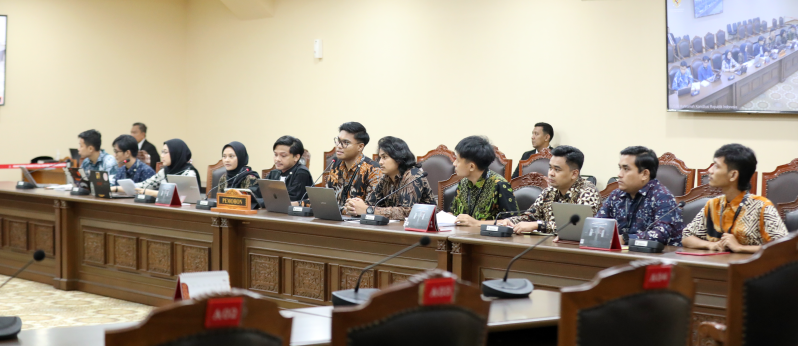
Legal counsels Achyat Daroini and partners with Petitioners delivering the petition against the Emergency Law for Case No. 151/PUU-XXIV/2026, Wednesday (5/6/2026). Photo by MKRI/Fauzan.
JAKARTA (MKRI) — Six citizens have filed a petition for judicial review of Government Regulation in Lieu of Law No. 23 of 1959 on the Revocation of Law No. 74 of 1957 and the Declaration of a State of Emergency before the Constitutional Court. They are Sahlul Lubis, Jumhadi, M. Rio Dozan, Lona Armevilia, Faly Antary Musaad, and Muhamad Fery Agung Gumelar (Petitioners I-VI). The preliminary examination hearing for Case No. 151/PUU-XXIV/2026 was presided over by Deputy Chief Justice Saldi Isra (chair) alongside Constitutional Justices Adies Kadir and Liliek P. Adi on Wednesday, May 6, 2026 in one of the Court’s panel courtrooms.
The Petitioners challenge the constitutionality of Article 1 paragraphs (1) and (2), Article 2 paragraph (1), Article 3 paragraph (2), Article 4 paragraph (1), Article 5 paragraph (1), Article 6 paragraph (1), Article 33, Article 37 paragraph (3), Article 41 Point 1, Article 43 paragraph (5), Article 54, General Elucidation Point 2, and the General Elucidation to Article 1 of the Law a quo, which they argue are inconsistent with the 1945 Constitution. The challenged provisions are alleged to contravene Article 7A, Article 11 paragraph (1), Article 18 paragraph (1), Article 20A paragraph (1), Article 24 paragraph (1), Article 24C paragraph (2), Article 27 paragraph (3), Article 28A, Article 28C paragraph (2), Article 28D paragraph (1), Article 28G paragraph (1), Article 28I paragraph (1), and Article 30 paragraph (2) of the 1945 Constitution.
The Petitioners argued that following the third amendment to the 1945 Constitution, sovereignty vested in the people is no longer exercised by the People’s Consultative Assembly (MPR), but rather in accordance with the Constitution. In addition, the president is no longer elected by the MPR, but directly elected by the people through general elections.
The Petitioners acknowledged that the elimination of the House’s supervisory function during a state of emergency does not constitute a direct constitutional loss to them because they are not members of the House. However, they argued that the loss of such supervisory authority adversely affects them because they would be required to submit to all orders issued by the emergency authority. The Petitioners therefore expect the House, as the people’s representative elected through general elections, to be able to exercise its oversight function in order to protect them should the law ever actually be invoked.
The Petitioners further raised a fundamental question: if citizens seek to hold the president accountable for unlawful acts or abuses of power committed as an emergency authority, what mechanism of accountability would be available? According to the Petitioners, this question cannot simply be answered through impeachment. The constitutional provisions governing presidential impeachment under Article 7A of the 1945 Constitution can only be initiated upon a proposal from the House.
They then questioned how the House could propose impeachment when, from the outset, its supervisory function has already been restricted during a state of emergency. Moreover, the House would be unable to submit such a proposal because all alleged violations would have been committed under emergency conditions that prohibit oversight. Accordingly, the Petitioners argued that all provisions restricting the House’s supervisory function, as contained in General Elucidation Point 2 and the General Elucidation to Article 1 of the law a quo, are contrary to Article 7A of the 1945 Constitution.
In their petition, the Petitioners also described the practices in sixteen countries—including Ireland, France, South Africa, and Colombia—all of which continue to involve legislative institutions as representatives of the people in supervising executive power during states of emergency. According to the Petitioners, none of these countries eliminate the supervisory function of the legislature during emergencies in the way Indonesia does.
In fact, they argued, oversight mechanisms during emergencies are generally strengthened by involving legislative institutions at every stage, including pre-declaration, declaration, post-declaration, administration of emergency conditions, revocation of emergency status, and even requiring the President to submit accountability reports to the legislature for evaluation of whether all measures taken during the emergency were justified.
“The checks-and-balances mechanisms applied during states of emergency in those countries demonstrate that legislative oversight is intended to prevent emergency rulers from becoming tyrannical and to prevent the public from becoming victims of arbitrary actions by emergency authorities,” stated Andi Muh. Iqbal Rahman, one of the Petitioners’ legal counsels.
Based on these arguments, the Petitioners requested the Court to declare Government Regulation in Lieu of Law No. 23 of 1959 on the Revocation of Law No. 74 of 1957 and the Declaration of a State of Emergency contrary to the 1945 Constitution and therefore conditionally unconstitutional insofar as “no amendments are made within six months from the pronouncement of this decision.”
“To order the House of Representatives of the Republic of Indonesia, as the lawmaking body, to make the necessary amendments within six months from the pronouncement of this decision, and if no amendments are made within that period, then Government Regulation in Lieu of Law No. 23 of 1959 on the Revocation of Law No. 74 of 1957 and the Declaration of a State of Emergency shall become permanently unconstitutional,” stated Achyat Daroini, counsel for the Petitioners, while reading their requests (petitum).
Constitutional Impairment
In response to the petition, Constitutional Justice Adies Kadir advised the Petitioners to pay close attention to Constitutional Court Regulation No. 7 of 2025 concerning Procedure for Judicial Review (PMK 7/2025), particularly regarding the structure of the petition. “In addition, the Petitioners also need to elaborate their legal standing, clearly explain their status, and describe their constitutional losses. Here, the Petitioners identify themselves as Indonesian citizens, master’s degree law students, members of JPPR, and taxpayers. The relevance of those qualifications to the challenged provisions must be demonstrated and explained individually,” he advised.
Meanwhile, Constitutional Justice Liliek P. Adi requested that the petition provide a clearer legal construction regarding the academic differences described in the petition in relation to how the challenged norms result in constitutional losses to the Petitioners. “The Petitioners are not objecting to the president’s powers [to declare a state of] emergency, but rather to the absence of any institution exercising oversight over those powers. Why is that not expressly stated in the petitums? There are eleven provisions being challenged, so each of them must individually be declared unconstitutional. This is important in assessing whether the Petitioners have legal standing, but that is not reflected in the wording of the petitum,” he explained.
Before adjourning the session, Deputy Chief Justice Saldi Isra announced that the Petitioners would have 14 days to revise the petition. The revised petition must be submitted to the Court’s Registrar’s Office no later than 12:00 WIB on Tuesday, May 19, 2026. The Court will then schedule another session to examine the revisions to the petition.
Explore Case No. 151/PUU-XXIV/2026 (in Indonesian).
Author : Sri Pujianti
Editor : N. Rosi
Translator : Yuniar Widiastuti (NL)
Disclaimer: The original version of the news is in Indonesian. In case of any differences between the English and the Indonesian versions, the Indonesian version will prevail.
Wednesday, May 06, 2026 | 18:07 WIB 104