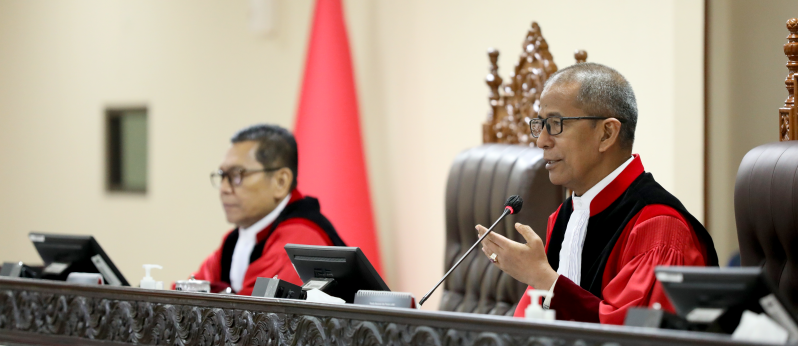
Dima Fajar Adus Kusumaramadan, as Legal Counsel, delivering the main points at petition revision hearing for Case No. 136/PUU-XXIV/2026. Photo by MKRI/Fauzan.
JAKARTA (MKRI) – Private employee Sandi Silvia as the Petitioner for Petition No. 136/PUU-XXIV/2026 submitted a revised petition for material review of Article 12 paragraph (1) and paragraph (2) of Law No. 18 of 2003 on Advocates (Advocate Law) in a hearing at the Constitutional Court (MK) on Wednesday, May 6, 2026. The Petitioner mentioned a number of cases of fraud committed by advocates against their own clients.
"The revisions are in the posita and petitum, Your Honor, posita point A Number 9 pages 11 to 12 Your Honor," said the Petitioner's Legal Counsel, Dima Fajar Adeus Kusumaramadan in the Panel Courtroom, Building II, MK, Jakarta.
In this revision, the Petitioner stated that the Denpasar District Court on April 28, 2026, handed down a verdict to an advocate, Togar Situmorang, because it was legally and convincingly proven that he had deceived his own client, Fanny Lauren Christie, by asking his client for IDR 1 billion to make his client's opponent a suspect at the National Police's Criminal Investigation Agency (Bareskim Polri). Then there was the case of a lawyer in Surabaya named Hairandha Suryadinata who was sued by his former client for IDR 5 billion for alleged unlawful acts.
According to the Petitioner, based on the facts of the case above, it is clear that the advocate supervision system as regulated in Article 12 paragraph (1) and paragraph (2) of the Advocates Law has failed to protect the interests of the justice-seeking public. This failure occurs because the norms of the article in question do not explicitly regulate: (i) which advocate organization is authorized to carry out supervision; (ii) a complaint mechanism that is easily accessible to the general public; (iii) a time limit for handling complaints; and (iv) measurable and legally certain sanctions for violations committed.
The Petitioner said that the ambiguity of the phrase "Advocate Organization" in Article 12 paragraph (1) of the Advocates Law has resulted in the emergence of an uncontrolled multi-organization of advocates in Indonesia. This condition was exacerbated by the issuance of the Letter of the Chief Justice of Supreme Court of the Republic of Indonesia No. 73/KMA/HK.01/IX/2015 dated September 25, 2015 on the Oath of Advocates, which PERADI stated had caused divisions in advocate organizations and the proliferation of advocate organizations that didn’t meet the requirements to carry out the duties and authorities of advocate organizations as recognized in the Constitutional Court Decision No. 35/PUU-XVI/2018.
Meanwhile, the Petitioner stated that in the uncontrolled multi-organization system of advocates as described above, the quality of advocate standards becomes unstandardized and tends to decline systematically. An advocate who is not accepted into one advocate organization can easily form or join another advocate organization with looser membership standards and ethical enforcement, so that the advocate profession can no longer guarantee the competence and integrity of its members to the wider community.
Article 12 paragraph (1) of the Advocates Law states that "Supervision of Advocates is carried out by the Advocates Organization." The Petitioner believes that the phrase "Advocates Organization" in the article doesn’t provide a clear and standardized definition regarding which advocate organization is authorized to carry out supervision, so that this provision contains vague norms and is open to multiple interpretations which result in a weak system of supervision of advocates in Indonesia.
In addition, Article 12 paragraph (2) of the Advocates Law states, "Supervision as referred to in paragraph (1) aims to ensure that advocates in carrying out their profession always uphold the code of ethics of the advocate profession and laws and regulations." However, this provision doesn’t explain in detail the standards of supervision that must be applied, measurable enforcement mechanisms, and parameters for successful supervision that can be accounted for to the public, so that this norm loses its operational power in protecting the justice-seeking public.
Meanwhile, the Petitioner in his petitum requested the Court to declare Article 12 paragraph (1) of the Advocates Law as contradictory to the 1945 Constitution of the Republic of Indonesia (UUD NRI) and not legally binding as long as it is not interpreted as "Supervision of Advocates is carried out only by one National Advocates Honorary Council whose members consist of various elements of advocates"; and to declare Article 12 paragraph (2) of the Advocates Law as contradictory to the 1945 UUD NRI and not legally binding as long as it is not interpreted as Supervision of Advocates is carried out by an Advocates Organization that has received official recognition from the state and has a standardized, measurable complaint mechanism that is accessible to all levels of society.
Also read:
Feeling Harmed by Advocates' Actions, Petitioner Questions the Supervision of Advocates' Organization
Previously, this petition stemmed from a concrete incident experienced by the Petitioner. The Petitioner claimed to have made several payments to an advocate to act as his legal representative in his case, but the advocate failed to respond to the Petitioner as his client.
"The Petitioner has given legal power to an advocate named Syamsul Jahidin to handle his case, and has fulfilled all his obligations as a client," said the Petitioner's Legal Counsel, Faisal Al Haq Harahap, in the preliminary examination hearing on Thursday, April 23, 2026.
Petitioner stated that he had fulfilled all his obligations as a client, including submitting case documents, providing a valid, stamped power of attorney, and paying the advocate's fee. He stated that he had made four payments to the advocate totaling 22.5 million rupiahs.
Although the Petitioner had fulfilled all of his payment obligations for the legal services, throughout the course of the case, the Petitioner was blocked by the advocate on all communication channels. When the Petitioner also attempted to contact the advocate partner listed in the power of attorney, the advocate partner claimed to be unaware that his name had been included in the power of attorney and was completely unaware of the issues the Petitioner was facing.
The fellow advocate stated that he had contacted the advocate, and the advocate claimed not to know the Petitioner at all. However, the Petitioner claimed that all evidence of the Petitioner's chats and transfers was clear to the advocate and that the Petitioner had tried to report the advocate to his legal organization, but received no response. Even requests for guidance were not responded to.
As a result, the Petitioner feels he is not receiving fair legal protection. He believes that if an advocate violates the code of ethics, they have nothing to fear, as they can easily move to another organization or form a new one, which can ultimately lead to the emergence of advocates lacking integrity.
Petitioner considers the advocate's actions to be in conflict with Article 8 letter f of the Indonesian Advocate Code of Ethics (KEAI) which states "Advocates are not permitted to seek publicity for themselves through the mass media and/or to attract public attention regarding their actions as an Advocate regarding cases they are or have handled, except when the information they provide is aimed at upholding legal principles that must be fought for by every Advocate." Because, the Petitioner argues that the advocate has been proven to use the mechanism for requesting judicial review of the Law at the Constitutional Court solely for the purpose of virality and self-publicity interests, not for the legal interests of the client.
The violations committed by the advocate not only contradict the normative provisions of the Advocates Law and the KEAI, but also violate the essence of the advocacy profession as an honorable profession (officium nobile) as affirmed in Article 3 letter g of the KEAI. The concept of officium nobile positions advocates as law enforcers who uphold integrity, morality, and public trust, so that any negative action constitutes a serious degradation of the profession's honor.
Track case No. 136/PUU-XXIV/2026
Author : Mimi Kartika
Editor : N. Rosi.
PR : Andhini S.F.
Translator : Donny Yuniarto
Disclaimer: The original version of the news is in Indonesian. In case of any differences between the English and the Indonesian versions, the Indonesian version will prevail.
Wednesday, May 06, 2026 | 20:05 WIB 18