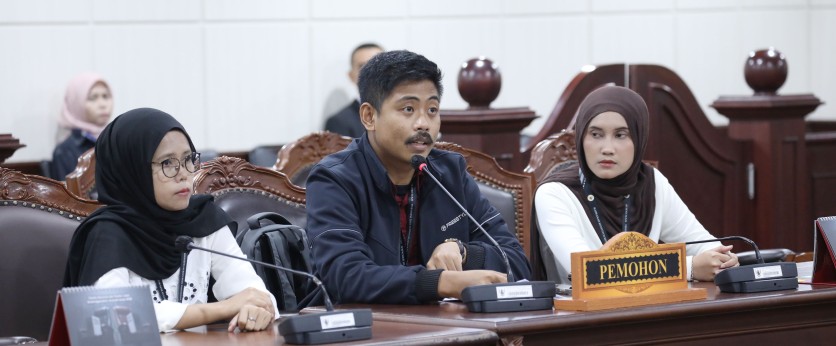
The Petitioners and legal counsel presenting the revisions to the judicial review petition of Law No. 1 of 2023 on the Criminal Code, Wednesday (5/6/2026). Photo by MKRI/Panji.
JAKARTA (MKRI) — The Constitutional Court held another material review hearing of Article 609 paragraph (1) of Law No. 1 of 2023 on the Criminal Code (KUHP) on Wednesday, May 6, 2026. This second hearing for Case No. 135/PUU-XXIV/2026 was to examine the revisions made by Sri Wahyuni, a homemaker.
At the panel hearing led by Chief Justice Suhartoyo, counsel Jovi Andrea Bachtiar detailed the revised parts. These include revision to the power of attorney, additional petitioners—now there are three petitioners, the format of petition following Constitutional Court Regulation No. 7 of 2025, and the posita (things being requested).
“Criminalization of any person who neither knows of nor intends to be entrusted with narcotics in items such as a wallet, plastic bag, or cardboard box, which belong to another person, may potentially occur. This is because the formulation of the article a quo indirectly affirms that anyone who intentionally and unlawfully controls narcotics illegally outside medical purposes in items entrusted by another person may still be subject to criminal punishment. Regardless of whether the person had knowledge of or intent regarding the entrusted item, they may nevertheless be prosecuted, beginning with the hasty designation of that person as a suspect, followed by detention and trial to determine whether the person is indeed guilty of the criminal offense of controlling narcotics, or conversely acquitted of all charges brought by the public prosecutor. Such a provision is certainly highly unjust and very dangerous, because anyone may be imprisoned by rogue investigators within the police and/or rogue investigators at the National Narcotics Agency by utilizing the article a quo,” Jovi explained.
Also read: Husband Criminalized, Wife Challenge Phrase “Without Right” in New Criminal Code
At the preliminary hearing on Thursday, April 23, 2026 in the Court’s plenary courtroom, Jovi Andrea Bachtiar and Stefano Gilbert Rumagit, as counsels for the Petitioner, argued that the provision a quo contains ambiguity and an overly broad scope of interpretation, giving rise to legal uncertainty and constitutional harm in the form of injustice. In a concrete case, due to the formulation of the provision a quo—particularly the phrase “without right”—the Tangerang District Prosecution Office allegedly used this broad and ambiguous interpretation to criminalize the Petitioner’s husband Tatang Sutarlan, who had stored a suitcase belonging to the Petitioner’s brother-in-law Usman Sitorus, which contained 34 kilograms of Category I narcotics (methamphetamine). The Petitioner and her husband only became aware of this after officers from the South Tangerang Resort Police came to their residence, conducted a search, opened the suitcase, and discovered the narcotics.
In the provisional petitum, Jovi stated, the Petitioner asks the Court to order Commission III of the House of Representatives (DPR) to hold a hearing (RDP) to hear her concerns. This is because, as a result of the legal case, the Petitioner’s husband faces the possibility of the death penalty, life imprisonment, or at least more than ten years’ imprisonment by the Tangerang District Court, despite having no knowledge of and no intent to possess or store narcotics. The Petitioner also requests that the Court recommend to judges at the Tangerang District Court, the Banten High Court on appeal, and/or the Supreme Court at the cassation or judicial review stages to impose, at most, a five-year term of imprisonment on her husband.
Accordingly, the Petitioner requests the Court to declare the phrase “without right” in Article 609 paragraph (1) of Law No. 1 of 2023 on the Criminal Code unconstitutional and not legally binding insofar as it is not interpreted to mean “intentionally and with intent.” Thus, the formulation of Article 609 paragraph (1) according to the request would read: “Any person who intentionally and with intent possesses, stores, controls, or provides: a. Category I Narcotics not derived from plants, shall be punished with imprisonment of at least four (4) years and at most twelve (12) years and a fine of at least Category IV and at most Category VI; b. Category II Narcotics, shall be punished with imprisonment of at least three (3) years and at most ten (10) years and a fine of at least Category IV and at most Category VI; and c. Category III Narcotics, shall be punished with imprisonment of at least two (2) year.”
Explore Case No. 135/PUU-XXIV/2026 (in Indonesian).
Author : Sri Pujianti
Editor : N. Rosi
Translator : Yuniar Widiastuti (NL)
Disclaimer: The original version of the news is in Indonesian. In case of any differences between the English and the Indonesian versions, the Indonesian version will prevail.
Wednesday, May 06, 2026 | 19:43 WIB 69