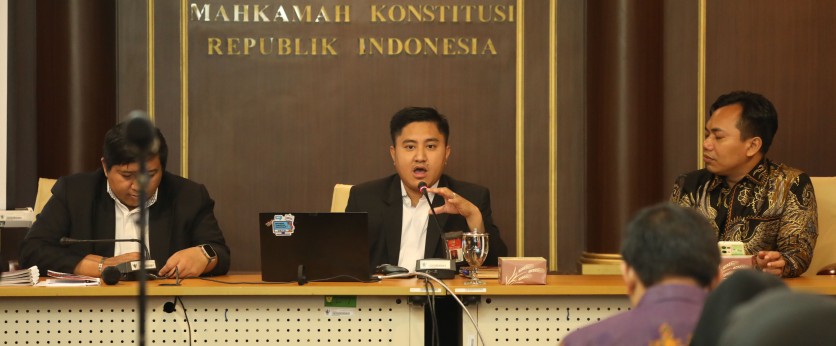
Legal Analyst Puguh Apriyanto welcoming and presenting materials to students of the Constitutional Law Study Program, Faculty of Sharia, KH Abdurrahman Wahid State Islamic University, Pekalongan (UIN Gusdur), during a visit to the Constitutional Court, Tuesday (5/5/2026). Photo by MKRI/Panji.
JAKARTA (MKRI) — A total of 141 students from the Constitutional Law Study Program of the Faculty of Sharia at KH Abdurrahman Wahid State Islamic University, Pekalongan (UIN Gusdur), visited the Constitutional Court on Tuesday, May 5, 2026. Accompanied by their lecturers, the students first toured the Constitutional History Center located in the Court’s Building I. At the digital learning center, they learned about the origins and development of Indonesia’s constitution throughout different periods.
The students were then welcomed by the Court’s Legal Analyst, Puguh Apriyanto, who introduced them to the functions and authority of the Constitutional Court. He explained that the Court was established following the third amendment to the 1945 Constitution and officially commenced its duties on August 13, 2003, as one of Indonesia’s judicial institutions.
Puguh further explained that the Court is authorized to conduct judicial reviews of laws against the Constitution, adjudicate disputes over the constitutional authority of state institutions, rule on the dissolution of political parties, and settle disputes over general election results.
Among the judicial review petitions received by the Court, Puguh noted, several had been filed by university students. Therefore, UIN Gusdur students may also become petitioners before the Court and may represent litigants or even serve as legal counsel in future constitutional cases.
“Anyone wishing to litigate before the Constitutional Court should first refer to the Court’s procedural rules as stipulated in Constitutional Court Regulation (PMK) No. 7 of 2025, which can be accessed through mkri.id. Petitions may also be submitted online through simpel.mkri.id,” Puguh said.
During the session, Puguh guided the students through the Court’s litigation process systematically. He explained each stage of the proceedings, from filing a petition and preparing the required documents to attending scheduled hearings, the ruling hearing, and the issuance of certified copies of the Court’s decision to the parties.
Author : Sri Pujianti
Editor : Tiara Agustina
Translator : N. Valentino Rahadityo/Yuanna Sisilia
Disclaimer: The original version of the news is in Indonesian. In case of any differences between the English and the Indonesian versions, the Indonesian version will prevail.
Tuesday, May 05, 2026 | 15:00 WIB 5