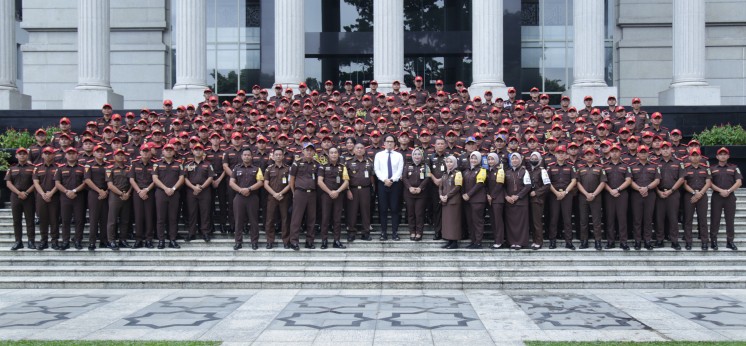
The Constitutional Court received a visit from the Education and Training Agency of the Attorney General’s Office on Tuesday (May 5, 2026). Photo by MKRI/Bay
JAKARTA, (MKRI) — The Constitutional Court received approximately 180 participants of the Prosecutor Formation Education and Training Program (PPPJ) Class LXXXIII Batch I of 2026, along with 15 accompanying officials from the Attorney General’s Office, on Tuesday, May 5, 2026. The group was welcomed by the Head of Public Relations and Domestic Cooperation Division of the Constitutional Court, Andi Hakim, at the Auditorium of Building I of the Court in Jakarta.
“The Constitutional Court is the result of a national consensus to provide a forum for the people to challenge legislative products enacted by lawmakers,” said Andi.
During the visit, the prospective prosecutors also received a presentation from Aditya Yuniarti, a Junior Legal Analyst at the Constitutional Court. Aditya explained that Indonesia’s constitutional system, after the amendments to the 1945 Constitution, adopts the principle of checks and balances, whereby the President (executive) and the House of Representatives (DPR) as lawmakers, along with the judiciary—comprising the Constitutional Court and the Supreme Court—do not subordinate one another, but instead share powers and exercise mutual oversight to uphold law and justice.
“The Constitution grants authority to the DPR and the President as lawmakers, as well as to the judiciary, and these three branches hold equal positions and oversee one another,” Aditya stated.
He further explained that the Constitution functions as a limitation on power. While the DPR and the President have the authority to propose bills, such bills cannot become law without the mutual consent of both parties.
Meanwhile, the Constitutional Court has the authority to review laws against the 1945 Constitution (judicial review), resolve disputes over the authority of state institutions, decide on the dissolution of political parties, adjudicate disputes over general election results, and is obligated to rule on the DPR’s opinion regarding alleged legal violations by the President and/or Vice President. In this context, the Court serves as a forum for citizens who believe their constitutional rights have been impaired by the enactment of statutory provisions deemed contrary to the 1945 Constitution.
The Constitutional Court may invalidate laws enacted by the DPR and the President if they are found to be inconsistent with the Constitution. In contrast, the Supreme Court reviews regulations below the level of law against statutory laws.
To carry out its functions, the Constitutional Court consists of nine Constitutional Justices drawn from the three pillars of the trias politica. The President, the DPR, and the Supreme Court each nominate three candidates to be appointed as Constitutional Justices, who are then formally appointed by presidential decree.
Aditya also highlighted several Constitutional Court decisions related to prosecutors, including Decision No. 20/PUU-XXI/2023 on the authority of prosecutors to file a case review (PK), Decision No. 6/PUU-XXII/2024 concerning the requirement that the Attorney General must not be affiliated with a political party, Decision No. 49/PUU-VIII/2010 regarding the five-year term of office of the Attorney General, Decision Number 70/PUU-XX/2022 on the retirement age of prosecutors set at 60 years, and Decision No. 15/PUU-XXIII/2025 concerning prosecutorial immunity rights.
For information, this activity is part of the program of the Education and Training Agency of the Attorney General’s Office, in accordance with Attorney General Regulation Number Per-006/A/JA/07/2017. The agency is responsible for planning, implementing, and evaluating education and training programs, as well as establishing cooperation with various institutions both domestically and internationally.
Author: Mimi Kartika
Editor: Tiara Agustina
Translator: Mauliza Ara Rizki (Rizky Kurnia Chaesario)
Disclaimer: The original version of the news is in Indonesian. In case of any differences between the English and the Indonesian versions, the Indonesian version will prevail
Tuesday, May 05, 2026 | 14:35 WIB 153