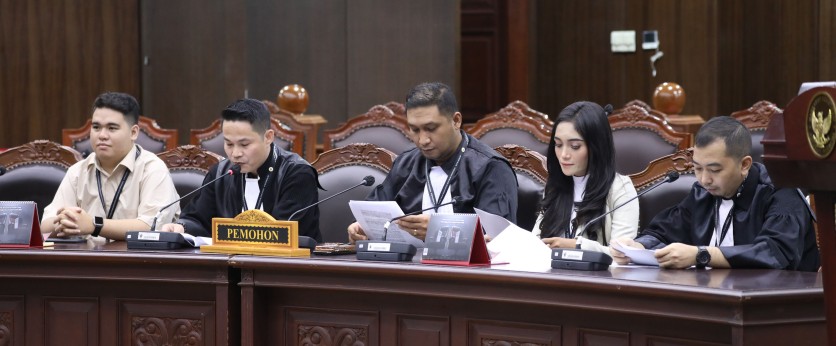
The Petitioners in the judicial review of Law No. 1 of 2009 on Aviation presenting their revised petition directly in the Court’s panel courtroom on Tuesday (5/5/2026). Photo by MKRI/Panji.
JAKARTA (MKRI) — The Constitutional Court (MK) held another hearing for the material judicial review of Law No. 1 of 2009 on Aviation (Aviation Law) on Tuesday, May 5, 2026. The agenda was to examine the revised petition in case No. 134/PUU-XXIV/2026.
At the hearing, one of the Petitioners, Doris Manggalang Raja Sagala, said the Petitioners had made several revisions to the petition. These included increasing the number of Petitioners from the original six to ten and restructuring the petition to comply with Constitutional Court Regulation (PMK) No. 7 of 2025 on Procedures in Judicial Review Cases.
The Petitioners also revised the description of their legal standing and the explanation of their constitutional impairment. They also revised the grounds for the petition. “There was an additional norm being challenged, in casu the Elucidation to Article 146 of the Aviation Law, specifically the phrase ‘among others,’” Doris Manggalang Raja Sagala said.
Doris also explained that the Petitioners had revised the comparison of delay regulations in other countries, namely delay compensation based on time bands and flight distance. She further explained the revision concerning Article 172 of the Aviation Law, which requires the minister to evaluate the amount of compensation at least once a year.
Also read:
Petitioners Question Transparency of Flight Delays
For reference, petition No. 134/PUU-XXIV/2026 concerning the material judicial review of the Aviation Law was filed by Doris Manggalang Raja Sagala, Jonswaris Sinaga, Amudin Laia, et al. The Petitioners challenge Article 146 and its elucidation, Article 170, Article 172, and Article 176 of the Aviation Law against the 1945 Constitution.
Information Asymmetry
The Petitioners highlighted an information imbalance between airlines as carriers and passengers as consumers. Airlines are considered to have full access to flight operational information, while passengers receive only unilateral information without transparency. The Petitioners argued that this condition creates information asymmetry that weakens passengers’ bargaining position. Airlines often cite reasons for delays such as weather or technical and operational issues without presenting verifiable evidence.
“Airlines only provide information unilaterally without authentic evidence. This causes passengers to lose the legal instruments to test unilateral claims by airlines due to the absence of valid comparative data,” Doris Manggalang Raja Sagala explained at the preliminary hearing before the Court on Wednesday, April 22, 2026.
Passengers do not know what actually happens behind the cockpit door or in the operations control room. According to the Petitioners, this creates a legal loophole that allows airlines to easily use weather or technical and operational factors as a shield for delays.
The Petitioners also argued that Article 146 of the Aviation Law contains a normative flaw because it provides broad exceptions to airline liability. The phrase “weather factors and technical and operational issues” is often used to avoid compensation obligations, while no strict sanctions exist for airlines that provide inaccurate information.
In addition, Article 170 of the Aviation Law is argued to lack provisions requiring airlines to transparently disclose data and evidence related to delays. This is deemed to create legal uncertainty and fail to provide adequate protection for passengers. Meanwhile, Article 176 of the Aviation Law is disputed because it limits passengers’ right to file lawsuits in court for losses due to delays, as it does not include Article 146 as a basis for a lawsuit.
The Petitioners are of the view that these provisions are contrary to Article 28D paragraph (1) of the 1945 Constitution on the guarantee of fair legal certainty and Article 28F of the 1945 Constitution on the right to obtain information.
In their petitums, the Petitioners ask the Court to declare Article 146 of the Aviation Law contrary to the 1945 Constitution and not legally binding insofar as it is not interpreted to mean that carriers are liable for delays, unless they can prove, with valid and accessible technical data, that the delays were caused by weather and/or technical and operational factors.
The Petitioners also ask that Article 170 of the Aviation Law be declared unconstitutional insofar as it is not interpreted to mean that the provision of technical data on delays and the amount of compensation be further regulated in a ministerial regulation.
In addition, they ask that Article 176 of the Aviation Law be declared contrary to the 1945 Constitution insofar as it is not interpreted to mean that passengers and relevant parties who suffer losses, including those caused by delays, may file lawsuits against carriers at district courts in Indonesia.
Author: Ilham Wiryadi Muhammad
Editor: N. Rosi.
Translator: Siti Rosmalina Nurhayati
Explore case: Petition No. 134/PUU-XXIV/2026
Disclaimer: The original version of the news is in Indonesian. In case of any differences between the English and the Indonesian versions, the Indonesian version will prevail.
Tuesday, May 05, 2026 | 17:36 WIB 5