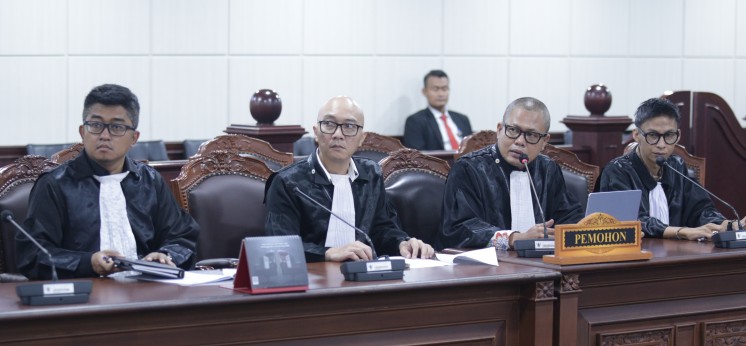
The Petitioner’s legal counsel during the Preliminary Examination Hearing of Petition Number 147/PUU-XXIV/2026 challenging Law Number 35 of 2009 on Narcotics, Monday (05/04/2026), at the Constitutional Court. Photo by MKRI/Bay.
JAKARTA, (MKRI) – Alpin, an individual Indonesian citizen, has filed a petition challenging Article 103 paragraph (1) letters a and b along with its Elucidation of Law Number 35 of 2009 on Narcotics (Narcotics Law) against the 1945 Constitution of the Republic of Indonesia (UUD 1945) before the Constitutional Court (the Court). The Preliminary Examination Panel Hearing of Petition Number 147/PUU-XXIV/2026 was held on Monday (05/04/2026), presided over by Chief Justice Suhartoyo, accompanied by Constitutional Justices Daniel Yusmic P. Foekh and M. Guntur Hamzah.
Article 103 paragraph (1) of Law 35/2009 provides that: “A judge examining a Narcotics Addict case may: a. decide to order the person concerned to undergo treatment and/or care through rehabilitation if the Narcotics Addict is proven guilty of committing a narcotics offense; or b. determine to order the person concerned to undergo treatment and/or care through rehabilitation if the Narcotics Addict is not proven guilty of committing a narcotics offense.”
The Petitioner claims to have been directly affected by legal uncertainty arising from the absence of explicit guidelines on rehabilitation for Narcotics Addicts and Narcotics Abusers through judicial decisions, both under Law Number 1 of 2023 on the Criminal Code and Law Number 1 of 2026 on Penal Adjustment. This condition raises concerns that the a quo provision will not be consistently applied as a guideline for judges in deciding cases involving Narcotics Addicts and/or Narcotics Abusers.
In the concrete case, the Petitioner was a defendant before the Tanjungkarang District Court and was sentenced to 6.5 years of imprisonment and a fine of Rp200,000,000. The Petitioner was found legally and convincingly guilty of unlawfully possessing Class I narcotics in plant form. According to the Petitioner, he was not a dealer—as revealed during trial—but rather a narcotics user. However, in its legal considerations, the panel of judges did not consider the application of Article 103 paragraph (1) of the Narcotics Law, despite the Petitioner’s positive urine test confirming active cannabis use.
The Petitioner argues that Article 103 paragraph (1) letters a and b of the Narcotics Law constitutes a fundamental provision granting judges the authority to order medical rehabilitation for Narcotics Addicts, whether proven guilty or not guilty of narcotics-related offenses. This provision reflects a health-based approach to narcotics abuse aligned with human rights principles.
“The Petitioner and all narcotics addicts in Indonesia are not guaranteed that their right to rehabilitation will be recognized in judicial decisions, which constitutes a violation of the right to legal certainty under Article 28D paragraph (1) of the 1945 Constitution. Medical rehabilitation is a concrete form of healthcare service that must be provided by the state. Narcotics addicts are a vulnerable group entitled to special treatment in the form of affirmative rehabilitation under Article 28H paragraph (2) of the 1945 Constitution, and ignoring Article 103 paragraph (1) of the Narcotics Law effectively eliminates the affirmative protection that the state is obligated to provide to this group,” stated Singgih Tomi Gumilang, counsel for the Petitioner.
Based on these arguments, the Petitioner requests the Court to declare that the substance of Article 103 paragraph (1) letters a and b along with its Elucidation is not contrary to the 1945 Constitution and remains legally binding, insofar as it is interpreted to mean that Article 103 paragraph (1) letters a and b along with its Elucidation constitutes the sole legal basis and binding guideline for judges in examining and deciding cases involving Narcotics Addicts and/or Narcotics Abusers, notwithstanding the enactment of Law Number 1 of 2023 on the Criminal Code and Law Number 1 of 2026 on Penal Adjustment.
Judicial Advice
In response to the petition, Constitutional Justice Guntur stated that the a quo provision already provides an opportunity for users to undergo rehabilitation.
“This norm is already appropriate; there is actually no issue with it. In fact, you are refusing to apply the Criminal Code, so this is error in objecto,” Guntur explained.
Constitutional Justice Daniel Yusmic P. Foekh noted that the petition contains excessive narration of the concrete case. According to him, the Petitioner has not sufficiently elaborated the specific constitutional impairment suffered.
Before closing the hearing, Chief Justice Suhartoyo stated that the Petitioner was given 14 days to revise the petition. The revised petition must be submitted no later than Monday (05/18/2026) at 12:00 WIB to the Court Registry. The Court will then schedule the next hearing to examine the substance of the revised petition. (*)
Author : Sri Pujianti
Editor : N. Rosi.
PR : Fauzan F.
Translator : Agusweka PS.
Disclaimer: The original version of the news is in Indonesian. In case of any differences between the English and the Indonesian versions, the Indonesian version prevails.
Case Track: Number 147/PUU-XXIV/2026
Monday, May 04, 2026 | 15:46 WIB 462