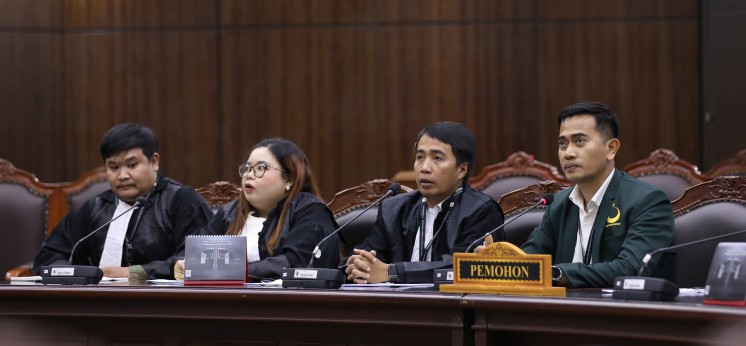
Petitioner Gugum Ridho Putra and his legal counsel attending the preliminary hearing for the judicial review of Law No. 2 of 2008 on Political Parties, Monday (5/4/2026) at the Constitutional Court courtroom. Photo by MKRI/Ifa.
JAKARTA (MKRI) — The Central Executive Board (DPP) of the Partai Bulan Bintang (PBB) established through the party’s Sixth Congress has brought the issue of dual leadership within the party before the Constitutional Court. The DPP PBB formed through the Sixth Congress (Petitioner) filed a judicial review against several phrases contained in Law No. 2 of 2008 on Political Parties and Law No. 2 of 2011 amending Law No. 2 of 2008 on Political Parties (Political Parties Law).
The petition challenges several provisions. First, provisions in Law No. 2 of 2008, namely the word “ratify” in Article 7 paragraph (1), the word “ratification” in Article 7 paragraph (2), and the phrase “Ministerial Decree” in Article 23 paragraph (3), Article 7 paragraphs (2) and (3), and Article 4 paragraphs (3) and (4). Second, provisions in Law No. 2 of 2011, namely the word “ratification” in Article 4 paragraphs (3) and (4), the phrase “Ministerial Decree” in Article 4 paragraphs (3) and (4), as well as Article 32 and Article 33. The Petitioners used Article 1 paragraph (3), Article 28, Article 28D paragraph (1), and Article 28E paragraph (3) of the 1945 Constitution as the constitutional basis for the review.
The preliminary hearing for Case No. 146/PUU-XXIV/2026 examining the petition was held at the Constitutional Court on Monday, May 4, 2026. The DPP PBB formed through the Sixth Congress was represented by its Chairperson Gugum Ridho Putra and Deputy Secretary-General for External Affairs Dega Kautsar Pradana.
At the panel hearing chaired by Constitutional Justice Enny Nurbaningsih, the Petitioners revealed that two factions currently claim legitimate authority over the party’s organizational leadership. One faction is the Petitioner, whose management structure was established through the Sixth Congress and ratified by the Ministry of Law of the Republic of Indonesia. The other faction claims its leadership was established through the Party Council Deliberation (MDP) and alleges that it also obtained a ratification letter from the Ministry.
The Petitioners stated that they had sought clarification regarding the ratification letter. However, to date, no explanation has been provided by the Minister of Law.
“Until today, the Ministry of Law and the officials authorized to issue the decree have never publicly announced that such a decree physically exists, including to the Petitioners themselves,” Gugum stated.
The Petitioners further elaborated on the alleged harm arising from provisions of the Political Parties Law concerning the authority of the Party Court, which they considered open to multiple interpretations and susceptible to abuse of authority. According to Gugum, the PBB Party Court had instead legitimized the MDP faction by issuing duplicate letters stating that no internal political party dispute existed.
“The Petitioners have suffered actual losses because the Crescent Star Party Court took measures that effectively legitimized the illegitimate MDP faction by issuing duplicate statements declaring the absence of political party disputes,” Gugum said.
In the petition’s posita, the Petitioners argued that the Minister of Law should only be authorized to receive registrations and verify their completeness and accuracy. However, other provisions allegedly grant the minister authority to determine legitimacy and issue ratification decisions—powers typically reserved for adjudicative bodies such as courts. The Petitioners asserted that such authority enables state intervention in internal party affairs.
“That authority creates room for state involvement in determining political party decisions. The potential abuse of authority by the Minister of Law becomes particularly evident when political parties experience central leadership disputes that result in dualism or competing management structures,” Gugum explained.
Therefore, in their petitum, the Petitioners requested the Court to declare the word “ratify” in Article 7 paragraph (1), the word “ratification” in Article 7 paragraph (2) of Law No. 2 of 2008, as well as the word “ratification” in Article 4 paragraphs (3) and (4) of Law No. 2 of 2011, unconstitutional and conditionally without binding legal force unless interpreted merely as “registration” and “recording” by the Minister of Law.
The Petitioners also requested the Court to declare the phrase “Ministerial Decree” in Article 23 paragraph (3), Article 7 paragraphs (2) and (3), and Article 4 paragraphs (3) and (4) of Law No. 2 of 2008, as well as Article 4 paragraphs (3) and (4) of Law No. 2 of 2011, unconstitutional and conditionally without binding legal force unless interpreted as “a certificate of registration publicly announced through the Ministry’s official channels, notified to affected parties no later than seven calendar days, while providing a 30-day objection period and open clarification.”
Furthermore, the Petitioners requested the Court to declare Article 32 and Article 33 of Law No. 2 of 2011 constitutional insofar as they are interpreted to exclude disputes concerning dual political party leadership, with such disputes to be resolved by the Constitutional Court through hearings open to the public whose decisions are final and binding.
Justices’ Advice
Responding to the petition, Constitutional Justice Arsul Sani advised the Petitioners to provide evidence in the form of the party’s articles of association and bylaws demonstrating that the Chairperson and Deputy Secretary-General are authorized to represent the organization before the courts. This was deemed necessary because the current Secretary-General of the DPP PBB reportedly belongs to the opposing faction.
“If the Secretary-General is unavailable and may be represented by the Deputy Secretary-General, there must be supporting references for that,” Arsul remarked.
Arsul also questioned whether the dispute would be more appropriately resolved before the Constitutional Court or the State Administrative Court (PTUN). In addition, he asked the Petitioners who should possess the authority to ratify political party leadership if such authority were no longer vested in the Minister of Law.
Meanwhile, Constitutional Justice Ridwan Mansyur advised the Petitioners to further elaborate on the constitutional inconsistency between the challenged provisions and the 1945 Constitution.
“The arguments concerning the constitutional rights allegedly harmed by these provisions have not yet been sufficiently elaborated. There should be clearer parameters explaining the constitutional issue,” Ridwan stated.
Lastly, Constitutional Justice Enny Nurbaningsih provided several suggestions for improving the petition, particularly regarding proof of the Petitioners’ legal standing as a legal entity.
“Like it or not, the articles of association and bylaws must be submitted, including organizational regulations if any exist, because the articles of association constitute the constitution of the political party itself, as recognized under the Political Parties Law,” Enny said.
Enny further requested that the Petitioners clearly explain the constitutional losses they had suffered due to the enforcement of the challenged provisions.
“What constitutional rights granted by the Constitution are actually being violated?” Enny asked.
She also reminded the Petitioners that they must demonstrate how granting the petition would prevent further violations of their constitutional rights. Enny emphasized that judicial review proceedings before the Constitutional Court are intended to assess the constitutionality of legal norms against the 1945 Constitution.
Before adjourning the hearing, Enny informed the Petitioners that they would have 14 days to revise the petition. The revised petition must be submitted no later than Monday, May 18, 2026, at 12:00 p.m. WIB to the Registrar’s Office of the Constitutional Court, either online or offline. The revision may only be submitted once. The Court will subsequently schedule the next hearing to hear the principal revisions made by the Petitioners.
Author: Ilham Wiryadi Muhammad.
Editor: N. Rosi.
PR: Raisa Ayuditha M.
Translator: Yuanna Sisilia
Disclaimer: The original version of the news is in Indonesian. In case of any differences between the English and the Indonesian versions, the Indonesian version will prevail.
Explore the Case: Case No. 146/PUU-XXIV/2026
Monday, May 04, 2026 | 17:56 WIB 19