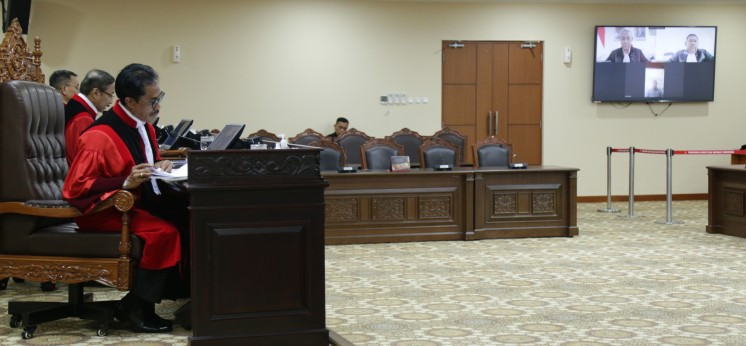
The Petitioners at the preliminary hearing for Case No. 84/PUU-XXIV/2026 on constitutional complaint, Thursday (4/30/2026). Photo by MKRI/Bayu.
JAKARTA (MKRI) — Heru Isdaryadi and Deni Syahputera, representing PT Anugrah Prabu Mandiri and PT Nusantara Mekanika Industri respectively, have lodged a constitutional complaint against the Government of Penukal Abab Lematang Ilir (PALI) Regency with the Constitutional Court. The preliminary hearing for Case No. 144/PUU-XXIV/2026 on Thursday, April 30, 2026 was presided over by Chief Justice Suhartoyo (panel chair) with Constitutional Justices Daniel Yusmic P. Foekh and M. Guntur Hamzah.
Their legal counsel Bahrul Ilmi Yakup stated that on October 19, 2025 Petitioner I, who represents PT Anugrah Prabu Mandiri, had signed a contract with the head of the Community and Village Government Empowerment Office to do eleven projects worth Rp1,837,875,000, under the order of the regent. When the projects were 90 percent finished, Petitioner I sent an invoice. The head of the said Office halted the projects while promising to pay for the work that had already been completed. Due to this negligence, Petitioner I filed a civil lawsuit before the Muara Enim District Court to claim payment for the work in question.
“The basis for filing this petition lies in Article 24 paragraphs (1) and (2) of the 1945 Constitution, under which the Constitutional Court exercises judicial power to uphold law and justice; and, attributively, the Court serves as the sole and highest interpreter of the Constitution and the guardian of the Constitution. To serve its function as the protector of citizens’ constitutional rights, the Court safeguards such rights against acts or omissions of public officials that result in their violation. We have no other option but to turn to the Constitutional Court,” explained Bahrul Ilmi at the hearing he attended virtually from Palembang.
In accordance with the laws on state finance and regional government administration, the execution of court decisions involving the payment of a sum of money must be carried out through the budgeting process within the Regional Revenue and Expenditure Budget (APBD). However, the respondent has consistently refused to allocate funds for payment to Complainants I and II on unfounded and contrived grounds. Such conduct not only reflects poor governance but also constitutes defiance of the court decisions a quo.
Moreover, following the complaints submitted by Petitioners I and II, the Ombudsman issued a recommendation ordering the PALI Regency Government to fulfill its obligation to execute the court decisions. Instead of complying in good faith, the PALI Regency Government persisted in its defiance by seeking or constructing further excuses to evade its obligation to pay the Petitioners. It even issued a letter stating that it was unable to implement the Ombudsman’s recommendation and requested that the Ombudsman facilitate a meeting between the Petitioners and the PALI Regency Government.
Based on these arguments, the Petitioners requested the Court to order and compel the PALI Regency Government to pay its obligations to Complainant I in the amount of Rp2,566,634,284 pursuant to Decision No. 23/Pdt.G/2016/PN.MRE in conjunction with Decision No. 80/PDT/2017/PT/PLG; to pay its obligations to Complainant II in the amount of Rp2,528,673,520 pursuant to Decision No. 22/Pdt.G/2016/PN.MRE in conjunction with Appellate Decision No. 83/PDT/2017/PT.PLG and Judicial Review Decision No. 590 PK/PDT/2018; and to order the PALI Regency Government to allocate the necessary funds for such payments in the Revised Regional Revenue and Expenditure Budget of Penukal Abab Lematang Ilir Regency for Fiscal Years 2026 and/or 2027.
Outside of Court’s Jurisdiction
In response to the petition, Constitutional Justice M. Guntur Hamzah stated that, in essence, the Court does not have the authority to adjudicate constitutional complaints. “In many constitutional courts in other countries, such authority is common; however, in this Court (Indonesia), it has not yet become part of its jurisdiction. While some scholars have developed such doctrines, if the Court lacks this authority, then being urged to handle such matters would itself risk violating the Constitution. This is indeed a challenging issue, but the Court cannot expand its own powers,” he explained.
Furthermore, Constitutional Justice Daniel Yusmic P. Foekh also emphasized the limitations placed on the Court in handling constitutional complaints. “This issue was once proposed in the draft amendment to the Constitutional Court Law, but it was not adopted. In various academic forums, the idea has been discussed as a possible means of granting new authority to the Court,” he added.
Before adjourning the session, Chief Justice Suhartoyo announced that the Petitioners would have 14 days to revise the petition. The revised petition must be submitted to the Court’s Registrar’s Office no later than 12:00 WIB on Wednesday, May 13, 2026. The Court will then schedule another session to examine the revisions to the petition.
Explore Case No. 144/PUU-XXIV/2026 (in Indonesian).
Author : Sri Pujianti
Editor : Lulu Anjarsari P.
PR : Andhini S. F.
Translator : Yuniar Widiastuti (NL)
Disclaimer: The original version of the news is in Indonesian. In case of any differences between the English and the Indonesian versions, the Indonesian version will prevail.
Thursday, April 30, 2026 | 16:01 WIB 70