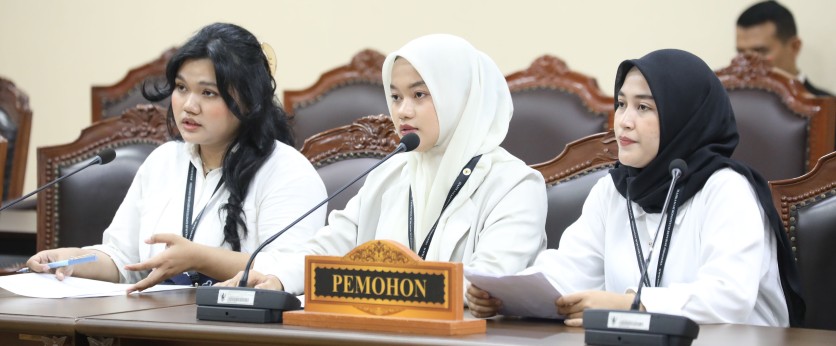
Petitioners in the judicial review of Law No. 8 of 1999 on Consumer Protection presenting the main points of their petition during a preliminary hearing in the Court’s panel courtroom on Wednesday (4/29/2026). Photo by MKRI/Panji.
JAKARTA (MKRI)-Seven law students have filed a petition with the Constitutional Court (MK) for the material judicial review of Law No. 8 of 1999 on Consumer Protection (Consumer Protection Law) against the 1945 Constitution. They are Sarah Rahayu, Nurhaliza Zahra, Livia Maulina, Primo Putra Ramadhan, Zalva Viola Munir, Amelia Harditya, and Muhamad Nabil Gunawan. The Petitioners challenge the phrase “as if” in Article 9 paragraph (1) of the Consumer Protection Law.
More specifically, Article 9 paragraph (1) of the Consumer Protection Law prohibits business actors from offering, promoting, or advertising goods and/or services inaccurately or in a way that creates a false impression.
The preliminary hearing to examine Case No. 141/PUU-XXIV/2026 was held at the Court on Wednesday, April 29, 2026. During the hearing, Zalva Viola Munir said that the challenged norm created legal uncertainty because it did not expressly provide clear, measurable, and objective parameters for promotional practices, preventing consumers from receiving accurate information about products in digital transactions.
“The lack of clarity in the norm has left the Petitioners without adequate standards of legal protection when facing promotional, offering, and/or advertising practices that appear formally correct but are substantively misleading,” Zalva said.
Another Petitioner, Nurhaliza Zahra, said that in today’s modern trade, business actors exploit loopholes in the law to mislead consumers by providing information that appears accurate but is substantively deceptive. “As a result, the disputed norm has shifted from an instrument of consumer protection into a tool for legitimizing misleading practices,” Nurhaliza said.
Justices’ Advice
In response to the petition, Constitutional Justice M. Guntur Hamzah advised the Petitioners to show the constitutional harm they had suffered and the causal link between that harm and the enforcement of the challenged norm. “This petition must explain the alleged violation of your constitutional rights. Is it actual or potential, and what is the causal link?” Justice Guntur said.
Next, Constitutional Justice Daniel Yusmic P. Foekh examined the structure of the petition. He noted that what the Petitioners were questioning was a prohibition imposed on business actors, meaning that the norm already served to protect consumers.
“This article sets out the obligation to guarantee the quality of goods or services and to provide accurate, honest, and non-misleading information. Please pay attention to this as an obligation imposed on business actors,” Justice Foekh said.
Lastly, Chief Justice Suhartoyo, who chaired the hearing, asked the Petitioners to explain the constitutional harm suffered by each Petitioner individually, as well as the constitutional conflict between the challenged norm and the 1945 Constitution. “Earlier, you referred only to the Petitioners collectively, whereas this should be explained one by one—what about Petitioner I, Petitioner II, Petitioner III, and so on? Each has a different case. That is the point of entry to establish the link between their constitutional rights and the enforcement of the norm,” Suhartoyo said.
Before closing the panel hearing, Suhartoyo informed the Petitioners that they had 14 days to revise their petition. The revised petition must be submitted to the Court’s Registrar’s Office no later than Tuesday, May 12, 2026. The Court will then schedule the next hearing to hear the main points of the revised petition.
Author: Ilham Wiryadi Muhammad
Editor: N. Rosi
PR: Adriana
Translator: Siti Rosmalina Nurhayati
Explore: Petition No. 141/PUU-XXIV/2026
Wednesday, April 29, 2026 | 13:02 WIB 35