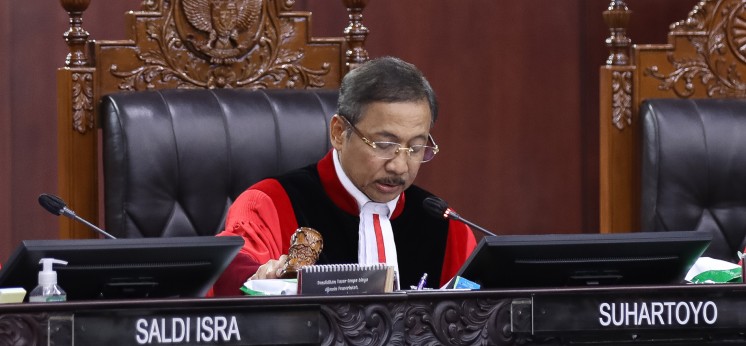
Chief Justice Suhartoyo reading out the verdict of the judicial review petition on Law No. 30 of 2004 on the Notary on Wednesday (29/04) at the Courtroom. Photo by MKRI/Ifa.
Jakarta (MKRI) – The Constitutional Court (MK) rejected Petition No. 65/PUU-XXIV/2026 on the material review of Article 66 paragraph (1), paragraph (3), and paragraph (4) of Law No. 30 of 2004 on the Notary as amended by Law No. 2 of 2014. The Court held that the formulation of Article 66 paragraph (1) of Law No. 2 of 2014 regarding the requirement to have the approval from the Notary Honorary Council (MKN) in litigation is to provide protection for notaries who serve as public officials in the exercise of their duties.
“It is to protect the minutes as confidential state documents, instead of an obstruction to legal proceedings,” Justice Ridwan Mansyur read out the legal reasoning of Decision No. 65/PUU-XXIV/2026 on Wednesday, April 29, 2026, at the Plenary Courtroom, Jakarta.
Article 66 paragraph (1) letters a and b of the Notary Law state: “(1) For the purposes of judicial proceedings, investigators, public prosecutors, or judges, with the approval of the Notary Ethics Council, are authorized to: a) obtain copies of deeds (Minuta Akta) and/or documents attached to deeds or to notarial protocols in the notary’s custody; and b) summon the notary to testify in proceedings relating to deeds or protocols in the notary’s custody.” Article 66 paragraph (3) states: “The Notary Honorary Council, within no later than 30 (thirty) working days from receipt of the letter requesting approval as referred to in paragraph (1), shall be obliged to provide an answer granting or refusing the request for approval.” Article 66 paragraph (4) stipulates: “If the Notary Honorary Council does not provide an answer within the period referred to in paragraph (3), the Notary Honorary Council shall be deemed to have granted the request for approval.”
Justice Ridwan explained that before further considering the petition on the constitutionality of the norms of Article 66 paragraphs (1) and (4) of Law No. 2 of 2014, the Court considered that the arguments in this case or the constitutionality issues being raised essentially share the issues in Constitutional Court Decision No. 22/PUU-XVI/2019.
The Court has consistently held that the requirement of approval from the MKN in judicial proceedings—where investigators, public prosecutors, or judges seek to obtain copies of deed minutes or notarial protocols kept by a notary, or to summon a notary for examination as provided in Article 66 paragraph (1) of Law No. 2 of 2014—is intended to afford protection to notaries who, in performing their duties, act as public officials, particularly to safeguard the existence of deed minutes as confidential state documents, and not to obstruct legal proceedings. Furthermore, the inclusion of Article 66 paragraph (4) of Law No. 2 of 2014 is intended to create fair legal certainty regarding the limits of MKN’s authority to grant approval for the summoning of notaries.
Based on these legal considerations, the Court at this time finds no sufficiently strong and fundamental legal reason to depart from its established position in Constitutional Court Decision Number 22/PUU-XVI/2019. Accordingly, the legal reasoning in Decision Number 22/PUU-XVI/2019 applies mutatis mutandis in assessing the arguments in the present petition.
The Court then turned to the Petitioners’ arguments that Article 66 paragraph (3) of Law No. 2 of 2014 is inconsistent with Article 27 paragraph (1) and Article 28D paragraph (1) of the 1945 Constitution of the Republic of Indonesia. In this regard, the Court found it important to reaffirm the philosophy underlying Law No. 2 of 2014, namely that written evidence of an authentic nature must be drawn up before or by a competent public official and, in this context, the Law confers such authority on notaries as public officials in the exercise of their profession. In addition, the practice of that profession requires that notaries receive protection and guarantees from the state as a form of assurance for the realization of legal certainty for notaries.
That protection, however, is not without limits. Article 66, paragraph (3), of Law No. 2 of 2014 sets a time limit within which the MKN must respond to a request for approval from law enforcement officials regarding the requested measures. Within 30 working days of receiving such a request, MKN is required to carry out its duty to summon and examine the notary. This mechanism is designed to give the notary an opportunity to explain to MKN the ongoing legal process involving the relevant deed or notarial protocol, or even the summons issued by law enforcement authorities to the notary.
Under this summons mechanism, MKN not only examines the notary but also performs its function of fostering and supervising the notarial profession. When carried out concurrently as guidance on all actions covered by the notarial code of ethics, this mechanism plays an important role in safeguarding the honor and dignity of the notarial profession as a public office that provides legal services to the public.
Justice Ridwan further explained that, with respect to requests for approval from law enforcement authorities, the term “shall” in Article 66 paragraph (3) of Law No. 2 of 2014 must be understood as imposing a duty on MKN to issue a response, whether in the form of approval or rejection, in the interest of the investigation and trial process, while at the same time ensuring legal certainty for law enforcement agencies handling cases related to notarial work. In other words, MKN’s response to a request from law enforcement authorities need not always be an approval; it may also take the form of a refusal.
Such a response must be based on the outcome of MKN’s examination of the notary’s actions in drawing up the deed in question. In essence, MKN’s approval is not intended to obstruct investigations or examinations involving notaries, but rather to ensure that legal procedures are carried out in a proportional and accountable manner. At the same time, this mechanism serves as a safeguard for notaries as public officials in the performance of their duties, particularly in protecting the minutes of deeds as confidential state documents.
The existence of these minutes is crucial because authentic deeds drawn up by notaries constitute strong and conclusive written evidence for the parties, which in turn obliges notaries, as public deed officials, to protect and maintain the confidentiality of the deed minutes in accordance with their oath of office. The protection and guarantees afforded to the notarial office under MKN thus serve to uphold the principle of fair legal certainty for all parties. Moreover, as part of its role in guiding and supervising the notarial profession, MKN may grant approval to a request from law enforcement authorities and may also accompany the notary during examination by those authorities.
“Therefore, the time limit imposed on MKN in responding to requests from law enforcement authorities cannot be regarded or construed as a form of unlimited legal protection,” Justice Ridwan stated.
Also read:
Two Lawyers Challenge Rule Requiring MKN Approval to Access Authentic Notarial Records
Number of Lawyers Challenging Notary Law Rises to Nine
The petition was submitted by nine advocates: Henoch Thomas, Syamsul Jahidin, ST Luthfiani, Popy Desiyantie, Fredy Limantara, Uswatun Hasanah, Steven Izaac Risakotta, Elyas Marulitua, and Irfan Wahyudi. According to the Petitioners, the MKN approval requirement set out in these provisions could constitute a form of constitutional disobedience because its substance mirrors a norm already struck down by the Constitutional Court.
Although the institution’s name has changed from MPD to MKN, the essence of the regulation remains the same: investigators, prosecutors, or judges must obtain approval from a particular body before examining a notary. This, they argue, indicates that the legislature has effectively disregarded a Constitutional Court decision that should serve as guidance in drafting legislation.
The Petitioners contended that the MKN approval requirement risks undermining the principle of independence in law enforcement. In practice, the MKN has the authority to refuse or delay requests to examine a notary, thereby impeding investigations. This situation not only slows access to justice (justice delayed) but also creates space for impunity for notaries suspected of involvement in criminal cases. When a non-judicial body, such as the MKN, holds a decisive position in law enforcement processes, the principle of equality before the law is diminished.
The dispute arises from a client’s report alleging forgery and/or the insertion of false information into an authentic deed as referred to in the Criminal Code. In practice, a witness summoned by investigators to provide testimony as evidence could not be examined until MKN approved it, even though the testimony was needed for an ongoing legal process.
During the investigation to identify suspects in the police report, Greater Jakarta Metropolitan Police investigators needed to question the notary as a witness, as the notary drafted the authentic deed suspected of containing false information. Because the person summoned is a notary, the investigators first had to request permission from MKN under Article 66 paragraph (1) of the Notary Law.
However, the Petitioners argued that such a request may be denied because Article 66 paragraph (3) allows MKN to either accept or reject investigators’ requests. At the same time, the Petitioners, their client, and the investigators have no legal remedy to challenge an MKN refusal.
They said this potential refusal creates serious obstacles for investigators in pursuing the police report concerning the alleged falsification of information in an authentic deed. In their view, if a notary is proven to have committed any of the alleged criminal acts, whether directly, by ordering others, by participating, by inducing others to use forged documents, by inserting false statements into an authentic deed, or by accepting gifts or promises to influence their actions or omissions in office, then the notary must also face criminal sanctions.
Decision No. 65/PUU-XXIV/2026 (in Indonesian)
Author: Mimi Kartika
Editor: Lulu Anjarsari P.
PR: Raisa Ayuditha M.
Translator: Rizky Kurnia Chaesario
Disclaimer: The original version of the news is in Indonesian. In case of any differences between the English and the Indonesian versions, the Indonesian version will prevail.
Wednesday, April 29, 2026 | 19:25 WIB 59