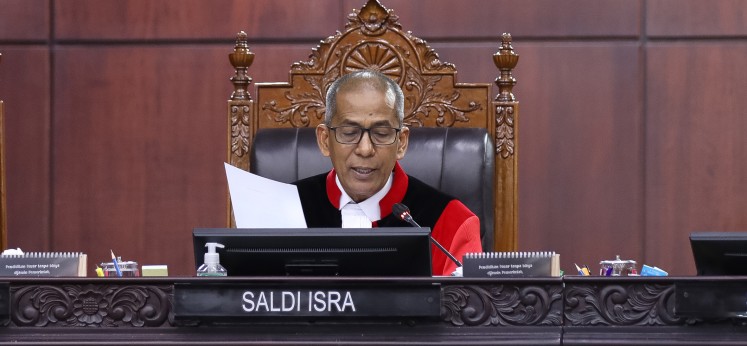
Deputy Chief Justice Saldi Isra reading out the Court's legal considerations at the judicial review hearing of Law No. 10 of 1998 on Banking, Wednesday (4/29/2026). Photo by MKRI/Ifa.
JAKARTA (MKRI) – The Constitutional Court (MK) ruled that Petition No. 99/PUU-XXIV/2026 on judicial review of Article 8 paragraph (1) of Law No. 10 of 1998 on Banking and Article 236 paragraph (1) and Article 238 of Law No. 4 of 2023 on the Development and Strengthening of the Financial Sector (UU P2SK) inadmissible. This is because the Petitioner didn’t submit sufficient stamped evidence as stipulated in the law.
"Therefore, the evidence was not validated in the hearing," said Deputy Chief Justice Saldi Isra when reading out the considerations of Decision No. 99/PUU-XXIV/2026 on Wednesday, April 29, 2026 in the Plenary Courtroom of the Court, Jakarta.
Deputy Chief Justice Saldi explained that on April 15, 2026, at 4:27 PM WIB, the Court held a preliminary hearing to hear the main points of the petition revision and validate the evidence. However, the Petitioner was not present at the hearing, resulting in the failure to provide sufficient stamped evidence as valid evidence in accordance with statutory provisions. Consequently, the evidence was not validated in the hearing.
Therefore, the petition doesn’t meet the formal requirements for filing a petition. Therefore, the Court will not further consider the petition.
Also read:
Residents Harmed by Compound Interest Practices Challenge Banking Law and P2SK Law
Petitioner Requests a Postponement of Judicial Review of Banking Law and P2SK Law
Previously, Rachmad Rofik, the Petitioner for petition No. 99/PUU-XXIV/2026, submitted a letter requesting a postponement of the hearing, originally scheduled for Wednesday, April 15, 2026. This was delivered by Deputy Chief Justice Saldi Isra, who presided over the panel of justices in today's hearing, which was scheduled to hear the revised petition.
"Petitioner Number 99 was not present, was he? There was a letter requesting a postponement but the reason was for various reasons. We will later deliver this at the Justices' Deliberation Meeting because he didn’t appear and there were also no revisions to the petition, and there was also no evidence so it was not approved," said Deputy Chief Justice Saldi in the Courtroom.
For your information, in his Petition, Rachmad admitted to experiencing predatory lending practices through an exploitative Top-Up/Refinancing scheme from PT MNC Leasing. In fact, he claimed to have only received a net disbursement of Rp 50 million. However, due to the lack of clear normative limits in the Banking Law and the P2SK Law regarding the prohibition of Anatocismus (compound interest), his principal debt was manipulated in accounting to Rp 157 million and is currently being sued for up to Rp 204 million.
Currently, the Petitioner is suing the Gresik District Court (PN) with Case No. 7/Pdt.G/2026/PN Gsk. However, the claim is hampered because a quo law doesn’t provide status quo protection (prohibition of execution) during the dispute, so that the Petitioner's property rights (the collateral object) are at risk of arbitrary forced execution.
The Petitioner's losses arose directly due to the norms in Article 8 paragraph (1) of the Banking Law and Article 236 paragraph (1) of the P2SK Law which provide too broad a scope for interpretation (multi-interpretation) and do not provide clear limits regarding the prohibition of compound interest and the obligation for document transparency. If these norms are reinterpreted by the Court in accordance with the Petitioner's petitum, then the Petitioner's constitutional losses in the form of legal uncertainty and the threat of confiscation of property rights will no longer occur. The case at the Gresik District Court only resolves specific contract disputes, while this petition challenges the norms of the law which cause national systemic injustice.
For information, Article 8 paragraph (1) of the Banking Law states: "In providing credit or financing based on Sharia Principles, Commercial Banks are required to have confidence based on in-depth analysis of the Debtor Customer's intentions and ability and capability to repay their debts or return the financing in accordance with what was agreed." Article 236 paragraph (1) of the P2SK Law states: "In implementing Consumer Protection in the financial sector, PUSK has rights, obligations and prohibitions that must be complied with."
Article 238 of the P2SK Law states: (1) PUSK must fulfill balance, justice and fairness in making agreements with consumers. (2) The agreement as referred to in paragraph (1) shall be in the form of a written agreement. (3) The written agreement as referred to in paragraph (2) may be in the form of a Standard Agreement containing standard clauses, except as prohibited by this law. (4) PUSK is prohibited from making and using a Standard Agreement containing standard clauses that contain: a. stating the transfer of PUSK's responsibilities or obligations to the Consumer; b. stating the granting of power of attorney from the Consumer to PUSK, either directly or indirectly, to carry out any unilateral action on goods pledged by the Consumer". (*)
Read Decision No. 99/PUU-XXIV/2026
Author : Mimi Kartika
Editor : Lulu Anjarsari P.
PR : Raisa Ayuditha
Translator : Donny Yuniarto
Disclaimer: The original version of the news is in Indonesian. In case of any differences between the English and the Indonesian versions, the Indonesian version will prevail.
Wednesday, April 29, 2026 | 15:34 WIB 60