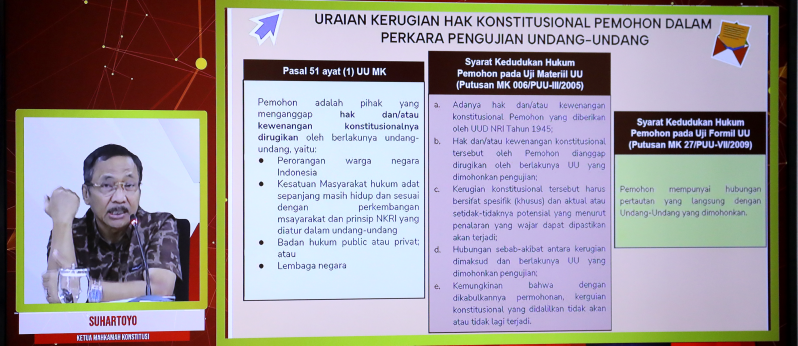
Chief Justice Suhartoyo delivers a presentation during the Constitutional Rights Awareness Program (PPHKWN) for the National Association of Pancasila and Civic Education Lecturers (ASDK). Photo by MKRI/Fauzan.
JAKARTA, (MKRI) – The Constitutional Court (MK), through the Constitutional Court Learning Center (MKLC), organized the Constitutional Rights Awareness Program (PPHKWN) for the National Association of Pancasila and Civic Education Lecturers (ASDK), held from April 16 to May 8, 2026. The program, officially opened on Monday afternoon (04/16/2026), marks ASDK as the first association to participate in this initiative.
Chief Justice Suhartoyo attended the opening session and delivered the main lecture, which was further elaborated by Deputy Chief Justice Saldi Isra. The program aims to strengthen constitutional understanding among educators, including lecturers and civic education teachers, as part of broader efforts to enhance constitutional literacy.
In his presentation, Suhartoyo comprehensively explained the characteristics of judicial review proceedings at the Court. He outlined that parties in judicial review cases consist of Petitioners—who may be Indonesian citizens, legal entities, customary law communities, or state institutions—and Responding Parties providing statements, such as the House of Representatives (DPR), the Regional Representative Council (DPD), the President, and other related parties.
“The object of review at the Constitutional Court is the constitutionality of laws or Government Regulations in Lieu of Laws against the 1945 Constitution of the Republic of Indonesia (UUD 1945),” Suhartoyo stated on Monday (04/27/2026).
He added that such reviews are divided into two types. First, material review, which examines the substance or norms of provisions. Second, formal review, which assesses the legislative process of law-making.
Furthermore, Suhartoyo emphasized that one of the most crucial aspects in a judicial review petition is the Petitioners’ legal standing. Based on Article 51 paragraph (1) of the Constitutional Court Law and reaffirmed in Constitutional Court Decision Number 006/PUU-III/2005, Petitioners must clearly demonstrate the existence of constitutional impairment. This impairment must meet five requirements: the existence of a constitutional right granted by the 1945 Constitution, an alleged impairment caused by the enactment of a law, the impairment being specific and actual or at least potential, the existence of a causal relationship, and the possibility of restoration if the petition is granted.
“Without a clear explanation of constitutional impairment, a petition will be difficult for the Court to accept,” he stressed.
In addition, Suhartoyo explained that in formal review cases, as reflected in Constitutional Court Decision Number 27/PUU-VII/2009, Petitioners must have a direct connection to the legislative process of the law being challenged. He also outlined the proper structure of a well-prepared petition, including the identity of the Petitioners, the Court’s jurisdiction, legal standing, legal arguments (posita), and the petitum. According to him, this structure is essential to ensure that legal arguments are systematically presented and easily understood by the Panel of Justices.
The Nature of Constitutional Court Decisions
Deputy Chief Justice Saldi Isra, during the in-depth session, highlighted the nature of Constitutional Court decisions, which are final and binding.
“Decisions of the Constitutional Court are final and binding, as there is no higher authority that can overturn them,” Saldi stated.
Nevertheless, he clarified that this does not mean such decisions are entirely beyond correction.
“There remains room for reconsideration through the submission of a new petition, provided there are fundamental reasons and stronger arguments. Some decisions show that petitions previously rejected were eventually granted,” he explained.
Saldi provided an example regarding the Court’s evolving stance on the presidential and vice-presidential nomination threshold. He noted that petitions on this issue had been rejected multiple times before eventually being granted.
“This demonstrates that the Court may change its position as long as there are strong arguments and relevance to constitutional developments,” he said.
Furthermore, Saldi elaborated on the fundamental distinction between the Constitutional Court and the Supreme Court (MA) within Indonesia’s dual judicial system. The Constitutional Court primarily handles cases related to constitutional and political issues, whereas the Supreme Court focuses on concrete cases involving individual interests.
He also emphasized that Constitutional Court decisions in judicial review cases have erga omnes effect, meaning they apply universally to all citizens.
“If granted, the decision does not only benefit the Petitioners, but also everyone—even those unaware of the petition,” he remarked.
In a broader context, Saldi reaffirmed the Court’s role as the guardian of the constitution and the final interpreter of the constitution. He explained that constitutional norms are inherently abstract and general, requiring interpretation to remain relevant over time.
“The Constitutional Court ensures that the constitution is not undermined, not deviated from, and remains the primary reference in state governance,” he asserted.
He added that the Court also plays a role in correcting actions of state officials that may potentially violate the constitution.
This program also forms part of efforts to enhance the capacity and professionalism of educators, particularly in understanding constitutional law and judicial review mechanisms. With deeper understanding, lecturers and teachers are expected to transmit constitutional values to students and learners, while contributing to the development of a rule-of-law-based society.
Through the PPHKWN program, the Court reaffirmed its commitment to expanding constitutional literacy across various segments of society as a fundamental pillar in national and state life.
Author : Fauzan F.
Editor : N. Rosi.
PR : Adriana
Translator : Mauliza Ara Rizki/Agusweka PS.
Disclaimer: The original version of the news is in Indonesian. In case of any differences between the English and the Indonesian versions, the Indonesian version prevails.
Monday, April 27, 2026 | 18:14 WIB 364