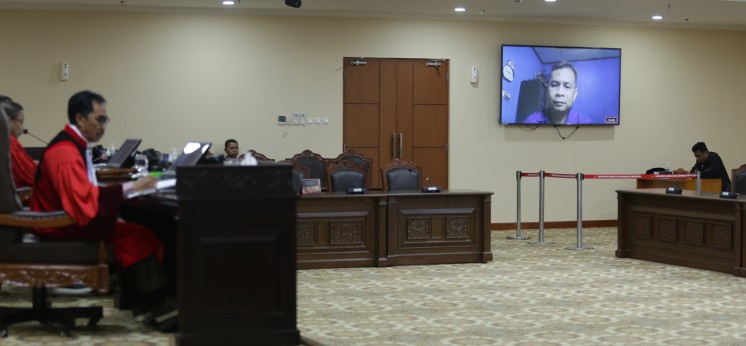
The Petitioner attending the preliminary hearing for Case No. 138/PUU-XXIV/2026 on the judicial review of Law No. 6 of 2023 on Job Creation, Monday (4/27/2026). Photo by MKRI/Bay.
JAKARTA (MKRI) — A security guard, Muhammad Said, has filed a petition for a judicial review of Article 59 paragraph (1) of Law No. 6 of 2023 on Job Creation with the Constitutional Court. He challenges the provision governing fixed-term employment agreements (perjanjian kerja waktu tertentu/PKWT), arguing that it enables employers to circumvent long-term obligations such as severance pay, long service awards, and adequate pension guarantees.
“This situation creates legal uncertainty for me, as my employment can be terminated at any time without protections equivalent to those afforded to permanent employees, even though the nature of my work is permanent,” Said asserted during the preliminary hearing of Case No. 138/PUU-XXIV/2026 on Monday, April 27, 2026.
The Petitioner, a resident of Balikpapan, East Kalimantan, works for the outsourcing company PT Kinarya Alih Daya Mandiri. He contended that security personnel perform ongoing and integral functions within a company’s operational security framework. However, due to the flexibility provided by Article 59 of the Job Creation Law, he has been continuously employed under contractual arrangements.
Under the PKWT scheme, he claimed to be perpetually at risk of losing his job without severance guarantees equivalent to those provided under an indefinite-term employment agreement (perjanjian kerja waktu tidak tertentu/PKWTT). Consequently, he argued that this condition deprives him of the right to a decent livelihood as guaranteed by Article 27 paragraph (2) of the 1945 Constitution.
Article 59 paragraph (1) of the Job Creation Law stipulates that “a fixed-term employment agreement may only be made for certain jobs which, by their type and nature or the activities involved, will be completed within a specified period.” In his petitum, the Petitioner requests the Court to declare the provision unconstitutional and not legally binding insofar as it is not interpreted to require permanent and continuous work, such as security services, to be governed by PKWTT.
The petition was examined by a panel of justices chaired by Chief Justice Suhartoyo, alongside Constitutional Justices Daniel Yusmic P. Foekh and M. Guntur Hamzah. In his advice, Justice Foekh suggested that the Petitioner review previous Constitutional Court decisions on similar issues.
He further advised the Petitioner to elaborate on actual losses he had experienced, such as unpaid wages, to substantiate his legal standing. Additionally, the Petitioner was encouraged to construct a more robust argument demonstrating the contradiction between the contested norm and the provisions of the 1945 Constitution invoked as the basis of the review.
“It should be clearly explained how this norm has caused constitutional harm to Mr. Said,” Foekh emphasized.
Before concluding the hearing, Chief Justice Suhartoyo stated that the Petitioner is granted one opportunity to revise his petition. The revised submission, in both softcopy and hardcopy, must be received by the Court no later than Monday, May 11, 2026, at 12:00 p.m. WIB.
Author: Mimi Kartika
Editor: Lulu Anjarsari P.
PR: Fauzan Febriyan
Translator: Yuanna Sisilia
Disclaimer: The original version of the news is in Indonesian. In case of any differences between the English and the Indonesian versions, the Indonesian version will prevail.
Monday, April 27, 2026 | 14:51 WIB 43