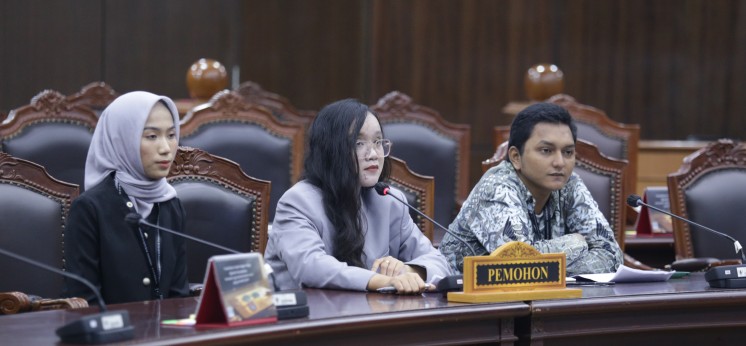
Petitioners attending the preliminary hearing of Case No. 131/PUU-XXIV/2026 on the material review of Law No. 8 of 1999 on Consumer Protection on Friday (17/4). Photo by MKRI/Bay.
Jakarta (MKRI) – Four law students of Universitas Terbuka filed a material review petition of Article 15 and Article 27 letter b and letter c of Law No. 8 of 1999 on the Consumer Protection (Consumer Protection Law) to the Constitutional Court (MK). They argue that the a quo provision creates uncertainty for them in identifying the limits of prohibited conduct and leaves a vacuum of responsibility for business actors, directly threatening their right to protection of life and property.
“It results in the lack of protection for consumers, preventively and repressively. There is a power imbalance between consumers and businesses,” said Annisa Susinta, who attended the hearing in person, along with Fahrezi Adam Mu’mmar, during the preliminary hearing of Case No. 131/PUU-XXIV/2026 on Friday, April 17, 2026. Petitioner Esri Setianingsih attended the hearing online, while Audy Zahra Rivianto arrived late to the Courtroom.
They stated that the combination of a vague norm (Article 15) and the easy release from liability (Article 27) creates a legal ecosystem that is unfriendly to the Petitioners' physical and spiritual well-being. The Petitioners consider that Article 15 of the Consumer Law should serve as a shield for them. However, because its wording is not specific, that shield becomes fragile and cannot be used when the Petitioners face structured corporate intimidation.
Meanwhile, the Petitioners state that Article 27 letter b of the Consumer Protection Law, which releases producers from liability if the “defect arises at a later time”, is a betrayal of the Product Liability doctrine. This is because hidden defects (latent defects) often only appear after the warranty period has expired.
They are challenging the provision in Article 15, which states, “Business actors in offering goods and/or services are prohibited from doing so by means of coercion or other methods that may cause physical or psychological disturbances to consumers,” as well as Article 27 letters b and c, which state: “Business actors who produce goods are released from liability for losses suffered by consumers if: ‘b. the defect in the goods arises at a later time;’ ‘c. the defect arises as a result of compliance with the provisions concerning the qualification of the goods.’”
The Petitioners say that their right to a sense of security is disrupted when marketing can be carried out aggressively (due to the lack of clarity in Article 15) and when the resulting losses cannot be claimed (due to the immunity in Article 27). They see a constitutional impairment, in which their dignity as legal subjects is downgraded to mere market objects whose fundamental rights can be compromised.
The Petitioners realize that the law must evolve in line with technological risks, but these static Articles 15 and 27 hinder the evolution of the protection of their rights. The existence of these provisions results in a power imbalance between the Petitioners and business actors being constitutionally legitimized, whereas the constitution should instead serve to balance it.
In their petitum, the Petitioners ask the Court to declare that the phrase “or other methods that may cause physical or psychological disturbances” in Article 15 of the Consumer Protection Law is inconsistent with the 1945 Constitution of the Republic of Indonesia and conditionally has no binding legal force insofar as it is not understood as encompassing all forms of intimidation, threats, harassment, violations of privacy, or manipulation of information that can be objectively measured based on medical standards or norms of public decency and that give rise to a sense of insecurity in consumers. They also request that the phrase “the defect in the goods arises at a later time” in Article 27 letter b be declared inconsistent with the 1945 Constitution and conditionally has no binding legal force insofar as it is not understood as damage caused by normal or natural use after the expiry of the warranty period, and does not include hidden defects originating from design, manufacturing, or information failures that already existed when the goods were handed over. Furthermore, they ask that the phrase “the defect arises as a result of compliance with the provisions concerning the qualification of the goods” in Article 27 letter c be declared inconsistent with the 1945 Constitution and has no binding legal force insofar as it is not understood as referring to minimum administrative standards set by the government, which do not relieve business actors from strict liability when the goods in fact still cause harm to consumers’ lives, health, or property.
This application was heard by a Panel of Justices chaired by Justice Enny Nurbaningsih, with Justices Ridwan Mansyur and Arsul Sani serving as members. In his advisory remarks, Justice Arsul said that the Petitioners should first study Constitutional Court Regulation (PMK) No. 7 of 2025 on Procedures in Judicial Review Cases.
Justice Arsul also stated that the Petitioners could research several Constitutional Court decisions that granted petitions filed by students and use those rulings as references in drafting their petition.
“If it is granted, what does that mean? It means, first, that the petition meets the formal requirements, and second, that the petition has been drafted or written properly in the sections on the Court’s jurisdiction, legal standing, grounds of the petition, and petitum, even if not perfect, but in principle clear,” said Justice Arsul.
Before adjourning the hearing, Justice Enny informed the Petitioners that they had 14 days to revise their petition. The revised petition documents, both soft copy and hard copy, must be received by the Court no later than Thursday, April 30, 2026, at 12.00 Western Indonesian Time.
Case tracking: Petition No. 131/PUU-XXIV/2026
Author: Mimi Kartika
Editor: Lulu Anjarsari P.
PR: Raisa Ayuditha M.
Translator: Rizky Kurnia Chaesario
Disclaimer: The original version of the news is in Indonesian. In case of any differences between the English and the Indonesian versions, the Indonesian version will prevail.
Friday, April 17, 2026 | 12:50 WIB 65