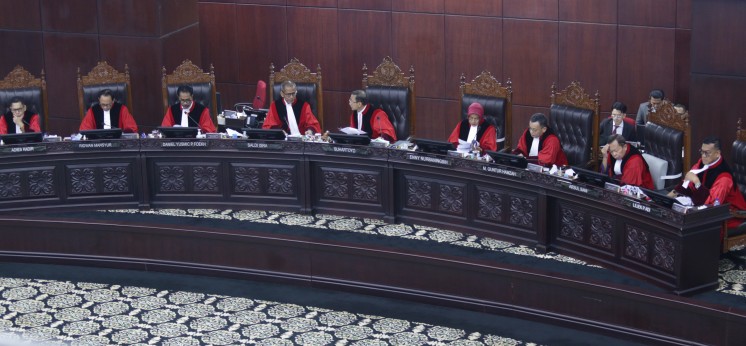
The Court delivers the ruling for Case Number 117/PUU-XXIV/2026 on the judicial review of Law Number 7 of 2017 on General Elections and related regulations concerning the unlimited terms of legislative members, Thursday (04/16/2026). Photo by MKRI/Bay.
JAKARTA, (MKRI) – The Constitutional Court issued a determination on the petition filed by an Indonesian citizen, Fahrizal, seeking a judicial review of Law Number 7 of 2017 on General Elections. The pronouncement of Determination Number 117/PUU-XXIV/2026 was held in the Plenary Courtroom on Thursday (04/16/2026).
Chief Justice Suhartoyo stated that the Court had received the petition on March 26, 2026, and had duly summoned the Petitioner for the Preliminary Examination Hearing scheduled on April 1, 2026. However, the Petitioner failed to appear when the hearing was opened. Despite reopening the session to reconfirm the Petitioner’s attendance, the Petitioner remained absent without valid reason, despite having been lawfully and properly summoned.
Based on Article 36 paragraph (4) and Article 69 paragraph (1) letter c of Constitutional Court Regulation Number 7 of 2025, as well as Article 2 paragraph (4) of Law Number 48 of 2009, the Justices’ Deliberation Meeting on April 9, 2026 concluded that the Petitioner’s absence without valid reason indicated a lack of seriousness in pursuing the petition.
“Accordingly, the petition must be declared lapsed, and therefore the Court issues a determination. To decide: the petition is declared lapsed,” Chief Justice Suhartoyo stated while reading the determination.
Read also:
Petitioner Challenging Legislative Term Limits Absent from Hearing Without Explanation
In the petition, the Petitioner argued that the provisions governing the terms of office of members of the House of Representatives (DPR) and Regional Legislative Councils (DPRD) under Law Number 7 of 2017 on General Elections and related regulations impose no term limits. According to the Petitioner, this condition creates constitutional implications that contradict fundamental principles guaranteed by the Constitution.
While the terms of office for the President and regional heads are limited to a maximum of two terms as a concrete manifestation of the principle of limiting power to prevent abuse and monopoly, no similar limitation applies to legislative positions. Members of the DPR and DPRD may be re-elected indefinitely, allowing them to hold office for decades.
The Petitioner argued that limiting power is not only necessary to prevent executive dictatorship, but also to avoid legislative oligarchy. Given the legislature’s functions in lawmaking, oversight, and budgeting, unlimited tenure may lead to the emergence of a permanent political class, contrary to the essence of Indonesia’s democracy as a government of the people, by the people, and for the people.
Therefore, the Petitioner requested the Court to declare provisions in the Election Law and/or related regulations that do not limit the terms of DPR and DPRD members as contrary to the 1945 Constitution of the Republic of Indonesia.
The Petitioner also requested the Court to declare such provisions as having no binding legal force unless interpreted as imposing term limits on members of the DPR and DPRD.
Furthermore, the Petitioner sought a ruling that the terms of office for members of the DPR and DPRD should be limited to a maximum of two terms, whether consecutive or non-consecutive, as a manifestation of the principles of limitation of power, constitutional democracy, equality before the law, and protection of citizens’ constitutional rights.
Author : Sri Pujianti
Editor : N. Rosi
PR : Raisa Ayuditha Marsaulina
Translator : Agusweka PS.
Disclaimer: The original version of the news is in Indonesian. In case of any differences between the English and the Indonesian versions, the Indonesian version prevails.
Full Decision: Number 117/PUU-XXIV/2026
Thursday, April 16, 2026 | 15:28 WIB 94