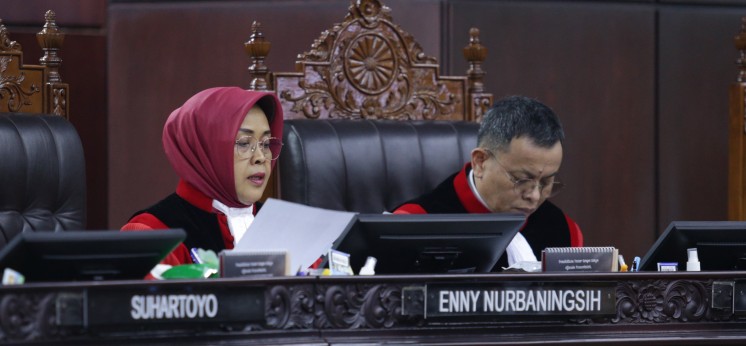
The pronouncement hearing of Decision Number 79/PUU-XXIV/2026 on the judicial review of Law Number 18 of 2003 on Advocates at the Constitutional Court’s Plenary Courtroom on Thursday April 04, 2026. Photo by Humas/Bay
JAKARTA, MKRI – The Constitutional Court (MK) declared Petition Number 79/PUU-XXIV/2026 concerning the judicial review of Article 3 paragraph (1) letters c and d of Law Number 18 of 2003 on Advocates (Advocates Law) inadmissible. The Court held that the Petitioners failed to provide arguments explaining the causal relationship between the alleged impairment of their constitutional rights and the enactment of the provisions being challenged.
“The Petitioners’ explanation regarding the alleged impairment of their constitutional rights could not convince the Court that such impairment has a causal relationship or causa verband with the enactment of Article 3 paragraph (1) letters c and d of Law Number 18 of 2003 being petitioned for review,” Constitutional Justice Enny Nurbaningsih stated while reading out the Court’s legal considerations in Decision Number 79/PUU-XXIV/2026 on Thursday April 16, 2026. at the MK Plenary Courtroom, Jakarta.
Enny stated that the Petitioners instead elaborated more on the alleged threats to the advocate profession arising from former judges, former prosecutors, and retired Indonesian National Armed Forces (TNI) and National Police (Polri) officers who choose to become advocates. In fact, according to the Court, such concerns merely reflected the Petitioners’ worries regarding the disruption of independence in handling cases due to institutional and personal proximity with law enforcement institutions.
In this regard, Enny explained that the absence of a maximum age limit, as argued by the Petitioners, does not constitute an issue of constitutional validity of the norm. Instead, it should encourage the Petitioners and advocates in general to improve their professionalism, capacity, and integrity.
Also Read:
Questioning the Absence of Maximum Age Limit Requirement for Advocates Petitioners Add Provision Challenged over Absence of Maximum Age Limit Requirement for Advocates
As additional information, the petition was filed by five advocates, namely St Luthfiani, Syamsul Jahidin, Henoch Thomas, Popy Desiyantie, and Fredy Limantara. They challenged Article 3 paragraph (1) letter c of the Advocates Law, which reads “Not holding the status of civil servant or state official,” and Article 3 paragraph (1) letter d of the Advocates Law, which reads “at least 25 (twenty-five) years of age.”
The Petitioners compared the advocate profession with professions in the civil service (ASN), the military (TNI), the police (Polri), the prosecution service, and the judiciary. In addition to minimum age requirements, those professions also impose maximum entry age limits, namely 35 years for civil servants, 32–35 years for the military, 33–35 years for police career officers, and 30 years for prosecutors. Meanwhile, there is no maximum age limit to become an advocate.
According to the Petitioners, the absence of a maximum age limit in the Advocates Law creates ambiguity and inequality within the advocate profession, causing advocates to be perceived as a “dumping ground” profession and shifting the meaning of advocates as an honorable and noble profession (officium nobile). Meanwhile, the Petitioners argued that advocates work throughout the entire jurisdiction of Indonesia, meaning that an advocate should ideally possess not only intellectual capability but also physical capability. They argued that elderly, ill, or physically incapable advocates would not be able to handle cases outside their respective regions. (*)
Writer: Mimi Kartika
Editor: Lulu Anjarsari P.
Public Relations: Andhini S.F.
Translator: Mauliza Ara Rizki/Siti Rosmalina Nurhayati
The complete decision can be accessed through the following link: Decision Number 79/PUU-XXIV/2026
Disclaimer: The original version of the news is in Indonesian. In case of any differences between the English and the Indonesian versions, the Indonesian version will prevail
Thursday, April 16, 2026 | 14:50 WIB 14