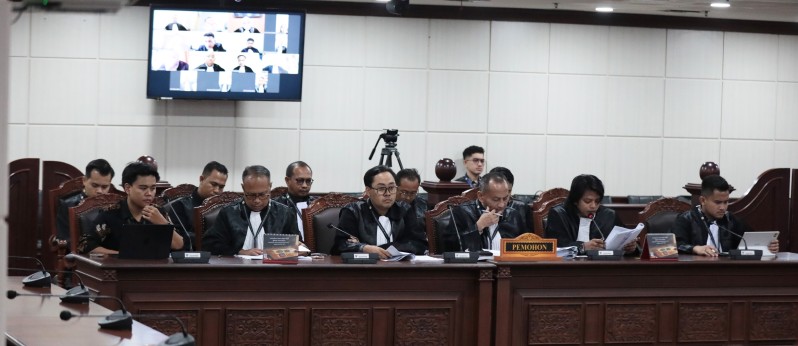
Petitioner’s legal counsel attending the judicial review hearing of the KUHAP both in person and online on Wednesday (15/04). Photo by MKRI/IlhamWM.
Jakarta (MKRI) – The Constitutional Court (MK) again heard a material review of Article 1 point 22 and Article 151 paragraph (2) letter b of Law No. 20 of 2025 on the Criminal Procedure Code (KUHAP) on Wednesday, April 15, 2026. Petition No. 104/PUU-XXIV/2026 was filed by a group of advocates, including Aldi Rizki Khoiruddin (Petitioner I), Erif Fahmi (Petitioner II), Firman (Petitioner III), Agung Handi Sejahtera (Petitioner IV), and Indra Gunawan (Petitioner V).
The hearing, chaired by Chief Justice Suhartoyo, was convened to hear the main points of the revised petition. During the session, Nawaz Syarif and Aldi Rizki Khoirruddin took turns reading out the revisions, which included adding six new Petitioners, bringing their number from 33 to 39.
The Petitioners further strengthened their arguments on legal standing, asserting that the expanded statutory definition of “advocate” under the a quo provisions has harmed their constitutional right to legal certainty by blurring the boundaries of the advocate’s profession, which is tightly regulated by the Advocates Law. They argued that the norm allows individuals who do not meet the statutory qualifications to claim the status of advocate, creating uncertainty about who is authorized to provide legal services in litigation.
Nawaz added that the enactment of Article 151 paragraph (2) letter b of the KUHAP has already harmed the Petitioners’ constitutional rights by placing the minutes of oath‑taking as an advocate on the same footing as membership identity in a Legal Aid Institution (LBH), potentially obstructing Petitioners who practice independently through law offices from providing legal services in criminal litigation.
“Next, in the grounds of the petition, we set out seven strands of argument. The a quo petition is an effort to uphold justice, not merely to entrench professional exclusivity. The Petitioners stress that the a quo provisions broaden the meaning and legitimacy of the term ‘advocate’, creating constitutional issues over legal certainty and the quality of protection for justice seekers. The review is not aimed solely at protecting advocates’ interests, but at ensuring that the criminal justice system operates within defense standards that are lawful, professional, and accountable, Nawaz said.
The session was chaired by Chief Justice Suhartoyo, with Justices Daniel Yusmic P. Foekh and M. Guntur Hamzah sitting as panel members.
Also read:
Clarifying the Distinction Between Advocates and Legal Aid Bodies in Indonesia’s Legal System
Petition No. 104/PUU-XXIV/2026 was filed by 39 advocates. During the preliminary hearing on Thursday, April 2, 2026, the petitioners argued that the challenged norms create disharmony and legal conflict between the definitions of “advocate” and “legal aid” under two distinct and autonomous regulatory regimes. They contended that Article 1 point 22 of the new KUHAP blurs these regimes by incorporating elements of free legal aid into the definition of an advocate.
They pointed out that Law No. 18 of 2003 on Advocates clearly positions the Advocate Organization as the sole professional body authorized to exercise eight organizational powers, while Law No. 16 of 2011 on Legal Aid defines Legal Aid Institutions (LBH) as organizations providing legal aid services to the poor as part of the state’s effort to guarantee access to justice.
On this basis, the Petitioners argued that LBHs have no inherent authority to appoint advocates or apply to the High Court for their swearing‑in, so equating “LBH membership identity” with “minutes of oath‑taking as an advocate” in Article 151 paragraph (2) letter b of the new KUHAP amounts to a normative error that creates structural disharmony in Indonesia’s legal system.
On these grounds, the Petitioners ask the Court to declare the phrase “and/or persons who may provide legal services inside or outside court as part of community service to provide free legal aid under statutory provisions” in Article 1 point 22 of the KUHAP unconstitutional and without binding force.
On these grounds, the Petitioners ask the Court to declare the phrase “and/or persons who may provide legal services inside or outside court as part of community service to provide free legal aid under statutory provisions” in Article 1 point 22 of the KUHAP unconstitutional and without binding force.
Case tracking: Petition No. 104/PUU-XXIV/2026
Author: Sri Pujianti.
Editor: N. Rosi.
PR: Fauzan F.
Translator: Rizky Kurnia Chaesario
Disclaimer: The original version of the news is in Indonesian. In case of any differences between the English and the Indonesian versions, the Indonesian version will prevail.
Wednesday, April 15, 2026 | 17:42 WIB 55