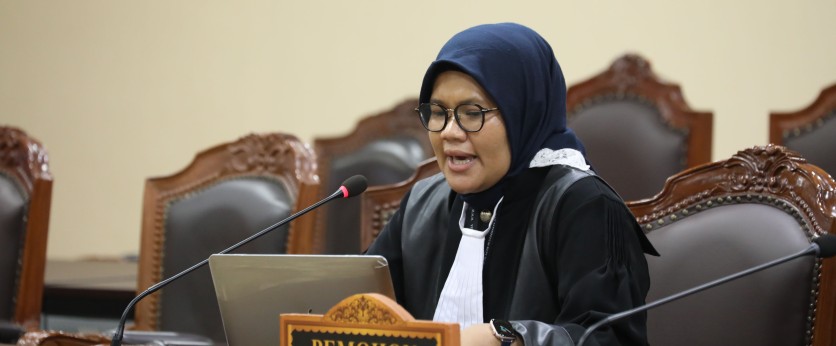
ST Luthfiani, one of the Petitioners of Case No. 127/PUU-XXIV/2026 on the 2026 State Budget Law presenting the petition before the constitutional justices, Wednesday (4/15/2026). Photo by MKRI/Panji.
JAKARTA (MKRI) — Marina Ria Aritonang, ST Luthfiani, Syamsul Jahidin, and Edy Rudyanto (Petitioners I-IV) have filed for the material review of Law No. 17 of 2025 on the State Budget for Fiscal Year 2026 (2026 APBN Law) to the Constitutional Court. The preliminary hearing for Case No. 127/PUU-XXIV/2026 in one of the Court’s panel courtrooms on Wednesday, April 15, 2026 was presided over by Chief Justice Suhartoyo and Constitutional Justices Adies Kadir and Liliek P. Adi. The Petitioners argue that Article 8 paragraph (5), Article 9 paragraph (4), Article 11 paragraph (2), Article 13 paragraph (4), Article 20 paragraph (1), and Article 29 paragraph (1) of the 2026 APBN Law are against Article 23 paragraph (1), Article 22A, and Article 28D paragraph (1) of the 1945 Constitution.
Article 8 paragraph (5) of the 2026 APBN Law reads: “The detailed allocation of Central Government Expenditure by Organization, Function, and Program as referred to in paragraph (2) shall be set out in Appendix I, which constitutes an integral part of this Law in accordance with the financial memorandum, and any amendments shall be regulated by a Presidential Regulation.”
Article 9 paragraph (4) of the 2026 APBN Law reads: “Further provisions regarding the detailed allocation of regional transfer funds (TKD) as referred to in paragraph (1) shall be regulated by a Presidential Regulation.”
Article 11 paragraph (2) of the 2026 APBN Law reads: “In the event of Government policies affecting the calculation of the general allocation fund (DAU), adjustments to the DAU as referred to in paragraph (1) may be made.”
Article 13 paragraph (4) of the 2026 APBN Law reads: “The use of Special Autonomy Funds shall be prioritized to support national priority programs, which may include education, health, free nutritious meals, food security, infrastructure, and energy resilience.”
Article 20 paragraph (1) of the 2026 APBN Law reads: “… changes to the expenditure for the payment of arrears from previous years or any Government obligation shall be determined by the Government.”
Article 29 paragraph (1) of the 2026 APBN Law reads: “The Government may undertake policy measures relating to State Revenue, State Expenditure, and/or Budget Financing to address threats that endanger the national economy and/or the stability of the financial system.”
Syamsul explained that Petitioner I and Petitioner III are homemakers as well as advocates with expertise in legislative risk analysis, oversight of government procurement of goods and services, and strengthening public participation in monitoring public policy. In their role as mothers with school-age children, they have directly observed the implementation of the free nutritious meals (MBG) program for their children. They argue that provisions on the MBG in the norm a quo in the 2026 State Budget Law is inconsistent with the Lawmaking Law, particularly due to the lack of transparency in its legislative process. To them, the enactment of the norm a quo indirectly legitimizes policies that waste state finances without adequate planning.
“Not to mention, based on her research on the MBG program, Petitioner III found that it only benefits foundations and SPPG (Nutrition Fulfilment Service Unit). In practice, the food provided is often not in accordance with standards, and much of it is close to expiration. In addition, the Petitioners observed food poisoning and inefficient budget allocation,” Syamsul stated while reading one of the grounds of the petition during the virtual hearing.
Based on these arguments, the Petitioners request the Court to declare Article 8 paragraph (5) of the 2026 State Budget Law contrary to the 1945 Constitution and without binding legal force, insofar as it is not interpreted to mean: “The details of Central Government Expenditure by Organization, Function, and Program as referred to in paragraph (2) shall be set out in Appendix I, which constitutes an integral part of this Law in accordance with the financial memorandum, and any amendments shall be regulated by a Presidential Regulation that does not contradict provisions under sectoral laws and ensures the provision of meaningful public participation.”
“We further request the Court to declare Article 9 paragraph (4) of Law No. 17 of 2025 on the State Budget for Fiscal Year 2026 contrary to the 1945 Constitution and without binding legal force, insofar as it is not interpreted to mean: ‘Further provisions regarding the detailed allocation of regional transfer funds (TKD) as referred to in paragraph (1) shall be regulated by a Presidential Regulation that does not contradict sectoral laws and ensures the provision of meaningful public participation,’” Luthfiani stated while reading the Petitioners’ petitums.
Error in Norms or Implementation
In his advisory remarks, Constitutional Justice Adies emphasized the need for the Petitioners to clarify their arguments, particularly with regard to the challenged norms. “Is it the norms that are flawed, or its implementation, which results in the alleged harm to the Petitioners? In this petition, the arguments still mix opinion, facts, and assumptions. The Petitioners are examining the constitutionality of the norm, not policy or its implementation—so what exactly is the constitutional defect in the formulation of the norm?” he asked.
Meanwhile, Constitutional Justice Liliek P. Adi noted that the constitutional basis used for the review includes Article 22A of the 1945 Constitution, which concerns procedures for lawmaking regulated by statute. “This is a material review, not a formal review. Should this provision still be included or not?” he questioned.
Before adjourning the session, the panel announced that the Petitioner would have 14 days to revise the petition. The copy of the revised the petition must have been received by the Court no later than 12:00 WIB on Tuesday, April 28, 2026 to the Registrar’s Office. The Court will then schedule a second hearing to examine the revisions to the petition.
Explore Case No. 127/PUU-XXIV/2026 (in Indonesian).
Author : Sri Pujianti
Editor : Lulu Anjarsari P.
PR : Andhini S. F.
Translator : Yuniar Widiastuti (NL)
Disclaimer: The original version of the news is in Indonesian. In case of any differences between the English and the Indonesian versions, the Indonesian version will prevail.
Wednesday, April 15, 2026 | 16:51 WIB 90