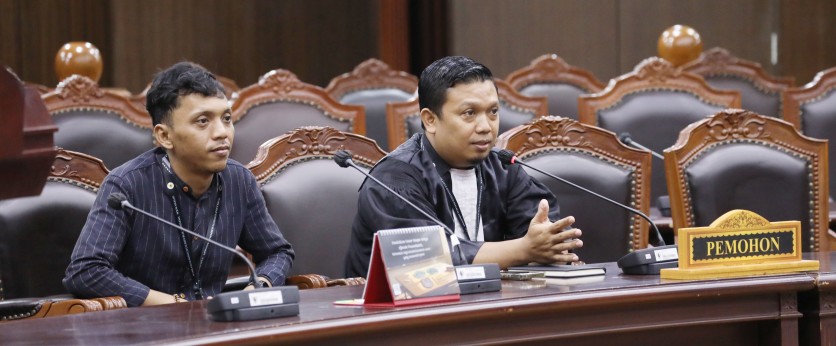
“Victor Tandiasa, as the petitioner for the judicial review of Law No. 2 of 2017 on Mass Organizations (Ormas Law), submitted the withdrawal of his petition during the revision hearing held in the Panel Courtroom on Tuesday (April 14, 2026). Photo: MKRI/Panji.”
JAKARTA, MKRI– Viktor Santoso Tandiasa, an advocate, submitted the withdrawal of his petition for the judicial review of Article 59 of Law No. 16 of 2017 concerning the Stipulation of Government Regulation instead of Law No. 2 of 2017 on Amendments to Law No. 17 of 2013 on Mass Organizations (Ormas) into law. The statement was delivered during a hearing originally scheduled to examine revisions to the petition at the Court on Tuesday (April 14, 2026).
“For this petition, we declare it withdrawn so that we may better prepare for a subsequent petition,” Viktor stated.
He explained that the Petitioner had identified a substantive distinction between mass organizations and foundations following the Court's preliminary examination. Should the petition proceed, the Petitioner considered that he would lose the causa verband argument, namely the nexus or conflict of norms in relation to his legal standing.
“Therefore, we indeed intend to pursue further legal measures, but with more thorough preparation,” Viktor added.
Accordingly, Constitutional Justice Enny Nurbaningsih, presiding over the Panel of Judges, stated that the hearing also served to confirm the withdrawal of Petition No. 97/PUU-XXIV/2026. In the hearing, the Panel acknowledged that the Petitioner had formally requested the withdrawal of the petition.
“In today’s hearing, we will record in the minutes that the Petitioner has submitted the withdrawal of the petition, and that has been confirmed. Therefore, we request that the written submission be delivered promptly,” Justice Enny remarked.
Also read:
Advocate Files Judicial Review of Mass Organizations Law over Its Application to Foundations
For information, the Petitioner challenged the normative provisions governing fundamental prohibitions imposed on mass organizations. According to the Petitioner, the provision under review has, in practice, also been applied to foundations; therefore, the Petitioner sought a new constitutional interpretation.
“Should the Court not provide a constitutional interpretation to exclude the application of the provision to foundations, it would create a legal precedent whereby any restrictive regulation applicable to mass organizations could likewise be imposed upon foundations,” Viktor stated, accompanied by his counsel, Isam Saifudin, during the preliminary examination hearing of Petition No. 97/PUU-XXIV/2026 on Wednesday (April 1, 2026) at the courtroom.
The prohibitions in question include the use of prohibited or separatist symbols, the engagement in separatist activities that threaten the Unitary State of the Republic of Indonesia, and the dissemination of teachings contrary to Pancasila. Article 59 paragraph (1) of the Ormas Law stipulates: “Mass organizations are prohibited from: (a) using names, symbols, flags, or attributes identical to those of government institutions; (b) using, without authorization, the names, symbols, or flags of other countries or international institutions/bodies as the names, symbols, or flags of the organization; and/or (c) using names, symbols, flags, or insignia that are substantially or entirely similar to those of other mass organizations or political parties.”
The Petitioner argued that Article 59 paragraph (1) of the Ormas Law explicitly designates mass organizations as the subject of the norm. From a legal doctrinal perspective, mass organizations and foundations constitute two distinct legal entities governed by different regulatory regimes. Mass organizations are subject to Law No. 16 of 2017, while foundations are governed by Law No. 16 of 2001 in conjunction with Law No. 28 of 2004.
However, the Directorate General of General Legal Administration (Ditjen AHU) of the Ministry of Law applied Article 59 paragraph (1) of the Ormas Law to reject the Petitioner’s reservation of a foundation name, thereby unilaterally extending the scope of the norm’s subject through an administrative action. The Petitioner had initiated the process of establishing and obtaining legal entity status for a foundation through a notary, who subsequently reserved the foundation name via the Ministry’s AHU system under the name “Yayasan Pembela Hak Konstitusional.”
The Directorate General rejected the reservation because the name contravened Article 59 of the Ormas Law, which prohibits mass organizations from using, without authorization, names, symbols, or flags of other countries or international institutions/bodies. The Petitioner contended that applying the Ormas Law to the foundation regime blurs the boundaries between distinct legal regimes and fundamentally contravenes the principle of legal certainty as guaranteed under Article 28D paragraph (1) of the 1945 Constitution.
In the absence of a constitutional interpretation stating that the provision “does not apply to foundations,” the registration authority (Ditjen AHU) would possess unfettered discretion to transpose norms from one statute to another. This legal uncertainty is further exacerbated by material losses in the form of non-refundable state fees (PNBP) resulting from a rejection based on a misapplied norm.
According to the Petitioner, the prohibitory nature of Article 59 paragraph (1) of the Ormas Law is restrictive, and therefore its interpretation must be narrow and must not be extended by analogy to other entities such as foundations. Accordingly, in his petitum, the Petitioner requested the Court to declare Article 59 paragraph (1) of the Ormas Law conditionally unconstitutional and lacking binding legal force insofar as it is not interpreted as “not applicable to foundations.” (*)
Author : Mimi Kartika
Editor : Lulu Anjarsari P.
PR : Adriana A. Y.
Translator : Nies Lindy
Explore Case No. 97/PUU-XXIV/2026 (in Indonesian)
Disclaimer: The original version of the news is in Indonesian. In case of any differences between the English and the Indonesian versions, the Indonesian version will prevail.
Tuesday, April 14, 2026 | 15:39 WIB 56