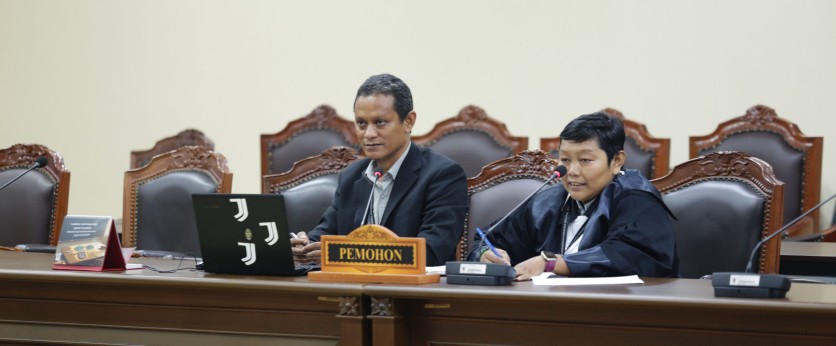
Ardi Usman presenting his petition against the Election Law at the preliminary hearing for Case No. 124/PUU-XXIV/2026, Thursday (4/13/2026). Photo by MKRI/Panji.
JAKARTA (MKRI) — Ardi Usman, an individual citizen, has filed for the material review of Article 240 paragraph (1) letter e of Law No. 7 of 2017 on General Elections and similar legislation on the education requirement for legislative candidates to the Constitutional Court. The preliminary hearing for Case No. 124/PUU-XXIV/2026 on Monday, April 13, 2026 in one of the Court’s panel courtrooms was presided over by Deputy Chief Justice Saldi Isra (chair) alongside Constitutional Justices Ridwan Mansyur and Adies Kadir.
As a citizen, the Petitioner argued that he has the constitutional right to participate in government and to equal opportunity in people’s representation. However, the lack of provisions on education requirement for legislative candidates has restricted competition in political intellect and integrity, regeneration of leadership without intellect and research, restricted his right to participate without intellect and research, restricted opportunities to join in determining public policies to fit the needs of parliament in alignment with one’s education background.
In his petition, the Petitioner explained the education background of members of parliament (MPs) in several countries. In Iran, Ukraine, and Poland, 100% of the MPs have a master’s degree. In Sweden 82 of the MPs have a bachelor’s degree. In the UK, the number of MPs with a master’s degree is 90%, while 80% of American MPs have a bachelor’s degree.
The Petitioner believes that globally, 78% of legislative members have a bachelor’s degree while 40% have a graduate degree. Meanwhile, Indonesia’s democracy is not intellectual, but an anomaly that is prone to oligarchs. Therefore, he argued, the Constitutional Court as the Guarding of the Constitution has a moral responsibility to break the anomaly.
“The Petitioner requests that the Court declare the provision of Law No. 7 of 2017 Article 240 paragraph (1) letter e on General Elections—and/or articles in other pieces of legislation regulating the education requirement for members of the DPR (House of Representatives), provincial and regency/city DPRD (Regional Legislative Council) that does not set any education requirement are against the 1945 Constitution, especially (Article 33) of the 1945 Constitution, the principle of integrity of state officials (Articles 17, 33) of the 1945 Constitution,” the Petitioner delivered his petitum.
He also requested that the Court declare provisions in the Election Law and/or similar regulations in question not legally binding insofar as they are not interpreted to mean that there are education requirements for members of the House and provincial and regency/city DPRD; time of office of these officials must be limited based on their education and may not be consecutive as a form of restriction of power, constitutional democracy, equality before the law, and protection of the constitutional rights of citizens.
Justices’ Advice
Constitutional Justice Ridwan Mansyur urged the Petitioner to carefully review the Constitutional Court Regulation No. 7 of 2025 on the Procedural Law for Judicial Review. He also advised the Petitioner to read Constitutional Court decisions that granted similar petitions to the petition a quo.
“In this petition, there is a phrase ‘and relevant provisions regulating the education requirement for legislative members.’ It is unnecessary, as it gives the impression that there are other provisions petitioned for review, and the Court does not have the authority to review regulations under laws,” Justice Ridwan explained.
Meanwhile, Constitutional Justices Adies Kadir urged the Petitioner to observe similar petitions filed to the Court. This is important so that the Petitioner is able to argue that the petition a quo does not fall into the category of ne bis in idem.
“What are the object and bases for review? This will make it clear whether the Court has the authority to review this (petition) or not,” he said.
Lastly, Deputy Chief Justice Saldi Isra stated that the article a quo has been petitioned for review several times. “So, the Petitioner must explain [whether the petition is ne bis in idem] or not. The Constitutional Court allows this on the condition that the Court is presented with proof that the petition is different from the three previous petitions or that it has different review benchmarks. If you fail to prove this, the petition cannot be refiled. So, you must explain this first,” Justice Saldi explained.
Before adjourning the session, Deputy Chief Justice Saldi Isra announced that the Petitioner would have 14 days to revise the petition. The copy of the revised the petition must have been received by the Court no later than 12:00 WIB on Monday, April 27, 2026 to the Registrar’s Office. The Court will then schedule a second hearing to examine the revisions to the petition.
Explore case No. 124/PUU-XXIV/2026 (in Indonesian).
Author : Sri Pujianti
Editor : N. Rosi
PR : Raisa Ayuditha Marsaulina
Translator : Yuniar Widiastuti (NL)
Disclaimer: The original version of the news is in Indonesian. In case of any differences between the English and the Indonesian versions, the Indonesian version will prevail.
Monday, April 13, 2026 | 18:03 WIB 94